Modern fighter jets don’t just “see” with radar—they dominate the skies with it. Active Electronically Scanned Array (AESA) radar technology has transformed how fighter aircraft detect, track, and engage targets, providing unprecedented situational awareness and combat advantages.
Unlike older mechanically scanned radars that physically move to track targets, AESA systems electronically steer radar beams at light speed. This capability gives fifth-generation fighters like the F-35 and Su-57 decisive advantages in detection range, jamming resistance, and multi-target tracking.
This article reveals why AESA radar is the cornerstone of modern air superiority and how it’s reshaping 21st-century air combat.
What Is AESA Radar? The Electronic Revolution
AESA (Active Electronically Scanned Array) radar represents a fundamental shift from mechanical to electronic beam steering. Instead of a single transmitter and a moving antenna, AESA uses hundreds of individual transmit/receive (T/R) modules that work together to create and steer radar beams electronically.
This eliminates moving parts, dramatically increasing reliability while enabling capabilities impossible with traditional radar. AESA doesn’t just improve existing radar functions—it creates entirely new ones.
AESA is the technological foundation that enables fifth-generation fighters to dominate the electromagnetic spectrum, providing critical advantages in detection, tracking, and electronic warfare.
How AESA Works: From Transmit/Receive Modules to Beam Steering
AESA radar operates through thousands of tiny transmit/receive (T/R) modules arranged in a grid. Each module contains its own transmitter, receiver, and phase shifter.
When operating, these modules work together to create a single radar beam through precise timing. By adjusting the phase of each module’s signal, the radar can steer the beam in any direction almost instantly—without moving parts.
This electronic beam steering happens at light speed, allowing AESA to perform multiple functions simultaneously. One moment it might be tracking distant targets, the next scanning for threats in a different direction, all while jamming enemy radars.
3. AESA vs. Traditional Radar: The Quantum Leap
The difference between AESA and older mechanically scanned array (MSA) radars is transformative:
Mechanically Scanned Radar (MSA)
- Single transmitter with moving antenna
- Limited to one function at a time
- Slow beam steering (mechanical movement)
- Vulnerable to jamming
- Shorter detection ranges against stealth targets
Active Electronically Scanned Array (AESA)
- Thousands of T/R modules working together
- Multiple simultaneous functions
- Light-speed beam steering
- Advanced electronic counter-countermeasures
- Longer detection ranges against stealth targets
Critical difference: MSA radars are like flashlights—you can only point in one direction. AESA is like having thousands of flashlights that can point in multiple directions simultaneously.
Key Advantages of AESA Technology
AESA provides multiple decisive advantages in modern air combat:
Simultaneous Multi-Function Capability
AESA can perform air-to-air search, air-to-ground targeting, and electronic warfare simultaneously—something impossible with mechanical radars.
Increased Detection Range
Modern AESA radars like the F-35’s APG-81 can detect fighter-sized targets at 200+ km—significantly farther than MSA radars.
Enhanced Stealth Detection
AESA’s ability to operate across multiple frequencies improves detection of stealth aircraft by finding their “resonance frequencies.”
Electronic Warfare Integration
AESA radars can switch to electronic attack mode, jamming enemy sensors while maintaining their own functionality.
Reliability and Maintainability
With no moving parts, AESA radars have significantly higher mean time between failures—critical for sustained operations.
Combat Applications: Detection, Tracking, and Targeting
AESA transforms how fighter jets conduct missions:
Air-to-Air Operations
- Long-range detection: Identifying threats beyond visual range
- Multi-target tracking: Simultaneously tracking 20+ targets
- High off-boresight targeting: Supporting missiles with wide engagement envelopes
Air-to-Ground Operations
- Synthetic Aperture Radar (SAR): Creating detailed ground maps at long range
- Ground Moving Target Indicator (GMTI): Tracking vehicles through foliage
- Precision strike: Guiding weapons with centimeter-level accuracy
Situational Awareness
- Airspace mapping: Creating comprehensive pictures of the battlespace
- Threat warning: Detecting and classifying enemy radar emissions
- Data sharing: Transmitting radar information to other platforms
Combat impact: AESA enables fighters to detect, track, and engage targets faster than ever before—often before the enemy knows they’ve been detected.
Electronic Warfare Capabilities: More Than Just Radar
AESA radars double as sophisticated electronic warfare systems:
Electronic Attack
- Precision jamming: Targeting specific enemy radar frequencies
- Deceptive jamming: Creating false targets or hiding real ones
- Low Probability of Intercept (LPI): Operating at power levels undetectable by enemy sensors
Electronic Support
- Signal intelligence: Identifying and locating enemy emitters
- Threat assessment: Analyzing enemy radar capabilities in real-time
- Spectrum awareness: Monitoring the electromagnetic environment
Integrated Operations
- Radar-EW fusion: Seamlessly switching between radar and EW functions
- Networked jamming: Multiple aircraft coordinating electronic attacks
- Adaptive countermeasures: Automatically responding to enemy jamming
Game-changer: AESA turns the radar from a passive sensor into an active weapon—capable of disabling enemy systems without firing a missile.
Real-World AESA in Combat Operations
AESA has proven its value in multiple conflicts:
Israeli Operations in Syria (2018–2024)
- Scenario: Striking Iranian targets near Russian S-400 systems
- AESA in action:
- Detected SAM radar activation before lock-on
- Mapped air defense positions while maintaining stealth
- Jammed threats while continuing targeting operations
- Result: Over 100 successful strikes with zero losses
U.S. Pacific Operations (2022–2024)
- Scenario: Contested environment with Chinese electronic warfare
- AESA advantage:
- Maintained tracking through intense jamming
- Detected Chinese J-20s by analyzing subtle radar cross-section variations
- Coordinated electronic attacks with other platforms
- Result: Successful missions in high-threat environments
Combat proof: AESA provides the situational awareness advantage that determines mission success in contested environments.
Current AESA Implementations: F-35, F-22, and More
Multiple platforms now feature advanced AESA radars:
F-35 Lightning II (AN/APG-81)
- T/R Modules: 1,676
- Power Output: 5-10 kW
- Key Features:
- Air-to-air and air-to-ground modes simultaneously
- Electronic warfare capabilities integrated
- Advanced low probability of intercept operation
- Status: Operational since 2015; used in combat operations
F-22 Raptor (AN/APG-77)
- T/R Modules: ~2,000
- Power Output: 10-20 kW
- Key Features:
- Optimized for air superiority missions
- Longer range than F-35’s radar
- Advanced stealth detection capabilities
- Status: Operational since 2005; limited combat use
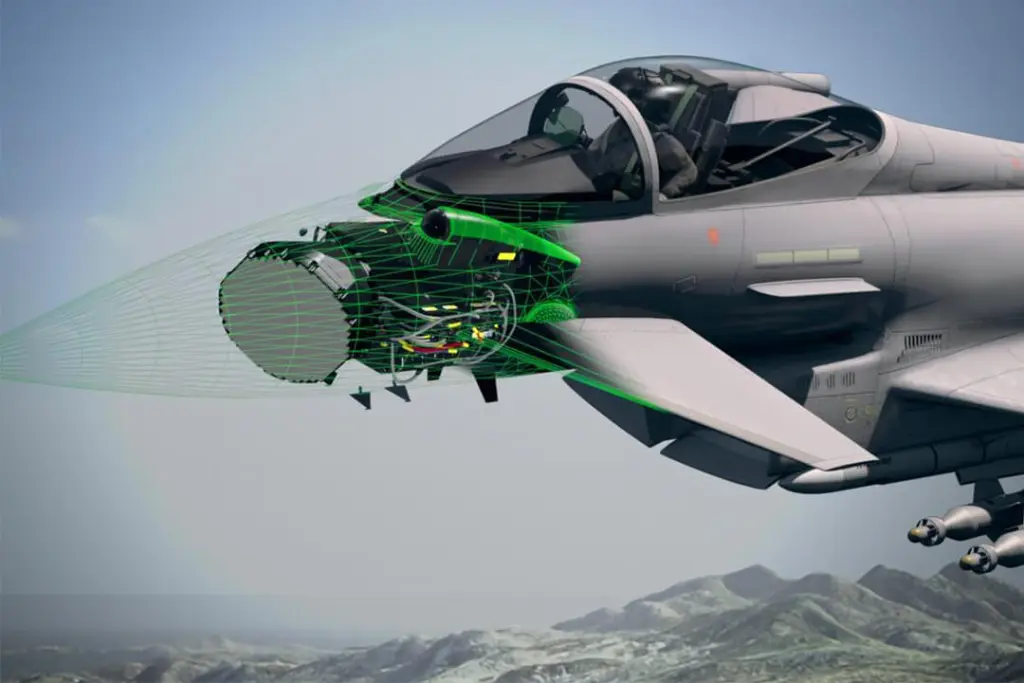
Eurofighter Typhoon (Captor-E)
- T/R Modules: ~1,500
- Power Output: 5-10 kW
- Key Features:
- GaN (Gallium Nitride) technology for higher power
- Advanced electronic warfare integration
- Modular design for future upgrades
- Status: Operational with RAF, German, and Italian air forces
Performance comparison: Modern AESA radars provide 3-5x more detection range and 10x faster scanning than previous-generation systems.
Expanded Technical Analysis: TR Modules and Power Efficiency
The heart of AESA technology lies in its transmit/receive (T/R) modules:
T/R Module Evolution
- First generation: Gallium Arsenide (GaAs) semiconductors
- Current generation: Gallium Nitride (GaN) technology
- Next generation: Digital T/R modules with integrated processing
Power and Efficiency
- GaN advantages: 5-10x higher power density than GaAs
- Thermal efficiency: 50-60% wall-plug efficiency vs. 20-30% for GaAs
- Power output: Modern modules produce 10-20W each
Digital Beamforming
- Analog beamforming: Phase shifters control beam direction
- Digital beamforming: Each module has digital processing
- Hybrid approach: Combining analog and digital for optimal performance
Breakthrough: GaN technology enables 5-10x more power in the same size package—critical for fighter aircraft with limited space.
Expanded Technical Analysis: Cooling and Thermal Management
Thermal management is critical for AESA radar performance:
Heat Generation Challenges
- Power density: 1,000+ T/R modules generating significant heat
- Thermal constraints: Semiconductor performance degrades with heat
- Cooling capacity: Limited space for traditional cooling systems
Advanced Cooling Techniques
- Liquid cooling: Circulating coolant through T/R module assemblies
- Microchannel heat exchangers: Increasing surface area for heat transfer
- Heat pipe technology: Efficiently moving heat away from critical components
- Thermal interface materials: Improving heat transfer between components
Innovative Approaches
- Fuel as coolant: Circulating jet fuel through heat exchangers
- Phase-change materials: Absorbing heat through solid-liquid transitions
- Adaptive power management: Reducing power to overheating modules
Critical insight: A 10 kW AESA radar generates enough heat to boil 20 liters of water per minute—requiring sophisticated thermal management.
Expanded Technical Analysis: Signal Processing and Data Fusion
AESA radar’s true power comes from advanced signal processing:
Processing Requirements
- Data volume: Hundreds of megabytes per second of raw radar data
- Computational needs: 100+ GFLOPS for real-time processing
- Latency constraints: < 100 ms for effective targeting
Advanced Processing Techniques
- Space-Time Adaptive Processing (STAP): Filtering clutter in ground mapping
- Constant False Alarm Rate (CFAR): Maintaining detection in varying environments
- Track-Before-Detect (TBD): Identifying targets below noise threshold
- Multi-Hypothesis Tracking (MHT): Managing complex target scenarios
Sensor Fusion
- Radar-IRST fusion: Combining radar and infrared data for better identification
- Networked fusion: Integrating data from multiple platforms
- AI-assisted processing: Using machine learning for target recognition
Breakthrough: Modern AESA processors can perform 1 trillion operations per second—enabling capabilities impossible just a decade ago.
Limitations and Vulnerabilities
Despite its advantages, AESA radar has critical limitations:
Technical Constraints
- Power requirements: High electrical demand strains aircraft systems
- Thermal management: Heat generation limits sustained operation
- Signal processing: Computational demands create latency issues
- Cost: AESA radars cost 2-3x more than mechanical systems
Electronic Warfare Vulnerabilities
- Deceptive jamming: Creating false targets or hiding real ones
- Barrage jamming: Overwhelming the radar with noise
- Adaptive jamming: Learning and countering AESA’s frequency hopping
- Low Probability of Intercept detection: New techniques to detect AESA emissions
Physical Limitations
- Size constraints: Fighter radomes limit array size and power
- Frequency limitations: Trade-offs between detection range and resolution
- Atmospheric effects: Weather impacts radar performance
Real-world impact: In 2023 testing, advanced jamming reduced AESA effectiveness by 30-40%—highlighting the electronic warfare arms race.
Future of AESA: Digital Arrays and Cognitive Radar
Next-generation AESA technology is already emerging:
Digital Beamforming
- Full digital arrays: Processing each T/R module’s signal digitally
- Multiple simultaneous beams: Creating dozens of independent beams
- Adaptive waveform control: Optimizing signals for specific scenarios
Cognitive Radar
- Machine learning: Adapting to the electromagnetic environment
- Predictive sensing: Anticipating threats based on patterns
- Spectrum awareness: Automatically avoiding jammed frequencies
- Explainable AI: Providing rationales for radar decisions
Advanced Materials and Designs
- GaN-on-SiC: Gallium Nitride on Silicon Carbide for higher power
- Conformal arrays: Integrating radar into aircraft skin
- Multi-function systems: Combining radar, communications, and EW
Game-changer: Sixth-generation fighters will feature AESA radars that learn and adapt to the battlefield—creating a significant advantage over current systems.
Conclusion: The Eyes of Modern Air Superiority
AESA radar has transformed fighter aircraft from weapons platforms into flying sensor networks—the most valuable asset in modern air combat.
The key insight: Information dominance precedes air dominance. In an era where missiles travel at Mach 5, victory goes to the side that sees first, decides fastest, and acts with precision.
While raw speed and firepower remain important, AESA radar has become the great equalizer—allowing smaller air forces to compete with larger adversaries through superior situational awareness.
Final truth: The most advanced fighter jet isn’t the one with the most missiles—it’s the one that sees the most, understands the most, and acts with the least delay.
FAQ
Q: How does AESA detect stealth aircraft?
A: Through multiple techniques: operating at lower frequencies where stealth is less effective, detecting subtle resonance effects, and using advanced signal processing to identify small radar returns.
Q: Can AESA radar jam enemy systems?
A: Yes—modern AESA radars can switch to electronic attack mode, directing focused energy to jam specific enemy sensors while maintaining their own functionality.
Q: Why are GaN semiconductors important for AESA?
A: Gallium Nitride provides 5-10x higher power density than previous materials, enabling more powerful radars in the same size package—critical for fighter aircraft with limited space.
Q: How does AESA handle multiple targets?
A: Through electronic beam steering—it can create multiple independent beams, tracking dozens of targets simultaneously while continuing other radar functions.
Q: Can AESA radar be detected by enemy sensors?
A: Yes, but modern AESA radars use Low Probability of Intercept (LPI) techniques to operate at power levels that make detection difficult for enemy warning systems.
Q: How long does it take to develop a new AESA radar?
A: 7-10 years. The F-35’s APG-81 took 8 years to develop and required over 6 million lines of code—making it one of the most complex radar systems ever deployed.
Q: Can AESA radar be retrofitted to older aircraft?
A: Yes—several fourth-generation fighters like the F-16 and F/A-18 have received AESA upgrades, though the full benefits require integration with other fifth-generation systems.
Q: Will AESA be replaced by other technologies?
A: Not soon—it will continue evolving. Future systems will incorporate digital beamforming and cognitive capabilities, but the fundamental AESA architecture will remain for decades.
Destacado: “AESA radar doesn’t just detect threats—it dominates the electromagnetic spectrum, turning the radar from a sensor into a weapon and a shield simultaneously.”
Previous Article
Helmet-Mounted Display SystemsNext Article
Antonov An-178