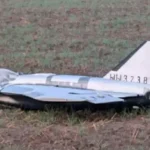
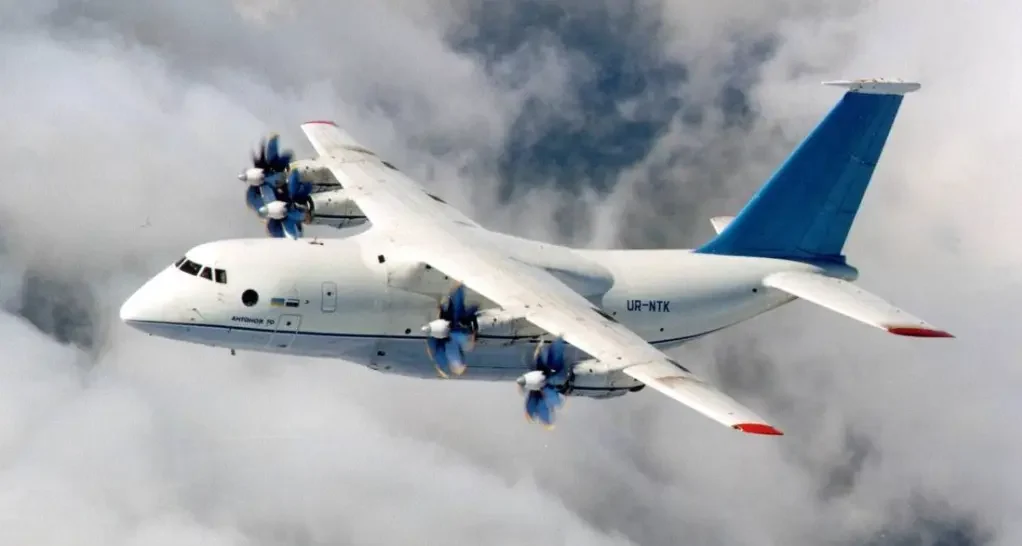
The Antonov An-70 is a medium-range, four-engine propfan military transport aircraft developed by Antonov in Ukraine. Designed for tactical and strategic airlift missions, the An-70 features advanced propfan engines, short and unprepared runway capability, and a large cargo hold for heavy and oversized loads. Its first flight was in 1994.
Fact Sheet
| Role | Military Transport |
|---|---|
| Manufacturer | Antonov |
| First Flight | December 16, 1994 |
| Crew | 4 |
| Capacity | Up to 300 troops or 47 tons of cargo |
Specifications
| Length | 40.7 m (133 ft 10 in) |
|---|---|
| Wingspan | 44.06 m (144 ft 7 in) |
| Height | 16.38 m (53 ft 9 in) |
| Max Takeoff Weight | 132,000 kg (291,010 lb) |
| Engines | 4 × Progress D-27 propfan engines (13,800 shp each) |
| Max Speed | 800 km/h (497 mph) |
| Range | 3,000 km (1,864 mi) with max payload |
| Service Ceiling | 12,000 m (39,370 ft) |
Notable Features
- Advanced propfan engines for high efficiency
- Short and unprepared runway capability
- Large rear cargo ramp for vehicles and heavy equipment
- Designed for tactical and strategic airlift missions
- Modern avionics and flight systems
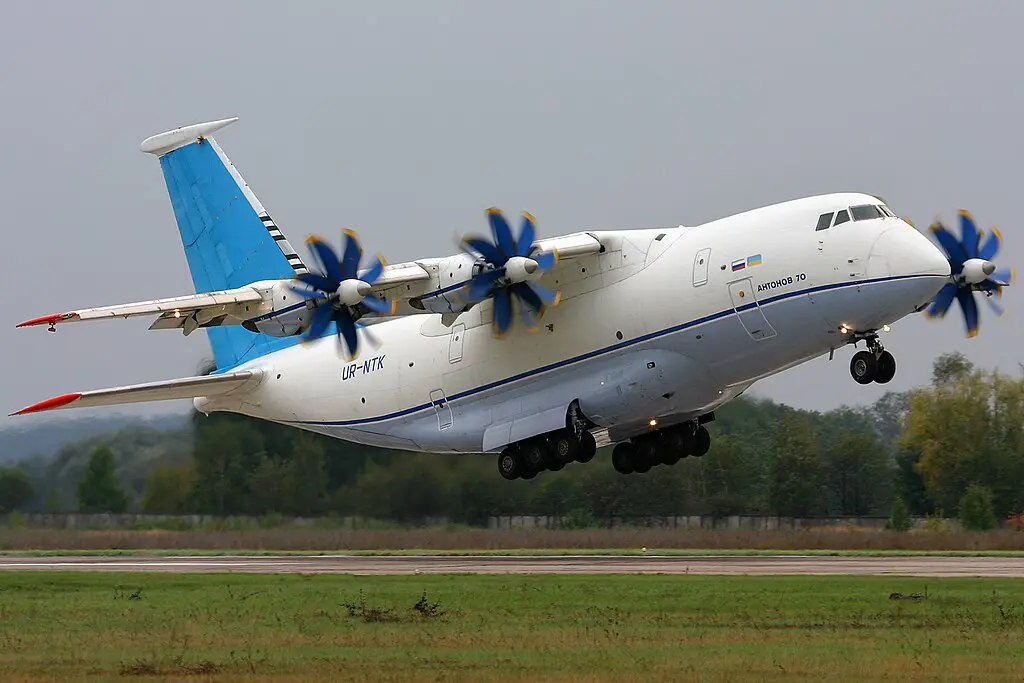
Antonov An-70
The Antonov An-70 is a medium-range military transport aircraft designed by the Ukrainian Antonov company. A highly ambitious project from the post-Soviet era, the aircraft was developed to be a next-generation transport, capable of carrying strategic payloads while maintaining the tactical flexibility to operate from short, austere runways. It is notable for being the first large aircraft powered solely by propfan engines.
A Unique Design with Innovative Propulsion
The An-70 is powered by four Progress D-27 propfan engines, each featuring a pair of large, contra-rotating propellers. This design was intended to combine the high fuel efficiency of a turboprop with the speed of a turbofan. The propfan engines are incredibly efficient and allow the An-70 to achieve a cruising speed comparable to a jet aircraft while consuming significantly less fuel.
The aircraft’s design also gives it impressive short takeoff and landing (STOL) capabilities. Using a technique known as “propeller wash,” the powerful airflow from its engines passes over the wings, increasing lift and allowing the An-70 to operate from runways as short as 600 meters (about 2,000 feet), even when fully loaded.
Development and Operational Challenges
The An-70 project, a joint effort between Russia and Ukraine after the dissolution of the Soviet Union, was plagued by a series of political, financial, and technical challenges.
- Political Instability: The project suffered from inconsistent funding and wavering commitment from the Russian government, which ultimately withdrew from the program in 2006.
- Technical Hurdles: The propfan engines, while innovative, proved to be complex and experienced technical issues during testing. The first prototype was tragically lost in a mid-air collision in 1995.
- Competition: The An-70 faced stiff competition from Western projects, such as the Airbus A400M Atlas, which were developed under more stable financial and political conditions.
Current Status
After decades of development, the An-70 was officially accepted into service by the Ukrainian Air Force in 2015. However, due to its turbulent history and the ongoing conflict in the region, only one fully functional aircraft has been built and remains in service.
The An-70’s ambitious design remains a testament to Antonov’s engineering prowess, but its troubled history and limited production have largely confined it to the realm of a technological pioneer rather than a successful production aircraft.
Previous Article
Lockheed C-130J HerculesNext Article
💥 NATO Engages Russian Drones in Poland