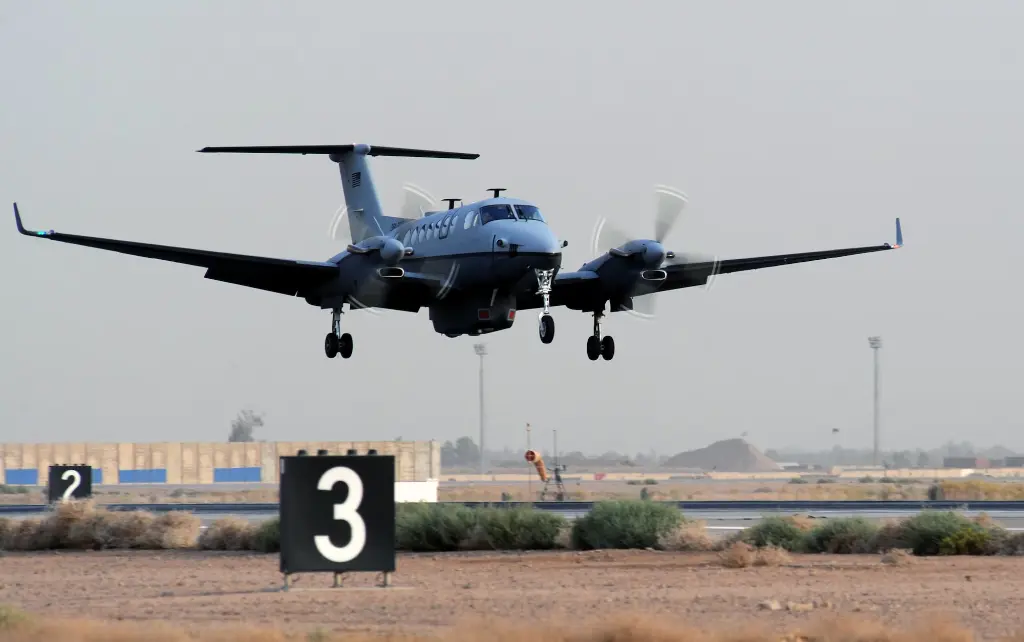
The Beechcraft MC-12W Liberty is an intelligence, surveillance, and reconnaissance (ISR) aircraft operated by the United States Air Force. Based on the Beechcraft Super King Air 350, the MC-12W is equipped with advanced sensors and communications systems to provide real-time full-motion video and signals intelligence to ground forces.
Fact Sheet
| Role | Intelligence, Surveillance & Reconnaissance (ISR) |
|---|---|
| Manufacturer | Beechcraft (Textron Aviation) |
| First Flight | 2009 (as MC-12W) |
| Service Entry | 2009 |
| Crew | 2 pilots + 2 mission system operators |
| Number Built | ~42 (converted) |
Specifications (MC-12W)
| Length | 46 ft 8 in (14.22 m) |
|---|---|
| Wingspan | 57 ft 11 in (17.65 m) |
| Height | 14 ft 4 in (4.37 m) |
| Empty Weight | 9,300 lb (4,218 kg) |
| Max Takeoff Weight | 16,500 lb (7,484 kg) |
| Powerplant | 2 × Pratt & Whitney Canada PT6A-60A turboprops (1,050 shp each) |
| Max Speed | 312 mph (502 km/h) |
| Range | 1,500 mi (2,400 km) |
| Service Ceiling | 35,000 ft (10,668 m) |
Sensors & Systems
| Sensors | Electro-optical/infrared (EO/IR) camera, signals intelligence (SIGINT) suite |
|---|---|
| Communications | Secure voice/data links, satellite communications |
| Other Systems | Onboard workstations for real-time analysis and dissemination |
Notable Features
- Provides real-time full-motion video and signals intelligence
- Rapidly fielded to support operations in Iraq and Afghanistan
- Based on the proven King Air 350 platform
- Operated by USAF, Army, and Special Operations units
- Flexible, cost-effective ISR solution for tactical commanders

The MC-12W Liberty was a U.S. Air Force intelligence, surveillance, and reconnaissance (ISR) aircraft known for its rapid development and crucial role in supporting ground troops during the wars in Iraq and Afghanistan. A militarized version of the commercial Hawker Beechcraft Super King Air 350ER, it was designed to fill a critical gap in battlefield intelligence.
Development and Mission
The MC-12 program was born out of an urgent operational need in 2008 to provide persistent, real-time intelligence to ground forces engaged in counter-insurgency operations. The goal was to deploy a manned ISR platform that was cheaper and more agile than large, high-altitude surveillance aircraft, and could be on-station for long periods.
The “Liberty” was a complete system, consisting of the aircraft itself and a ground exploitation cell. Its primary mission was to provide direct support to special operations and conventional forces on the ground by:
- Full-Motion Video (FMV): The aircraft was equipped with an electro-optical/infrared (EO/IR) sensor turret (a Wescam MX-15 system) that could provide high-definition, real-time video of the battlefield, day or night.
- Signals Intelligence (SIGINT): The MC-12 could intercept and analyze enemy communications.
- Laser Designation: The EO/IR sensor included a laser designator, allowing the crew to “paint” targets for laser-guided munitions from other aircraft, greatly improving targeting accuracy.
The program was a stunning success, going from funding approval to combat deployment in less than a year. The first MC-12 flew its first combat sortie on June 10, 2009, and proved to be a “game-changer,” saving countless lives by helping troops avoid ambushes, locate improvised explosive devices (IEDs), and direct firepower against insurgents.
Retirement and Legacy
The MC-12W fleet, once numbering more than 40 aircraft, was gradually phased out of the U.S. Air Force’s active combat inventory starting in the mid-2010s. The Air Force transferred a portion of the fleet to the U.S. Army and U.S. Special Operations Command (USSOCOM).
Today, the MC-12W’s primary operator is the Oklahoma Air National Guard’s 137th Special Operations Wing. While its numbers and mission have been reduced, the aircraft continues to support special operations missions.
The MC-12’s legacy is significant. It proved the value of a manned, propeller-driven ISR platform for low-intensity conflict and demonstrated that the U.S. military could rapidly develop and deploy a low-cost, effective solution to meet a specific combat need. The insights gained from the MC-12’s operations have influenced the development of new platforms, such as the OA-1K Sky Warden, which is being acquired to replace the MC-12 and other similar aircraft in the special operations inventory.
Previous Article
Northrop Grumman E-8C Joint STARSNext Article
Iconic Fighter Jets of the Cold War