
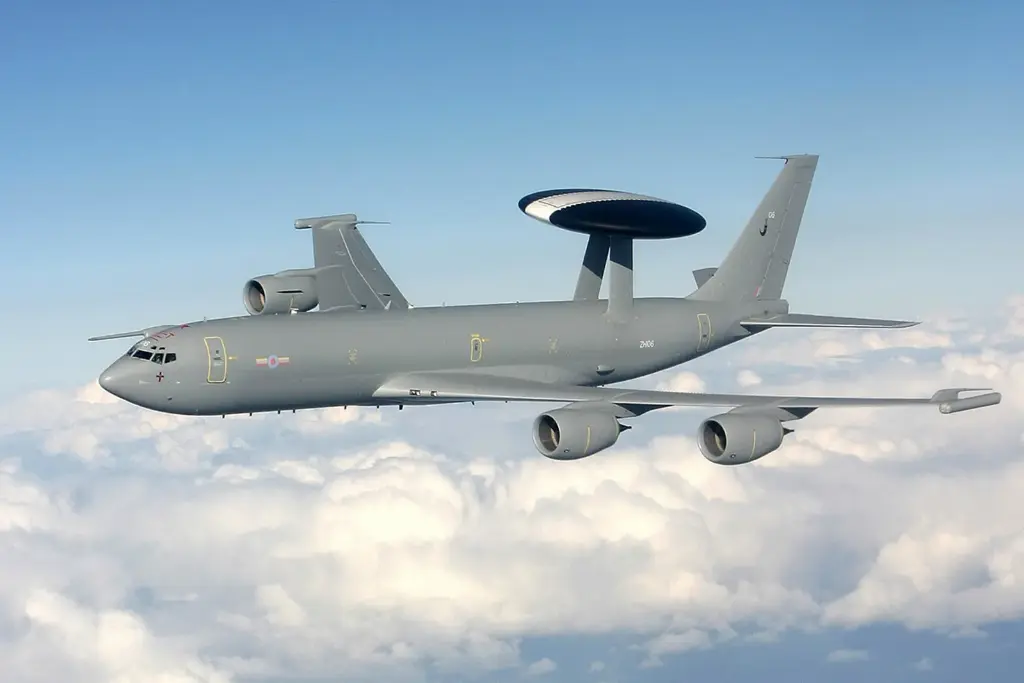
The Boeing E-3 Sentry is an Airborne Warning and Control System (AWACS) aircraft developed by Boeing for the United States Air Force and NATO. Based on the Boeing 707 airframe, the E-3 is equipped with a distinctive rotating radar dome and advanced sensors, providing all-weather surveillance, command, control, and communications for air and maritime operations.
Fact Sheet
| Role | Airborne Early Warning & Control (AEW&C) |
|---|---|
| Manufacturer | Boeing |
| First Flight | October 31, 1975 |
| Service Entry | 1977 |
| Crew | Up to 21 (flight and mission crew) |
| Number Built | 68 |
Specifications (E-3B/C Model)
| Length | 152 ft 11 in (46.68 m) |
|---|---|
| Wingspan | 145 ft 9 in (44.42 m) |
| Height | 41 ft 4 in (12.60 m) |
| Empty Weight | 185,000 lb (83,915 kg) |
| Max Takeoff Weight | 347,000 lb (157,400 kg) |
| Powerplant | 4 × Pratt & Whitney TF33-PW-100A turbofans (21,000 lbf each) |
| Max Speed | 530 mph (853 km/h) |
| Range | 4,000 mi (6,400 km) |
| Service Ceiling | 29,000 ft (8,800 m) |
Radar & Systems
| Radar | AN/APY-1 or AN/APY-2 pulse-Doppler radar (360° coverage) |
|---|---|
| Detection Range | Over 250 mi (400 km) for low-flying targets |
| Other Systems | IFF, ESM, secure communications, data links |
Notable Features
- Rotating radar dome (“rotodome”) for 360° surveillance
- Provides command and control for air operations
- Operated by USAF, NATO, UK, France, and Saudi Arabia
- Key asset for airspace management and battle management
- Can direct fighter, bomber, and interceptor aircraft
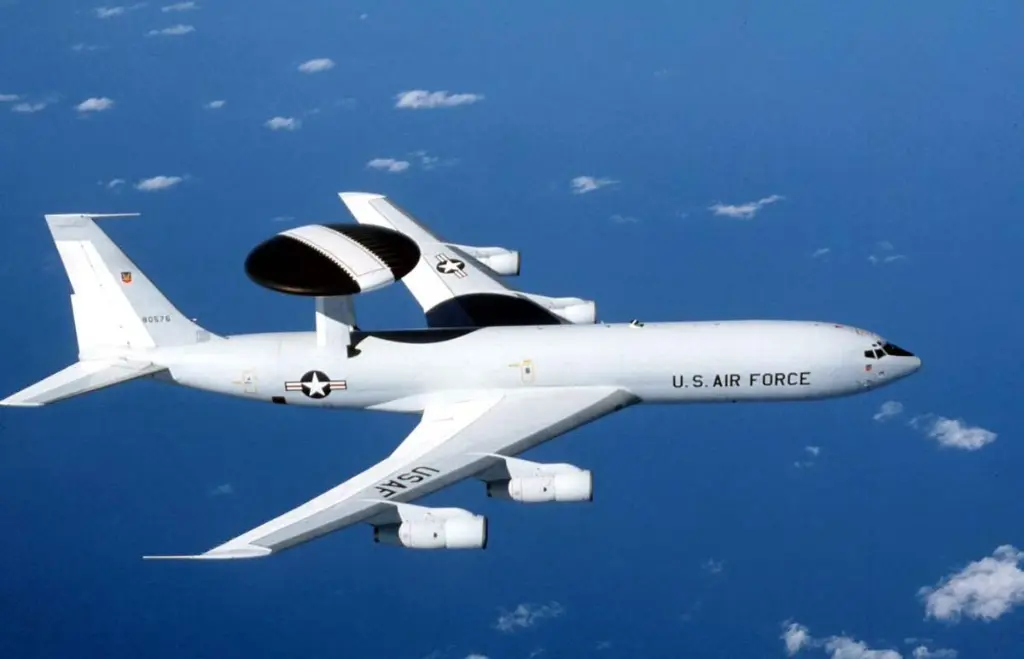
The Boeing E-3 Sentry is an airborne warning and control system (AWACS) aircraft that has served as the “eye in the sky” for the U.S. Air Force, NATO, and other allies for nearly five decades. It is instantly recognizable by its large, rotating radar dome mounted on the fuselage of a modified Boeing 707 airliner.
Role and Capabilities
The E-3 Sentry’s primary role is to provide all-weather surveillance, command, control, and communications (C3) support for ground and air forces. Its key features and capabilities include:
- AN/APY-1/2 Radar: The most prominent feature of the E-3 is its radar dome (rotodome), which houses a powerful radar system. This radar can detect aircraft and other objects from a great distance, providing a comprehensive, real-time picture of the battlespace.
- Command and Control: The aircraft serves as a mobile command center, directing friendly fighter aircraft to targets, managing air traffic in a combat zone, and providing early warning of enemy threats.
- Situational Awareness: By fusing data from its own radar with information from other platforms (e.g., ground radar, ships), the E-3 provides a unified, “big picture” of the battlefield, greatly enhancing a military force’s situational awareness.
Current Status and Operators
As of mid-2025, the E-3 Sentry remains in active service with several air forces, though its numbers are declining:
- United States Air Force (USAF): The USAF operates the largest fleet of E-3s.
- NATO: The NATO Airborne Early Warning & Control Force (NAEW&CF) operates a multinational fleet of E-3s, which are a cornerstone of the alliance’s collective defense.
- United Kingdom (RAF): The Royal Air Force is in the process of replacing its E-3s with the E-7 Wedgetail.
- France (Armée de l’air): The French Air and Space Force operates a small fleet of E-3s.
- Saudi Arabia: The Royal Saudi Air Force also operates E-3s.
The E-7 Wedgetail: The Sentry’s Successor
The E-3 fleet is aging, with some airframes dating back to the 1970s. The costs and technical challenges of maintaining the airframes, which are based on the now-out-of-production Boeing 707, have made a replacement program a top priority.
The Boeing E-7 Wedgetail has been chosen as the E-3’s successor for the USAF and other operators. The E-7 is based on the more modern and efficient Boeing 737-700 airliner. Its most significant technological advancement is its fixed, “fin-like” radar array, which is an advanced AESA (Active Electronically Scanned Array) radar. This radar provides 360-degree coverage without physically rotating, offering superior performance and reliability.
The USAF plans to acquire a fleet of E-7s, with the first aircraft expected to be delivered in 2027. This transition will be gradual, and the E-3 Sentry is expected to continue flying for several more years as the new E-7s are phased into service. The E-3’s legacy of revolutionizing air command and control will live on through its more modern, digitally-native successor.

Previous Article
Tupolev Tu-95 “Bear”Next Article
Northrop Grumman E-8C Joint STARS