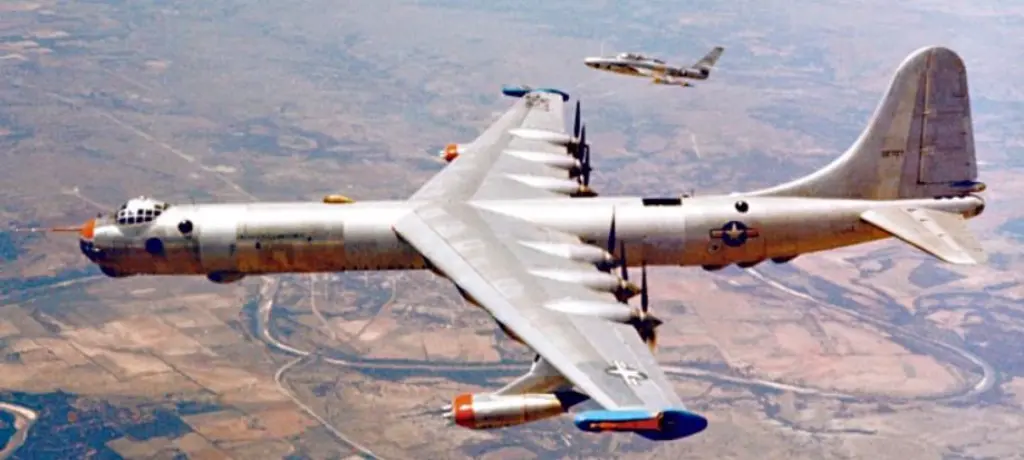
The Convair B-36 Peacemaker was a strategic bomber built by Convair and operated by the United States Air Force from 1949 to 1959. It was the largest mass-produced piston-engined aircraft ever made and the first bomber capable of delivering any of the nuclear weapons in the U.S. arsenal from inside its bomb bays without aircraft modifications. The B-36 had intercontinental range and was a key element of American nuclear deterrence during the early Cold War.
Fact Sheet
| Role | Strategic Bomber |
|---|---|
| Manufacturer | Convair |
| First Flight | August 8, 1946 |
| Service Entry | 1949 |
| Crew | 13 |
| Number Built | 384 |
Specifications (B-36J Model)
| Length | 162 ft 1 in (49.4 m) |
|---|---|
| Wingspan | 230 ft (70.1 m) |
| Height | 46 ft 9 in (14.3 m) |
| Wing Area | 4,772 sq ft (443.33 m²) |
| Empty Weight | 166,165 lb (75,400 kg) |
| Loaded Weight | 262,500 lb (119,100 kg) |
| Max Takeoff Weight | 410,000 lb (186,000 kg) |
| Powerplant | 6 × Pratt & Whitney R-4360-53 radial engines (3,800 hp each) + 4 × General Electric J47 turbojets (5,200 lbf each) |
| Max Speed | 435 mph (700 km/h) |
| Cruise Speed | 230 mph (370 km/h) |
| Range | 10,000 mi (16,000 km) |
| Service Ceiling | 45,700 ft (13,900 m) |
| Rate of Climb | 1,700 ft/min (8.6 m/s) |
Armament & Defensive Equipment
| Guns | Up to 16 × 20 mm M24A1 autocannons (later reduced to tail only) |
|---|---|
| Bomb Load | Up to 86,000 lb (39,000 kg) |
| Aiming Equipment | K-3A, K-4A, K-5, and K-6 fire control systems |
Notable Features
- Largest wingspan of any combat aircraft ever built
- Six pusher-propeller engines and four jet engines (“six turning and four burning”)
- Intercontinental range without refueling
- Could carry the largest nuclear weapons of its era
- Served as a deterrent during the early Cold War
Convair B-36 Peacemaker: The Cold War’s “Big Stick”
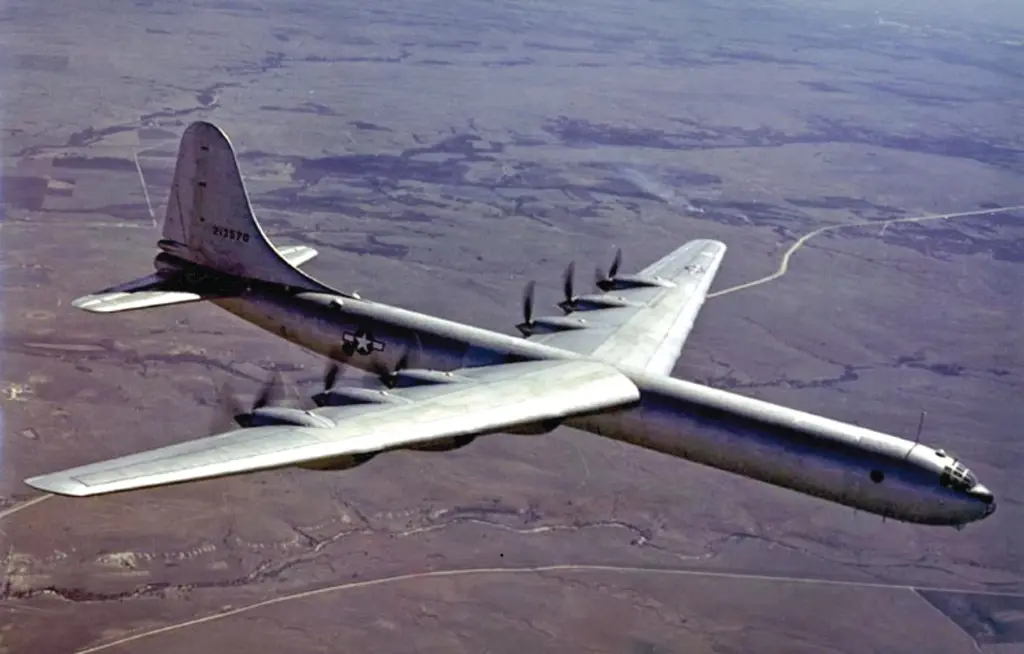
The Convair B-36 Peacemaker was a behemoth of the skies, an awe-inspiring American strategic bomber that defined the early years of the Cold War. It was the largest mass-produced piston-engined aircraft ever built and the first bomber capable of intercontinental flight without refueling, making it the backbone of the United States Air Force’s (USAF) Strategic Air Command (SAC) during a crucial period of nuclear deterrence.
B-36 Development & Cold War Imperative
The B-36 program originated in 1941, during World War II, when the U.S. Army Air Corps (USAAC) foresaw the potential need for a bomber that could strike targets in Europe from North American bases, should Britain fall to Nazi Germany. This audacious requirement called for an aircraft with an unprecedented range of 10,000 miles (16,000 km) and a substantial bomb load.
Despite the end of World War II, the development of the atomic bomb and the escalating Cold War with the Soviet Union ensured the B-36’s continued importance. Its ability to deliver nuclear weapons over intercontinental distances without modifications made it uniquely suited for the nascent strategic nuclear role. The XB-36 prototype first flew on August 8, 1946, and the B-36 officially entered service with SAC in 1948. A total of 384 Peacemakers were built between 1947 and 1954.
B-36 Design Features: Gigantic Scale & Hybrid Propulsion
The B-36 was a marvel of engineering for its time, notable for its immense size and unusual propulsion system.
- “Six-Pistons, Four-Jets” Hybrid Propulsion: The most unique and defining feature of the B-36 was its hybrid propulsion system. It was initially powered by six massive Pratt & Whitney R-4360 “Wasp Major” 28-cylinder radial piston engines, mounted in a pusher configuration on the trailing edge of the wings. To boost performance during takeoff, climb, and combat, four General Electric J47 turbojet engines were later added, mounted in two pods (two engines per pod) beneath the outer wings. This “six turning, four burning” configuration gave the B-36 impressive power, but also presented maintenance challenges.
- Massive Wingspan: With a wingspan of 70.1 meters (230 feet), the B-36 had the longest wingspan of any combat aircraft ever built. Its thick wings (1.8 meters or 6 feet at the roots) allowed for enormous internal fuel capacity, crucial for its intercontinental range, and even contained a crawlspace for in-flight engine access.
- Pressurized Crew Compartments: The B-36 featured pressurized forward and aft crew compartments, connected by a 25-meter (85-foot) pressurized tunnel through which a crew member could crawl on a trolley. This was a critical innovation for long, high-altitude missions.
- Maximum Payload: The B-36 was designed to carry an immense bomb load, with four bomb bays capable of holding a maximum of 39,000 kg (86,000 lbs) of conventional bombs. It was also capable of carrying the first generation of massive Mark 17 hydrogen bombs (weighing 42,000 lbs, requiring the merging of two adjacent bomb bays).
- High Altitude Performance: It could operate at altitudes above 45,000 feet (13,700 meters), putting it beyond the reach of most contemporary piston-engine interceptors and early jet fighters.
- Crew: A typical crew consisted of 15 personnel, including pilots, navigators, bombardiers, flight engineers, radio operators, electronic countermeasures operators, and gunners.
B-36 Avionics & Defensive Armament
The B-36’s systems were designed for long-range, independent operations:
- Radar System: Equipped with advanced radar systems for navigation and bombing.
- Defensive Armament: Early variants featured six retractable, remotely controlled turrets, each mounting two 20 mm M24A1 autocannons, plus fixed nose and tail turrets with similar armament. Later “Featherweight” variants eliminated many or all of these turrets to reduce weight and increase speed, relying on altitude and electronic countermeasures for defense, retaining only a manned tail turret.
- Electronic Countermeasures (ECM): Carried a comprehensive suite of ECM equipment to jam enemy radar.
B-36 Variants: Iterative Improvements
The B-36 went through several iterative design and upgrade phases:
- XB-36 / YB-36: Prototypes and service test aircraft. The YB-36 introduced the raised “bug-eye” cockpit.
- B-36A: Initial unarmed evaluation aircraft.
- B-36B: The first armed production variant with R-4360-41 engines.
- B-36D: Introduced the distinctive four jet engines (J47) in twin pods for augmented thrust, along with the six piston engines.
- RB-36D/E/F/H: Dedicated strategic reconnaissance variants, making up over a third of all B-36 production. These carried massive cameras and photo-flash bombs, and were vital for Cold War intelligence gathering over vast landmasses.
- B-36F: Featured upgraded R-4360-53 piston engines and J47-GE-19 jets.
- B-36H: Similar to the F variant, with minor modifications.
- B-36J: The final and most advanced production variant, with strengthened airframes, additional fuel tanks, and many later models configured as “Featherweight III” variants with reduced defensive armament for even higher altitude performance.
- XC-99: A massive transport variant based on the B-36 wings and tail, but with a double-deck fuselage, capable of carrying 400 troops or 45 tons of cargo. Only one was built.
- X-6: A proposed nuclear-powered aircraft testbed based on the B-36, which never materialized beyond initial design studies.
B-36 Role in the Cold War: Deterrence, Not Combat
The Convair B-36 Peacemaker was the primary strategic nuclear bomber of the USAF’s Strategic Air Command (SAC) from 1948 until the mid-1950s.
- Nuclear Deterrence: Its main role was to act as a powerful deterrent against Soviet aggression. While never dropping a bomb in combat against hostile forces, its sheer range and capacity to deliver the largest nuclear weapons of the era made it a formidable threat. It maintained a constant readiness posture, including ground and airborne alert missions.
- Strategic Reconnaissance: The RB-36 variants were crucial for Cold War reconnaissance missions over vast territories, including areas near the Soviet Union, gathering vital intelligence. These missions often involved flying at extreme altitudes.
- Symbol of American Might: The B-36 was a highly visible symbol of American technological and military superiority during a tense period of the Cold War.
B-36 Retirement & Enduring Legacy
Despite its impressive capabilities, the B-36’s operational life was relatively short. The advent of faster, more modern jet bombers and the increasing sophistication of Soviet air defenses quickly rendered the propeller-driven Peacemaker obsolete.
The B-36 began to be replaced by the all-jet Boeing B-47 Stratojet and later the Boeing B-52 Stratofortress, which continues to serve today. The last operational B-36 Peacemaker was retired from USAF service on February 12, 1959, with a ceremonial flight of the last aircraft built, serial number 52-2827.
Out of 384 B-36s built, only four complete examples survive today in museums across the United States. These colossal aircraft remain powerful reminders of a unique era in aviation history, serving as a testament to the extremes of design driven by the strategic imperatives of the early Cold War.
Previous Article
Boeing B-29 SuperfortressNext Article
Boeing B-47 Stratojet