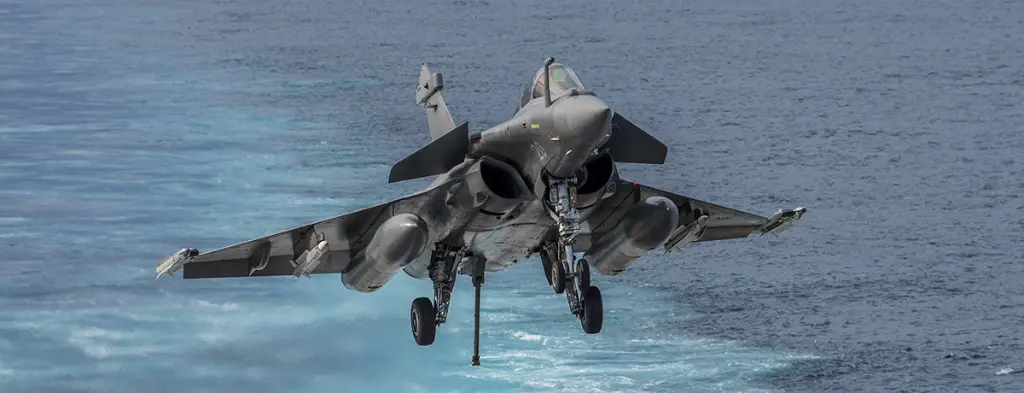
The Dassault Rafale is a twin-engine, multirole fighter aircraft developed by Dassault Aviation for the French Air Force and Navy. First flown in 1986 and introduced in 2001, the Rafale is designed for air superiority, ground attack, reconnaissance, and nuclear deterrence missions. Known for its agility, advanced avionics, and multirole capabilities, the Rafale is widely regarded as one of the most versatile and capable fighter aircraft in service today.
Fact Sheet
| Role | Multirole fighter |
|---|---|
| Manufacturer | Dassault Aviation |
| First Flight | 1986 |
| Service Entry | 2001 |
| Crew | 1 (Rafale C/M) or 2 (Rafale B) |
Specifications
| Length | 15.3 m (50 ft 2 in) |
|---|---|
| Wingspan | 10.9 m (35 ft 9 in) |
| Height | 5.3 m (17 ft 5 in) |
| Empty Weight | 10,600 kg (23,370 lb) |
| Max Takeoff Weight | 24,500 kg (54,013 lb) |
| Powerplant | 2 × Snecma M88-2 turbofans |
| Thrust | 16,900 lbf (75 kN) per engine with afterburner |
| Max Speed | Mach 1.8 (2,223 km/h; 1,381 mph) |
| Service Ceiling | 15,240 m (50,000 ft) |
| Range | 1,850 mi (2,960 km) combat radius |
| Rate of Climb | ~60,000 ft/min (305 m/s) |
Avionics & Armament
| Main Radar | RBE2 AESA radar |
|---|---|
| Avionics | Advanced avionics suite, Spectra electronic warfare system |
| Armament | One 30-mm GIAT 30 cannon (125 rounds); Up to 14 external hardpoints for: – Air-to-air missiles (MICA, Meteor) – Air-to-ground munitions (SCALP, AASM, bombs) – Nuclear-capable missiles (ASMP-A) – External fuel tanks |
Notable Features
- Multirole capability for air-to-air, air-to-ground, and reconnaissance missions.
- Advanced avionics for superior situational awareness.
- Carrier-capable variant (Rafale M) for naval operations.
- High interoperability with NATO forces.
- Widely exported to allied nations, including India, Egypt, and Qatar.
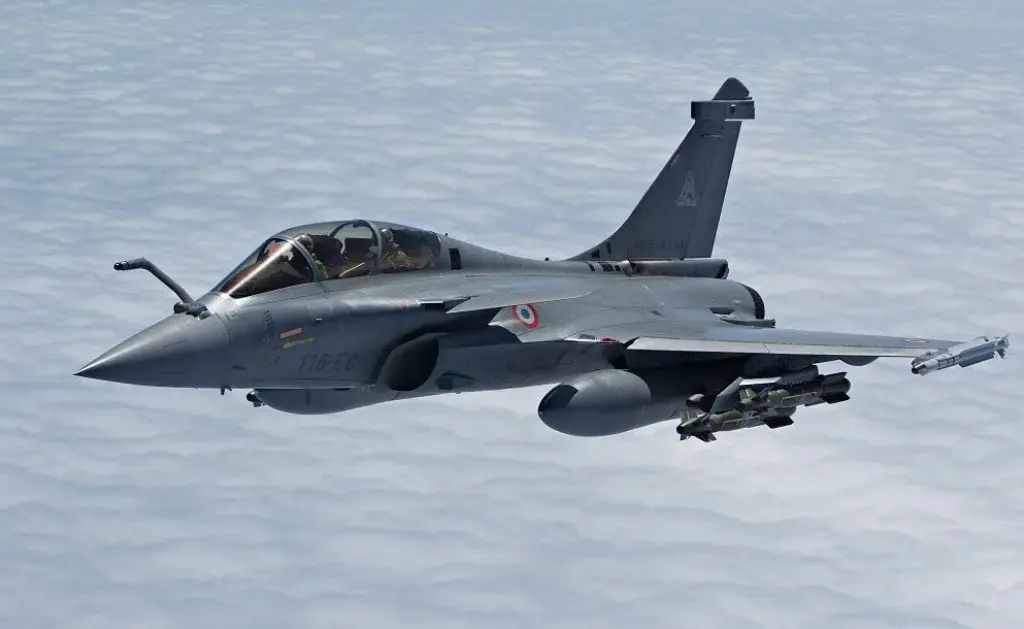
The Dassault Rafale (French: “gust of wind” or “burst of fire”) is a French twin-engine, canard-delta wing, multirole (or “omnirole” as Dassault calls it) fighter aircraft designed and built by Dassault Aviation. It is a highly versatile and combat-proven platform, capable of performing a wide range of missions, including air superiority, interdiction, aerial reconnaissance, ground support, in-depth strike, anti-ship strike, and nuclear deterrence.
Development and Philosophy
The Rafale’s development began in the early 1980s. France initially participated in discussions for a common European fighter (which eventually led to the Eurofighter Typhoon), but ultimately withdrew due to differing requirements. France sought a lighter, more agile aircraft that could serve both its Air Force and Navy (including carrier operations) and replace a multitude of existing specialized aircraft types. This led Dassault to embark on an independent project, emphasizing an “omnirole” design where one aircraft could perform all missions without significant reconfiguration.
The technology demonstrator, Rafale A, first flew on July 4, 1986. After extensive testing and refinement, the first production Rafale entered service with the French Navy in 2002, followed by the French Air Force (now Air and Space Force) in 2006.
Key Design Features and Capabilities
- Canard-Delta Wing Configuration: This aerodynamic layout provides exceptional agility, high angle-of-attack performance, and efficient supersonic flight. The aircraft’s inherent instability is managed by a sophisticated digital fly-by-wire (FBW) system, offering precise control and enhancing maneuverability.
- Twin Engines: Powered by two Snecma M88 turbofan engines. These engines are designed for high performance, reliability, ease of maintenance, and low running costs. They provide a high thrust-to-weight ratio, allowing for excellent acceleration and climb rates. The M88 also features rapid throttle response, crucial for combat.
- “Omnirole” Capability: This is a defining characteristic. The Rafale is designed to perform air-to-air, air-to-ground, and naval missions with minimal changes. This reduces logistical complexity and allows for dynamic mission adaptation in flight.
- Advanced Materials and Low Observability: The airframe extensively uses composite materials (70% of the wetted area), contributing to its relatively light weight and robustness. While not a true stealth fighter, its design incorporates features like careful shaping, serrated edges, and radar-absorbent materials to achieve a reduced radar cross-section (RCS).
- “Glass Cockpit” and Human-Machine Interface: The cockpit features multiple large, reconfigurable multi-function displays, a wide-angle Head-Up Display (HUD), and a high-performance Helmet-Mounted Display (HMD). It utilizes a Hands-On-Throttle-And-Stick (HOTAS) control concept and incorporates Direct Voice Input (DVI) for critical commands, minimizing pilot workload.
- Sophisticated Sensor Suite (SPECTRA and RBE2 AESA):
- RBE2 AESA Radar: The Rafale was the first European fighter to field an Active Electronically Scanned Array (AESA) radar (the RBE2-AA variant). This radar offers significantly improved range (over 50% increase compared to previous generation fire control radars), multi-target tracking, higher resolution synthetic aperture radar (SAR) imaging for ground mapping, and enhanced resistance to jamming. It allows the pilot to perform air-to-air and air-to-ground missions simultaneously.
- SPECTRA Electronic Warfare System: The Rafale’s integrated Self-Protection Equipment Countering Threats to Rafale Aircraft (SPECTRA) is a comprehensive electronic warfare system. It provides 360° multi-spectral warning against enemy radars, missiles, and lasers, and can detect, identify, locate, and jam threats over long ranges, employing electromagnetic jamming, infrared decoys, and other countermeasures.
- Front Sector Optronics (FSO): A passive, long-range electro-optical system (EOTS/IRST) that combines infrared and TV sensors for detection, tracking, and identification of targets without emitting any radar signals, enhancing stealthy engagements.
- Recce NG Pod (AREOS): An advanced digital reconnaissance pod providing day and night, long-range, and high-resolution imagery for tactical and strategic intelligence.
- TALIOS Targeting Pod: A high-performance laser designator and targeting pod for precision air-to-ground strikes.
- Diverse Armament: The Rafale has 14 external hardpoints (13 for the naval variant Rafale M) and an internal cannon. It can carry up to 9.5 tons (20,944 lbs) of external stores.
- Internal Cannon: A single 30mm GIAT 30 M791B cannon.
- Air-to-Air Missiles: MBDA MICA (available in IR and EM active radar versions, for short and medium range), and the potent MBDA Meteor (long-range ramjet-powered active radar-guided), giving it a significant beyond-visual-range (BVR) capability.
- Air-to-Surface Weapons: AASM Hammer (Armament Air-Sol Modulaire – modular precision-guided weapon, GPS/inertial/laser/IR guided), SCALP-EG (Storm Shadow) long-range stand-off cruise missile, Exocet AM39 (anti-ship missile), various laser-guided and conventional bombs.
- Nuclear Deterrence: Capable of carrying the ASMP-A (Air-Sol Moyenne Portée-Amélioré) medium-range air-to-surface nuclear missile for France’s strategic nuclear deterrent.
Key Variants
- Rafale C: Single-seat land-based version for the French Air and Space Force.
- Rafale B: Two-seat land-based version for the French Air and Space Force, used for training and complex strike missions where a WSO is beneficial.
- Rafale M: Single-seat carrier-based version for the French Navy. It features a stronger airframe, longer nose gear for catapult launches, an arrestor hook, and compatibility with carrier systems. The Rafale M is notable as the only non-US type of fighter cleared to operate from the decks of US Navy aircraft carriers.
“Standards” and Continuous Upgrades
Dassault follows a philosophy of continuous improvement through “Standards” (software and hardware upgrades):
- F1: Initial naval capability.
- F2: Initial air-to-ground capability.
- F3/F3-R: Significant multirole enhancements, including RBE2 AESA radar integration, Meteor missile capability, and TALIOS pod.
- F4.1 & F4.2 (Current Production/Upgrade): Focuses on network-centric warfare, improved sensor fusion, enhanced connectivity, new data links, MICA NG missile integration, and integration of the Scorpion Helmet-Mounted Display. The F4.1 standard was qualified in March 2023.
- F5 (Future Development): Planned to be a significant leap, incorporating advanced AI algorithms for collaborative combat, potential for “loyal wingman” drone control (UCAS – Unmanned Combat Air System, benefiting from the nEUROn UCAV program), improved stealth features, new weapons, and potentially more powerful M88 engine variants. It is expected to enter service around 2030 and operate beyond 2060.
Operators and Combat History
The Rafale has seen significant export success in recent years, making it one of the most purchased fighter jets globally since 2022.
- Current Operators:
- France (French Air and Space Force, French Navy) – The primary operator, with a total order of 234 aircraft.
- Egypt (Egyptian Air Force) – 55 Rafales ordered.
- India (Indian Air Force, Indian Navy) – 36 Rafales for the IAF, and 26 for the Indian Navy (carrier-based).
- Qatar (Qatar Emiri Air Force) – 36 Rafales.
- Greece (Hellenic Air Force) – 24 Rafales (12 new-built, 12 ex-French).
- Croatia (Croatian Air Force) – 12 ex-French Rafales.
- United Arab Emirates (UAE Air Force) – 80 Standard F4 Rafales (largest export order, deliveries from 2027).
- Indonesia (Indonesian Air Force) – 42 Rafales ordered.
- Serbia (Serbian Air Force) – 12 Rafales ordered in 2024.
- Combat History: The Rafale is truly combat-proven and has demonstrated its effectiveness in various theaters:
- Afghanistan (2007-2012): French Rafales conducted their first combat missions, providing close air support and precision strikes with laser-guided bombs.
- Libya (Operation Harmattan / Unified Protector, 2011): Rafales were among the first aircraft to fly over Libyan territory, conducting reconnaissance, precision strikes with AASM Hammer bombs, and maintaining air superiority.
- Mali (Operation Serval, 2013): French Air Force Rafales conducted deep strike missions against jihadist infrastructure, including a notable 9-hour, 6,000 km mission with multiple aerial refuelings.
- Iraq and Syria (Operation Chammal, 2014-Present): Both French Air Force and Navy (from the Charles de Gaulle aircraft carrier) Rafales have been extensively involved in operations against ISIS, conducting reconnaissance, precision strikes, and deep strikes with SCALP cruise missiles.
- India-Pakistan Border (2025): Indian Air Force Rafales have been deployed near the border with Pakistan, asserting their presence in the region.
- Air Policing: French Rafales regularly conduct Quick Reaction Alert (QRA) duties and participate in NATO air policing missions.
The Dassault Rafale has emerged as a major success story for France’s aerospace industry, showcasing its ability to produce a highly capable, versatile, and independent combat aircraft that is highly sought after on the international market. Its “omnirole” design, advanced sensor fusion, and continuous upgrade path ensure its relevance for decades to come.
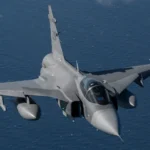
Previous Article
Saab JAS 39 GripenNext Article
Dassault Mirage 2000