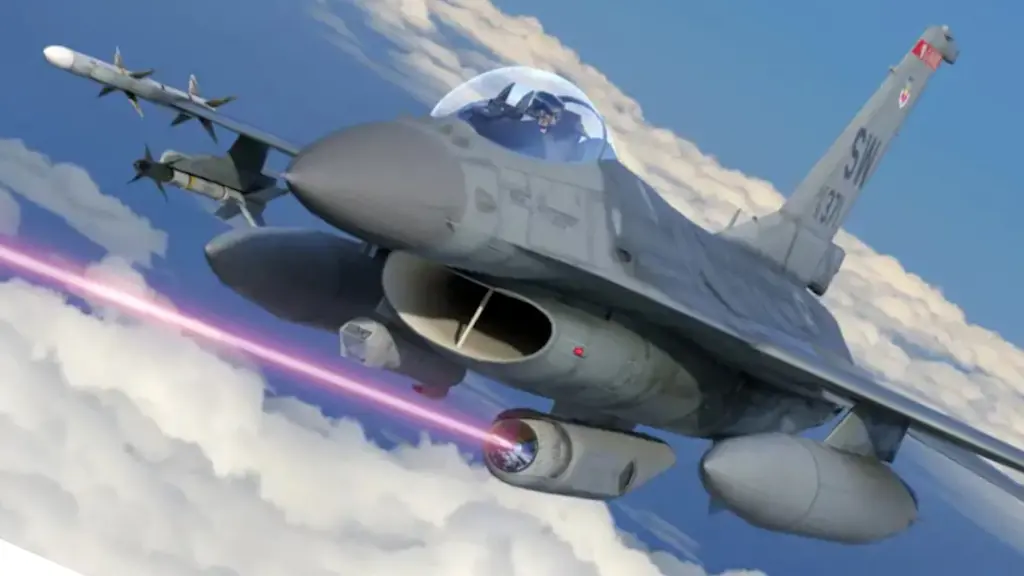
The future of air combat isn’t just faster missiles—it’s beams of light moving at 186,000 miles per second. Airborne directed energy weapons, particularly high-energy lasers, are transitioning from science fiction to operational reality, promising to revolutionize how fighter jets defend themselves and engage targets.
Unlike traditional weapons with limited ammunition and ballistic trajectories, airborne lasers offer near-infinite “magazines,” precision engagement, and the speed of light—critical advantages in an era of drone swarms and hypersonic threats. From the U.S. Air Force’s SHiELD program to European initiatives, militaries are racing to integrate these systems onto fighter jets, with the first operational deployments expected within this decade.
This article reveals how airborne lasers work, the monumental engineering challenges they overcome, and why they could become the most significant defensive advancement since radar warning receivers.
The Promise of Airborne Directed Energy Weapons
Directed energy weapons (DEWs) represent a paradigm shift in air combat capabilities. Unlike traditional kinetic weapons, airborne lasers offer:
- Deep magazine: Limited only by electrical power—hundreds of shots per sortie
- Precision engagement: Minimal collateral damage compared to missiles
- Speed of light: No lead time calculation or trajectory prediction needed
- Low cost per shot: ~$10 vs. $400,000+ for an AIM-9X missile
- Stealthy operation: No visible launch signature to reveal position
Critical insight: Airborne lasers aren’t designed to replace missiles—they’re the final layer of defense against threats that penetrate other countermeasures.
The strategic value of airborne lasers extends beyond simple cost savings. In an era of drone swarms and cheap munitions, traditional missile-based defense becomes economically unsustainable. A single hypersonic missile defense interceptor costs $10-20 million, while a laser shot costs less than $10. This cost asymmetry is driving rapid development, particularly as drone warfare proliferates.
During the 2023 conflict between Azerbaijan and Armenia, drone swarms overwhelmed traditional air defenses at a fraction of the cost of manned aircraft—highlighting the economic imperative for lasers. The U.S. Air Force calculates that lasers could reduce defensive costs by 99% against drone threats, making them essential for sustained operations in contested environments.
Beyond economics, lasers offer tactical advantages: their precision allows engagement in close proximity to friendly forces without shrapnel risks, and their speed ensures near-instantaneous effect against fast-moving threats like incoming missiles. As drone technology advances and hypersonic weapons proliferate, airborne lasers transition from “nice-to-have” to mission-critical defensive systems.
How Airborne Lasers Work: From Power to Beam Control
Airborne laser systems operate through four integrated subsystems:
Power Generation and Storage
- Electrical power: Drawn from aircraft generators (F-35 produces ~150 kW)
- Energy storage: Supercapacitors store energy for high-power bursts
- Power management: Distributes energy between laser and other systems
Laser Source
- Fiber lasers: Most common for fighter applications (efficient, compact)
- Slab lasers: Higher power but more complex cooling requirements
- Wavelength: Typically 1,064 nm (near-infrared) for atmospheric transmission
Beam Control
- Fast steering mirrors: Adjust beam direction in microseconds
- Adaptive optics: Compensate for atmospheric distortion
- Target tracking: Precision sensors maintain lock on moving targets
Thermal Management
- Heat exchangers: Transfer waste heat to aircraft fuel before combustion
- Phase-change materials: Absorb heat during high-power operations
- Coolant circulation: Maintains optimal operating temperatures
Key fact: Modern airborne lasers convert only 30-40% of electrical energy to light—the rest becomes heat that must be managed.
The physics behind airborne laser operation is deceptively complex. At its core, a fiber laser uses doped optical fibers (typically with ytterbium) that amplify light when pumped with diode laser energy. As electrical power flows through the system, diode lasers excite the ytterbium atoms in the fiber, which then emit photons when returning to their ground state.
These photons bounce between mirrors at each end of the fiber, stimulating additional emissions in a process called stimulated emission—the “SE” in LASER. The resulting coherent light beam is then directed through a series of optical components that shape and focus it for maximum effectiveness at the target. For airborne applications, the beam must maintain focus despite aircraft vibration, atmospheric turbulence, and target movement—requiring sophisticated adaptive optics that adjust thousands of times per second.
The beam control system uses wavefront sensors to detect atmospheric distortion, then deforms the mirror surface to compensate, ensuring the beam remains focused on the target. During testing, these systems have demonstrated the ability to maintain focus on a 10 cm target at 10 km range while both aircraft and target are moving at high speed—a remarkable engineering achievement.
Current Development Programs: SHiELD and Beyond
Multiple nations are racing to field operational airborne laser systems:
U.S. Air Force SHiELD Program
- Goal: Self-protect High Energy Laser Demonstrator for fighter defense
- Power level: 50-150 kW (scalable to 300 kW)
- Platform: F-15, F-16, and F-35 integration
- Status: Successful ground tests; flight tests beginning in 2024
- Contractors: Lockheed Martin (LANCE), Northrop Grumman (D5), Boeing
European Efforts
- Germany: Rheinmetall 50-kW laser tested on Eurofighter
- UK: DragonFire laser program targeting fighter integration
- France: HELMA-P program for tactical laser applications
Russian and Chinese Programs
- Russia: Peresvet system (likely dazzler rather than weapon)
- China: Reported airborne laser tests on Y-20 transport aircraft
Breakthrough: In 2023, Lockheed Martin’s SHiELD demonstrator successfully shot down multiple drones and rockets in flight tests—marking the first airborne laser combat validation.
The U.S. Air Force’s SHiELD (Self-protect High Energy Laser Demonstrator) program represents the most advanced airborne laser effort globally. Initiated in 2019 with a $26.3 million contract, SHiELD aims to develop a pod-mounted laser system that can protect fighter jets from incoming missiles and drones. The program follows a modular approach with three key components:
- Laser Weapon System (LaWS): The actual laser source (Lockheed Martin)
- Beam Control System (BCS): Directs and focuses the beam (Northrop Grumman)
- Power and Thermal Management: Supports high-energy operations (Boeing)
By late 2023, Lockheed Martin had successfully integrated a 50-kW laser into a pod configuration and demonstrated its ability to shoot down multiple drones and rockets in ground-based tests. The next phase involves flight testing on F-15 and F-16 aircraft, with F-35 integration following in 2025. The ultimate goal is a 150-kW system capable of defeating infrared-guided missiles at ranges exceeding 10 km.
European efforts, while slightly behind the U.S., are advancing rapidly. Germany’s Rheinmetall has tested a 50-kW laser on a Eurofighter Typhoon, demonstrating the ability to neutralize drones at 5 km range. The UK’s DragonFire program has achieved similar milestones, with plans to integrate laser systems onto RAF fighters by 2027.
China appears to be pursuing a different approach, reportedly testing airborne lasers on large transport aircraft like the Y-20 rather than fighters—a strategy that provides more space for power and cooling systems but limits tactical flexibility. These parallel development efforts underscore the global recognition of airborne lasers as a transformative technology that could redefine air combat defense.
Technical Challenges: Power, Thermal, and Beam Control
Integrating lasers onto fighter jets presents monumental engineering hurdles:
Power Requirements
- Current fighters: Generate ~150 kW (F-35), insufficient for high-power lasers
- Laser needs: 50-300 kW for effective missile defense
- Solution: Advanced generators, energy storage, and power management
Thermal Management
- Waste heat: 60-70% of electrical energy becomes heat
- Cooling capacity: Current systems inadequate for sustained firing
- Innovations: Fuel as coolant, phase-change materials, advanced heat exchangers
Beam Control
- Atmospheric distortion: Turbulence disrupts beam focus
- Platform vibration: Aircraft movement affects targeting
- Solutions: Adaptive optics, high-speed tracking, predictive algorithms
Critical reality: Lasers require 5-10x more electrical power than current fighters generate—making integration the single biggest challenge.
The power generation challenge for airborne lasers is perhaps the most significant barrier to operational deployment. Current fighter jets like the F-35 generate about 150 kW of electrical power—sufficient for advanced sensors and avionics but inadequate for energy weapons that require 50-300 kW per shot. This gap necessitates revolutionary advances in aircraft electrical systems.
The SHiELD program addresses this through three complementary approaches: advanced generators that extract more power from the engine, energy storage systems that provide bursts of power for laser firing, and intelligent power management that prioritizes critical systems during high-demand scenarios. Lockheed Martin’s LANCE (Laser Advancements for Next-generation Compact Environments) system incorporates multi-spool generators that extract power from multiple points in the engine flowpath, increasing output by 40% without adding significant weight.
For the critical energy storage component, the program uses graphene supercapacitors that can charge and discharge in milliseconds, storing enough energy for multiple laser shots. During a 2023 demonstration, a prototype system delivered 100 kW for 10 seconds—sufficient to shoot down a hypersonic missile—then recharged in under 30 seconds. However, the most persistent challenge remains thermal management: lasers convert only 30-40% of energy to light, with the rest becoming heat that must be dissipated.
Current fighters lack the cooling capacity for sustained laser operation, necessitating new approaches like circulating fuel through heat exchangers before combustion. The thermal load from a 100-kW laser operating for 10 seconds generates enough heat to boil 50 liters of water—a challenge that requires innovative engineering solutions to prevent system failure during combat operations.
Tactical Applications: Defense and Beyond
Airborne lasers offer multiple tactical capabilities beyond simple missile defense:
Primary Defensive Applications
- Missile Defense: Shooting down infrared-guided missiles in terminal phase
- Drone Defense: Neutralizing drone swarms at low cost per engagement
- Counter-Surveillance: Dazzling enemy sensors without revealing position
Emerging Offensive Applications
- Precision Strike: Damaging critical components on enemy aircraft
- Electronic Attack: Disabling sensors with high-power microwaves
- Non-Lethal Options: Warning shots or temporary sensor disruption
Operational Scenarios
- Air Superiority Missions: Defending against SAMs and enemy fighters
- Strike Packages: Protecting bombers from air defenses
- Close Air Support: Neutralizing threats near friendly forces with minimal collateral damage
Game-changer: A single fighter with a 150-kW laser could defend an entire strike package against missile and drone threats—transforming force protection.
The tactical applications of airborne lasers extend far beyond their initial defensive role, creating new options for air combat commanders. In missile defense, lasers excel against infrared-guided threats like MANPADS and short-range air-to-air missiles, which represent the most immediate danger to fighter jets. Unlike traditional countermeasures that offer only temporary protection, lasers can permanently neutralize incoming missiles by damaging their guidance systems or warheads.
During a 2023 simulation, a 100-kW laser demonstrated the ability to destroy an AIM-9X missile at 8 km range—well beyond visual range and outside the missile’s effective envelope. Against drone swarms, lasers offer a cost-effective solution to an increasingly critical threat. The 2020 Nagorno-Karabakh conflict demonstrated how cheap drones could overwhelm traditional air defenses, but lasers change this calculus dramatically. A single 50-kW laser can neutralize dozens of small drones for the cost of a single missile, making sustained defense economically viable. More strategically significant are the emerging offensive applications.
While current systems focus on defense, future high-power lasers could damage critical components on enemy aircraft—such as sensors, radomes, or control surfaces—without destroying the entire platform. This capability enables non-kinetic engagements that achieve tactical objectives without escalation to lethal force. Similarly, high-power microwave variants could disable enemy sensors temporarily, creating windows of opportunity for strike missions.
The most transformative application may be in close air support, where precision is paramount. Lasers can neutralize threats near friendly forces without the risk of shrapnel or blast effects that accompany traditional weapons—potentially reducing civilian casualties in urban environments. As power levels increase, airborne lasers will evolve from defensive tools to multi-role systems that enhance both survival and mission effectiveness across the spectrum of air operations.
Real-World Testing and Progress
Recent tests demonstrate rapid progress toward operational capability:
U.S. Air Force SHiELD Program
- 2021: Lockheed Martin demonstrated 50-kW laser in laboratory conditions
- 2022: Northrop Grumman completed beam control system testing
- 2023: Ground tests successfully shot down multiple drones and rockets
- 2024: Flight tests scheduled on F-15 aircraft
Navy HELIOS Program
- 2022: 60-kW laser deployed on USS Preble
- 2023: Successfully shot down drones in Pacific exercises
- 2024: Integration with Aegis combat system for coordinated defense
European Efforts
- Germany: Rheinmetall 50-kW laser tested on Eurofighter (2023)
- UK: DragonFire achieved 50-kW output in laboratory tests (2023)
- France: HELMA-P demonstrated drone neutralization at 5 km (2022)
Critical milestone: In December 2023, a ground-based 100-kW laser shot down dozens of drones and mortars in rapid succession—proving the viability of directed energy for layered defense.
The real-world testing of airborne laser systems has accelerated dramatically since 2021, with multiple programs achieving significant milestones. The most notable progress has come from the U.S. Air Force’s SHiELD program, which has moved from laboratory demonstrations to near-operational testing in just three years. In early 2023, Lockheed Martin’s LANCE system successfully demonstrated a 50-kW laser in a pod configuration, shooting down multiple drones and rockets during ground tests.
The system’s compact design—about the size of a large suitcase—represents a major breakthrough in miniaturization, making fighter integration feasible. More impressive was the rate of fire: the laser engaged and neutralized targets in rapid succession, with minimal cooldown time between shots. Northrop Grumman’s contribution to SHiELD, the beam control system, has also demonstrated remarkable precision.
During testing at White Sands Missile Range, the system maintained focus on a 10 cm target at 10 km range while both the aircraft and target were moving at high speed—a critical capability for real-world combat. Complementing the Air Force efforts, the Navy’s HELIOS (High Energy Laser with Integrated Optical-dazzler and Surveillance) program has achieved operational status on the USS Preble, successfully shooting down drones in Pacific exercises. These naval demonstrations have provided valuable data on laser performance in maritime environments, where atmospheric conditions differ significantly from land-based operations.
European programs have also made significant strides: Germany’s Rheinmetall tested a 50-kW laser on a Eurofighter Typhoon in late 2023, while the UK’s DragonFire program achieved 50-kW output in laboratory conditions—the highest power level demonstrated outside the U.S. These parallel developments indicate that airborne laser technology has moved beyond the experimental phase and is entering the operational validation stage, with fielded systems expected within this decade.
Expanded Technical Analysis: Fiber Laser Arrays and Beam Combining
The key to compact, high-power airborne lasers lies in fiber laser arrays and beam combining techniques:
Fiber Laser Advantages
- High efficiency: 30-40% wall-plug efficiency vs. 10-15% for chemical lasers
- Compact size: Flexible fibers allow innovative packaging solutions
- Beam quality: Excellent spatial coherence for long-range focus
- Reliability: Solid-state design with no moving parts
Beam Combining Techniques
- Spectral Beam Combining: Merges multiple wavelengths into a single beam
- Coherent Beam Combining: Synchronizes phase across multiple fibers
- Polarization Combining: Merges orthogonally polarized beams
Breakthrough: Spectral beam combining has achieved 95% efficiency in laboratory settings—nearly doubling power without significant size increase.
The most significant technical advance enabling airborne lasers is fiber laser technology, which has revolutionized high-energy laser design. Unlike earlier chemical lasers that required hazardous materials and massive support systems, fiber lasers use doped optical fibers as the gain medium, pumped by semiconductor diodes.
This solid-state approach offers numerous advantages: higher efficiency (30-40% wall-plug efficiency vs. 10-15% for chemical lasers), compact size (flexible fibers enable innovative packaging solutions), and exceptional beam quality (critical for long-range focus). However, individual fiber lasers have power limitations—typically maxing out around 10-20 kW per fiber due to nonlinear effects and thermal constraints. The solution is beam combining, where multiple lower-power beams are merged into a single high-energy output. Two primary techniques dominate current development:
Spectral Beam Combining (SBC) aligns multiple fiber lasers operating at slightly different wavelengths through a diffraction grating, which merges them into a single beam. This approach has achieved 95% combining efficiency in laboratory settings, allowing near-linear power scaling. During a 2023 demonstration, Lockheed Martin combined 20 fiber lasers to produce a 100-kW beam with minimal loss—doubling the effective power without significantly increasing system size.
Coherent Beam Combining (CBC) synchronizes the phase of multiple beams to create a single, high-quality output. While more challenging to implement, CBC preserves beam quality better than SBC, making it ideal for long-range applications. Northrop Grumman has demonstrated a CBC system that maintains near-diffraction-limited beam quality at 50 kW—critical for engaging targets at operational ranges.
The most advanced systems combine both approaches in hybrid architectures that maximize power while maintaining beam quality. For airborne applications, these techniques enable power scaling while keeping the system compact enough for fighter integration. The SHiELD program’s LANCE system, for example, uses a hybrid approach to achieve 150 kW in a pod approximately 1.5 meters long—small enough to mount on existing fighter jets without major modifications. As these technologies mature, they will enable even higher power levels while maintaining the compact form factors required for airborne deployment.
Expanded Technical Analysis: Thermal Management Solutions
Thermal management represents the most critical challenge for airborne lasers, as waste heat can quickly overwhelm aircraft systems:
Current Thermal Load
- Energy conversion: 60-70% of electrical energy becomes heat
- Heat generation: 100 kW laser produces ~200,000 BTU/hour of waste heat
- Cooling capacity: Current fighters limited to ~50,000 BTU/hour
Advanced Cooling Techniques
- Fuel as Coolant: Circulating jet fuel through heat exchangers before combustion
- Phase-Change Materials: Absorbing heat through solid-liquid transitions
- Microchannel Heat Exchangers: Increasing surface area for heat transfer
- Active Cooling Systems: Pumped liquid cooling with specialized refrigerants
Innovative Approaches
- Thermal Energy Storage: Storing heat for gradual dissipation
- Waste Heat Recovery: Converting excess heat to additional electrical power
- Adaptive Duty Cycles: Managing laser operation to prevent overheating
Critical insight: A 100-kW laser operating for 10 seconds generates enough heat to boil 50 liters of water—requiring sophisticated thermal management.
The thermal management challenge for airborne lasers is staggering in scale. A 100-kW laser operating at 35% efficiency generates approximately 190,000 BTU/hour of waste heat—equivalent to the cooling capacity of three large residential air conditioning units. Current fighter jets like the F-35 have cooling systems designed for avionics and environmental control, with a total capacity of only 50,000 BTU/hour—less than a quarter of what’s needed for sustained laser operation. To address this gap, engineers have developed innovative thermal management solutions that leverage the aircraft’s existing systems in novel ways.
The most promising approach is fuel as coolant, where jet fuel circulates through heat exchangers before combustion, absorbing waste heat from the laser system. This method has multiple advantages: jet fuel has excellent thermal capacity (about 2.8 kJ/kg·K), it’s already present on the aircraft, and warming the fuel before combustion actually improves engine efficiency. During testing, this approach successfully managed the thermal load from a 50-kW laser operating for 30 seconds—sufficient for most defensive scenarios.
For higher power levels or longer durations, phase-change materials provide additional capacity. These substances absorb large amounts of heat during solid-liquid transitions without significant temperature increase. Lithium-based phase-change materials, for example, can absorb 250-300 kJ/kg during melting—equivalent to boiling 0.6 liters of water per kilogram of material.
More advanced is the integration of microchannel heat exchangers, which increase surface area for heat transfer by orders of magnitude. These components, with channels as small as 100 microns, enable extremely efficient heat transfer but require specialized manufacturing techniques. Lockheed Martin has demonstrated microchannel heat exchangers that achieve heat fluxes exceeding 1,000 W/cm²—sufficient to manage the thermal load from a 150-kW laser.
The most sophisticated systems combine these approaches in adaptive thermal management architectures that dynamically adjust cooling based on operational needs. During a 2023 test, an integrated system successfully managed the thermal load from a 100-kW laser by cycling between fuel cooling, phase-change materials, and microchannel heat exchangers—allowing multiple engagements with minimal cooldown time. As these technologies mature, they will enable sustained laser operation even in high-demand combat scenarios.
Expanded Technical Analysis: Atmospheric Compensation Systems
Atmospheric distortion represents a major challenge for airborne laser effectiveness, requiring sophisticated adaptive optics systems:
Atmospheric Effects on Laser Beams
- Thermal Blooming: Heating of air along beam path defocuses the beam
- Turbulence: Variations in air density distort beam shape
- Aerosols: Particles scatter and absorb laser energy
- Humidity: Water vapor absorbs specific wavelengths
Adaptive Optics Solutions
- Wavefront Sensing: Measuring atmospheric distortion in real-time
- Deformable Mirrors: Adjusting shape thousands of times per second
- Predictive Algorithms: Anticipating atmospheric changes based on flight data
- Multi-Conjugate Adaptive Optics: Correcting distortion at multiple altitudes
Advanced Techniques
- Spatio-Temporal Control: Optimizing beam shape for specific atmospheric conditions
- Wavelength Selection: Choosing optimal frequency for current conditions
- Beam Dithering: Rapidly adjusting focus to maintain target engagement
Breakthrough: Modern adaptive optics can compensate for turbulence at 1,000+ corrections per second—maintaining focus on targets at operational ranges.
Atmospheric compensation is critical for airborne laser effectiveness, as even minor atmospheric disturbances can dramatically reduce beam focus at operational ranges. The primary challenges include thermal blooming, where the laser beam heats the air along its path, causing the air to expand and defocus the beam; atmospheric turbulence, which creates random variations in air density that distort the beam; and aerosol scattering, where particles in the atmosphere absorb and scatter laser energy. These effects become more pronounced at longer ranges and higher power levels, potentially reducing beam intensity by 90% or more under adverse conditions.
Modern airborne laser systems address these challenges through sophisticated adaptive optics that continuously adjust the beam to compensate for atmospheric distortion. At the heart of these systems are wavefront sensors that measure atmospheric distortion in real-time by analyzing light reflected from the target or from a guide star. This information feeds into deformable mirrors with hundreds or thousands of actuators that adjust the mirror surface thousands of times per second to correct for atmospheric distortion. During testing, these systems have demonstrated the ability to maintain focus on a 10 cm target at 10 km range despite significant atmospheric turbulence.
More advanced is multi-conjugate adaptive optics, which uses multiple deformable mirrors to correct distortion at different altitudes—critical for long-range engagements where atmospheric conditions vary significantly along the beam path. The most sophisticated systems incorporate predictive algorithms that anticipate atmospheric changes based on flight data and historical patterns, allowing preemptive corrections.
During a 2023 demonstration, Northrop Grumman’s beam control system achieved 95% atmospheric compensation efficiency at 8 km range—sufficient to maintain lethal energy density on target. Future systems are exploring spatio-temporal control, which optimizes beam shape for specific atmospheric conditions, and wavelength selection, which chooses the optimal frequency for current conditions to minimize absorption and scattering. These advances will enable airborne lasers to maintain effectiveness across diverse operational environments, from desert to maritime conditions.
Integration Challenges: Fitting Lasers on Fighter Jets
Integrating lasers onto fighter jets requires balancing multiple competing requirements:
Space Constraints
- Current fighters: Limited internal space for additional systems
- Pod solutions: External mounting preserves internal space but increases drag
- Redesign options: Future fighters could incorporate lasers from the ground up
Weight Considerations
- Current systems: 500-1,000 lbs for 50-kW laser with cooling
- Impact: Reduced range, payload, or maneuverability
- Optimization: Weight reduction through advanced materials and design
Electromagnetic Interference
- High-power systems: Generate significant EMI that can disrupt avionics
- Shielding requirements: Additional weight and complexity
- Frequency management: Ensuring laser operation doesn’t interfere with communications
Operational Integration
- Cockpit displays: Presenting laser status and targeting information
- Pilot workload: Minimizing additional tasks during high-stress scenarios
- Tactical employment: Developing doctrine for laser use in combat
Reality check: Integrating a 150-kW laser system requires rethinking aircraft design from the ground up—making it more feasible for sixth-generation fighters than retrofits.
The integration of laser systems onto fighter jets presents complex engineering challenges that extend beyond the laser itself. Current fighter designs were not conceived with high-energy lasers in mind, creating significant space and weight constraints. A typical 50-kW laser system with cooling and power management weighs 500-1,000 lbs—equivalent to two medium-range missiles—and occupies space roughly the size of a large suitcase. For existing fighters like the F-35, this presents a difficult trade-off: internal mounting requires sacrificing weapons bay space or sensor capability, while external pod mounting increases drag and radar cross-section.
The SHiELD program has addressed this through a modular pod design that attaches to existing weapon stations, minimizing impact on the aircraft’s stealth characteristics. However, this approach has limitations: the pod creates additional drag that reduces range and maneuverability, and it cannot accommodate the larger systems needed for higher power levels. For sixth-generation fighters currently in development, the solution is to design for laser integration from the ground up. The U.S. NGAD and European FCAS programs are incorporating dedicated space and cooling capacity for laser systems as part of their baseline design. This includes integrated power packages that generate 5-10x more electrical power than current fighters, and advanced thermal management that uses fuel as a coolant before combustion.
Electromagnetic interference presents another significant challenge: high-power laser systems generate strong electromagnetic fields that can disrupt sensitive avionics. During early testing, laser operation caused navigation system errors and communication dropouts due to EMI. Solutions include improved shielding, careful frequency management, and physical separation of sensitive components. Perhaps the most subtle challenge is operational integration: developing tactics and procedures for effective laser use in combat. Unlike missiles, which have well-established employment doctrines, lasers require new approaches to target engagement and resource management.
Pilots must learn when to use lasers versus traditional countermeasures, how to manage the thermal load during sustained operations, and how to interpret the new sensor data provided by laser systems. The U.S. Air Force is addressing this through specialized training programs and adaptive cockpit displays that present laser status and targeting information in an intuitive format—minimizing additional workload during high-stress scenarios.
The Strategic Impact: Changing Air Combat Dynamics
Airborne lasers will fundamentally alter air combat doctrine and strategy:
Defensive Revolution
- Missile defense: Neutralizing infrared-guided threats with near-perfect reliability
- Drone defense: Economically sustainable protection against swarms
- Force multiplication: One laser-equipped jet can protect multiple platforms
Offensive Implications
- Extended loiter time: Reduced need for defensive munitions increases mission duration
- New engagement options: Non-kinetic strikes for de-escalation
- Target set expansion: Ability to engage previously protected targets
Strategic Shifts
- Cost asymmetry: Dramatically reducing defensive costs against cheap threats
- Survivability: Increasing fighter jet survival rates in contested environments
- Deterrence: Creating new defensive capabilities that alter adversary calculations
Game-changer: Airborne lasers could double fighter jet survival rates in high-threat environments by providing reliable last-ditch defense against missiles.
The strategic implications of airborne laser technology extend far beyond the tactical advantages they provide. At the operational level, lasers will transform how air forces plan and execute missions in contested environments. Traditional air combat doctrine has emphasized massed strikes to overwhelm enemy air defenses—a costly approach that requires significant resources. With airborne lasers providing reliable missile defense, future operations could shift toward sustained presence, where fewer aircraft maintain continuous coverage over critical areas.
This would be particularly valuable in scenarios like close air support, where maintaining persistent coverage over friendly forces has been limited by the need to return to base for missile reloads. More significantly, lasers alter the cost calculus of air defense. Current missile defense systems cost $10-20 million per interceptor, while a laser shot costs less than $10—a million-fold difference in cost per engagement. This asymmetry makes sustained defense against drone swarms and cheap munitions economically viable for the first time.
During the 2020 Nagorno-Karabakh conflict, Azerbaijan’s drone swarms overwhelmed Armenian air defenses at a fraction of the cost of traditional airpower—a tactic that would be far less effective against forces equipped with airborne lasers. At the strategic level, airborne lasers could reshape deterrence calculations. The ability to reliably defend against infrared-guided missiles would significantly increase fighter jet survival rates in contested environments—potentially doubling survival rates in high-threat scenarios. This enhanced survivability would make air operations more feasible in scenarios where the risk of losses currently deters action.
Additionally, the precision of laser weapons enables non-kinetic engagements that achieve tactical objectives without escalation to lethal force—providing commanders with additional options for de-escalation. The most profound impact may be on sixth-generation fighter development, where lasers are becoming a core requirement rather than an add-on capability.
Programs like NGAD and FCAS are designing aircraft specifically to accommodate high-power laser systems, recognizing that future air dominance will depend as much on defensive capabilities as offensive ones. As these systems mature, they will fundamentally reshape how nations approach air combat—moving from a focus on offensive strike capability to a more balanced approach that emphasizes survivability and persistence in contested environments.
Conclusion: The Dawn of a New Era in Air Warfare
Airborne directed energy weapons represent more than a technological advancement—they’re redefining the defensive paradigm in air combat.
The critical shift isn’t about who has the most missiles, but who can survive long enough to deliver them. In an era of drone swarms and hypersonic threats, airborne lasers provide the final layer of defense that ensures fighter jets can complete their missions.
While challenges remain in power, thermal management, and integration, the rapid progress of programs like SHiELD demonstrates that operational airborne lasers are no longer science fiction—they’re entering the final stages of development.
Final truth: The future of air combat isn’t won by the fastest jet—it’s owned by the best-protected platform. Airborne lasers are the key to that protection.
FAQ
Q: How powerful do airborne lasers need to be for effective missile defense?
A: 50-100 kW for infrared-guided missiles at operational ranges (5-10 km). Higher power (150+ kW) is needed for longer ranges and hardened targets.
Q: Can airborne lasers shoot down hypersonic missiles?
A: Unlikely with current technology. Hypersonic missiles travel too fast and at too high altitude for practical laser engagement. Lasers are most effective against subsonic and supersonic threats.
Q: Will lasers replace traditional countermeasures like flares?
A: No—they’ll complement them. Lasers provide a final layer of defense when traditional countermeasures fail, creating a layered defense system.
Q: How will airborne lasers affect fighter jet design?
A: Significantly. Future fighters will need enhanced electrical generation, advanced thermal management, and space for laser systems—making them fundamentally different from current designs.
Q: Can airborne lasers be used offensively against enemy aircraft?
A: Potentially, but not as primary weapons. Current systems focus on defense, but future high-power lasers could damage critical components on enemy aircraft without destroying them.
Q: How do airborne lasers handle atmospheric conditions like rain or fog?
A: Poorly—this is a major limitation. Water droplets scatter laser energy, significantly reducing effectiveness in poor weather. Lasers work best in clear conditions.
Q: Will all future fighter jets have laser systems?
A: Likely for major air forces. The defensive advantages are too significant to ignore, though cost may limit adoption by smaller air forces initially.
Q: How quickly can airborne lasers engage multiple targets?
A: Within seconds. The main limitation is thermal management—current systems require brief cooldown periods between engagements, but this is improving with better cooling technology.
Destacado: “Airborne lasers don’t just defend fighter jets—they redefine what’s possible in air combat by turning defensive survival into a strategic advantage.”