The skies are changing. Once ruled by fighter jets and dogfights, modern air combat now sees drones playing a central role—from reconnaissance to lethal strikes.
In conflicts like Ukraine and Nagorno-Karabakh, drones have proven they can destroy advanced jets and tanks at a fraction of the cost. But does this mean fighter jets are becoming obsolete?
This article breaks down the strengths, weaknesses, and future roles of drones and fighter jets, and reveals how the two are not rivals—but partners in the next era of air dominance.
The Rise of Military Drones
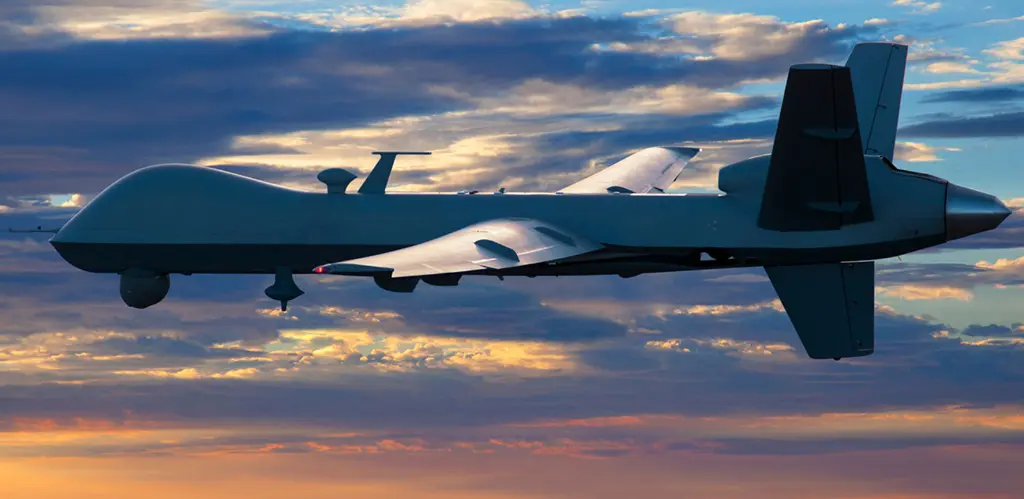
Drones, or Unmanned Aerial Vehicles (UAVs), have evolved from surveillance tools to frontline weapons.
- Reconnaissance drones (e.g., MQ-9 Reaper) provide real-time battlefield intelligence.
- Loitering munitions (e.g., Switchblade, Lancet) hover over battlefields and strike on command.
- Combat UAVs (e.g., Bayraktar TB2) carry missiles and destroy tanks, radars, and even jets.
In the 2020 Nagorno-Karabakh war, Azerbaijani forces used Turkish drones to destroy over $1 billion in Armenian air defenses and armor—with minimal losses.
This shift has proven that cheap, smart drones can challenge expensive, high-end systems.
Strengths of Fighter Jets
Despite drone advances, fighter jets remain unmatched in several key areas:
- Speed and altitude: Jets like the F-22 and Su-35 fly at Mach 2+ and operate above 50,000 feet.
- Air superiority: Designed to dominate the skies in high-intensity combat.
- Payload and range: Can carry multiple missiles, bombs, and fuel for long missions.
- Sensor fusion and stealth: The F-35 integrates radar, infrared, and electronic data in real time.
Fighter jets are still the only platforms capable of securing airspace against other advanced aircraft.
Example: In Israel’s 2024 strikes on Iran, F-35s penetrated deep into enemy airspace thanks to stealth and electronic warfare—something current drones cannot replicate.
How Drones Are Changing Combat
Drones are redefining warfare by offering persistent presence, low risk, and high cost-efficiency.
- Swarm attacks: Dozens of small drones can overwhelm air defenses.
- Kamikaze missions: Loitering drones like the Shahed-136 fly for hours before diving into targets.
- Battlefield surveillance: Drones provide 24/7 monitoring, guiding artillery and jets.
In Ukraine, both sides use drones for:
- Targeting enemy positions
- Destroying supply lines
- Shooting down helicopters and jets
Fact: Over 90% of artillery fire in Ukraine is directed by drone footage.
Key Differences: Cost, Risk, and Capability
| Factor | Drones | Fighter Jets |
|---|---|---|
| Cost | $10,000–$5 million | $80–$150+ million |
| Pilot Risk | None (remote control) | High (pilot onboard) |
| Flight Time | Hours to days (some) | 1–4 hours typical |
| Speed | Subsonic (mostly) | Supersonic capable |
| Stealth | Limited (small radar signature) | Advanced (F-35, B-21) |
| Payload | Light to medium | Heavy (multiple weapons) |
While drones win on cost and persistence, jets dominate in speed, survivability, and firepower.
When Drones Win—and When Jets Still Rule
✅ Drones dominate when:
- Conducting surveillance in low-threat zones
- Attacking static targets (e.g., artillery, supply depots)
- Operating in swarms to saturate defenses
- Fighting in asymmetric conflicts (e.g., Ukraine, Gaza)
✅ Jets dominate when:
- Facing enemy fighters (air-to-air combat)
- Penetrating high-threat airspace with advanced SAMs
- Requiring speed and heavy payload delivery
- Flying in adverse weather or electronic warfare environments
Critical point: Drones struggle against integrated air defense systems like the S-400—while jets are built to survive them.
The Future: Manned-Unmanned Teaming
The real future isn’t drones vs. jets—it’s drones with jets.
Militaries are developing “loyal wingman” programs where:
- One pilot controls multiple drones from a fighter jet.
- Drones act as sensors, jammers, or missile carriers.
- Jets stay at a safe distance while drones enter high-risk zones.
Examples:
- U.S. Skyborg and MQ-28 Ghost Bat (Australia) are AI-powered drones designed to fly alongside F-35s.
- Russia and China are testing similar systems.
This teaming multiplies combat power: one jet + four drones = a flying combat network.
Conclusion: Coexistence, Not Replacement
Drones are not replacing fighter jets—they’re transforming how they fight.
While drones excel in surveillance, attrition, and low-risk strikes, fighter jets remain essential for air dominance and high-intensity war.
The future belongs to hybrid air forces that combine the precision and persistence of drones with the power and speed of manned fighters.
Who dominates the sky? The side that best integrates both.
FAQ
Q: Can a drone shoot down a fighter jet?
A: Yes—via missile (e.g., Iranian drone hit an Israeli jet in 2021) or by guiding other weapons. But it’s rare in direct combat.
Q: Are drones more accurate than jets?
A: Often—drones can loiter and confirm targets before striking, reducing collateral damage.
Q: Will future wars be fought only by drones?
A: Unlikely. Human judgment, rapid decision-making, and electronic warfare still require manned platforms.
Q: What’s a “loyal wingman” drone?
A: An AI-controlled UAV that flies alongside a fighter jet, extending its sensors and weapons reach.
You may also be interested in:
Destacado: “The future of air combat isn’t man vs. machine—it’s man and machine, working as one.”
Previous Article
How Cruise Missiles Work: Guided Destruction from DistanceNext Article
The Rise of AI in Military Aviation