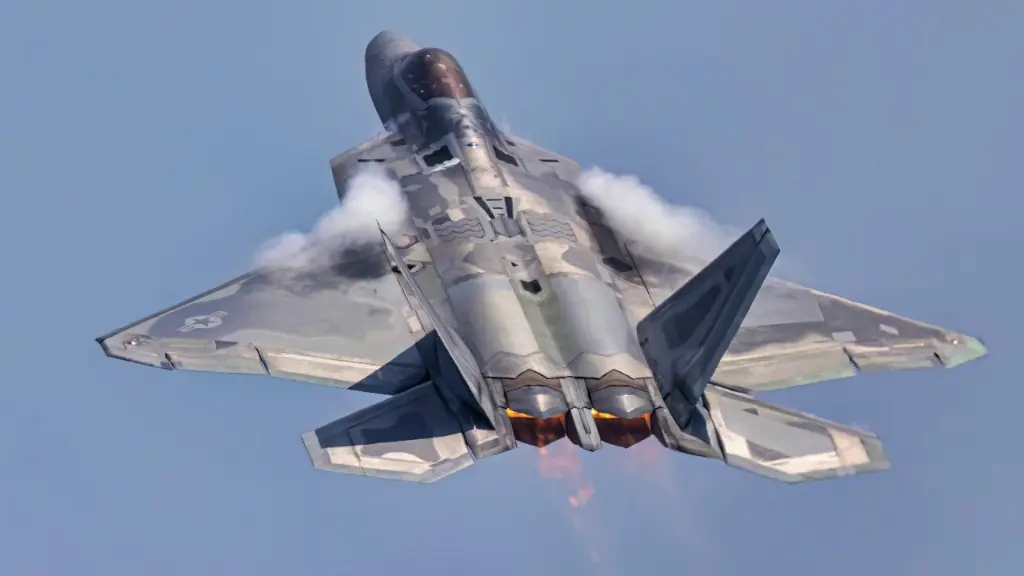
The F-22 Raptor is a fifth-generation stealth air superiority fighter developed by Lockheed Martin and Boeing for the U.S. Air Force. First flown in 1997 and introduced in 2005, the F-22 combines stealth, speed, agility, and advanced avionics to dominate air combat. Its unique design and cutting-edge technology make it one of the most capable and advanced fighter aircraft in the world.
Fact Sheet
| Role | Stealth air superiority fighter |
|---|---|
| Manufacturer | Lockheed Martin / Boeing |
| First Flight | 1997 |
| Service Entry | 2005 |
| Crew | 1 |
Specifications
| Length | 18.9 m (62 ft) |
|---|---|
| Wingspan | 13.56 m (44.5 ft) |
| Height | 5.08 m (16.7 ft) |
| Empty Weight | 19,700 kg (43,430 lb) |
| Max Takeoff Weight | 38,000 kg (83,500 lb) |
| Powerplant | 2 × Pratt & Whitney F119-PW-100 turbofans |
| Thrust | 35,000 lbf (156 kN) per engine with afterburner |
| Max Speed | Mach 2.25 (2,414 km/h; 1,500 mph) |
| Service Ceiling | 20,000 m (65,000 ft) |
| Range | 1,864 mi (3,000 km) ferry range |
| Rate of Climb | ~62,000 ft/min (315 m/s) |
Avionics & Armament
| Main Radar | AN/APG-77 AESA radar |
|---|---|
| Avionics | Integrated avionics suite, advanced EW systems |
| Armament | One 20-mm M61A2 rotary cannon (480 rounds); Internal bays for: – 6 AIM-120 AMRAAMs and 2 AIM-9 Sidewinders – Optional JDAMs or SDBs for ground attack – External hardpoints for ferry tanks (non-stealth configuration) |
Notable Features
- Stealth technology for reduced radar cross-section.
- Supercruise capability for sustained supersonic flight without afterburners.
- Thrust vectoring for unmatched agility.
- Advanced avionics for superior situational awareness.
- Limited production run (187 units) due to high costs and export restrictions.
The Apex Predator of the Skies: Unveiling the Lockheed Martin F-22 Raptor
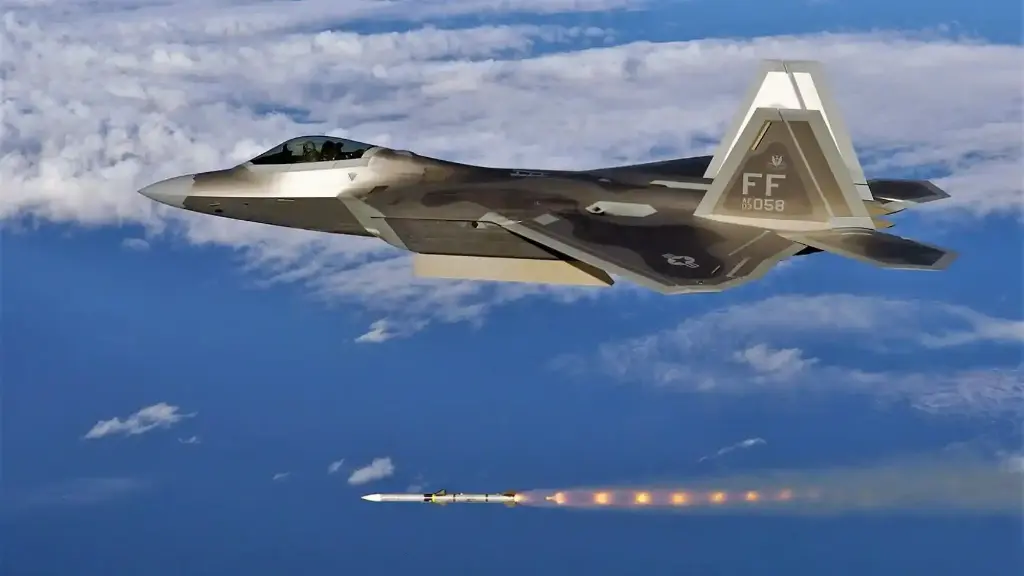
Imagine a fighter jet that can vanish from radar, fly faster than the speed of sound without using fuel-guzzling afterburners, and outmaneuver virtually any other aircraft in the sky. That’s not a scene from a science fiction movie; it’s the reality of the Lockheed Martin F-22 Raptor. This incredible machine is widely considered one of the most advanced and capable fighter aircraft ever built, setting a new standard for air superiority.
Let’s take a closer look at what makes the F-22 Raptor a true marvel of modern engineering and an undisputed apex predator in the realm of aerial combat.
Born from a Need: The F-22’s Genesis
The story of the F-22 began in the early 1980s. The United States Air Force (USAF) recognized the need for a new air superiority fighter to replace its aging F-15 Eagles. They envisioned an aircraft that could dominate future battlefields, especially against emerging threats from advanced Soviet designs. This led to the Advanced Tactical Fighter (ATF) program.
After a rigorous competition between two prototypes, the YF-22 (developed by Lockheed Martin, Boeing, and General Dynamics) emerged victorious in 1991. The development process was long and complex, involving thousands of hours of testing and refinement. Finally, in 2005, the F-22 Raptor officially entered service with the USAF, marking the dawn of the fifth generation of fighter aircraft.
What Makes it “Fifth Generation”? The Raptor’s Core Strengths
The F-22 Raptor isn’t just an upgrade; it’s a revolutionary leap. Its “fifth-generation” status comes from a unique combination of advanced features, working together seamlessly to give it an unparalleled advantage:
- Stealth Technology: This is perhaps the F-22’s most famous characteristic. The Raptor is designed to be incredibly difficult to detect by enemy radar. Its unique shape, with carefully aligned edges and continuously curving surfaces, deflects radar waves away from the source. Special radar-absorbent materials (RAM) are also applied to its exterior, which absorb incoming radar energy rather than reflecting it. Even its internal components and engine faces are hidden or designed to minimize radar signature. This makes the F-22 virtually invisible to most conventional radar systems, allowing it to get close to threats without being detected.
- Supercruise: Unlike older jets that need to use their “afterburners” (which guzzle fuel) to go supersonic, the F-22 can fly at supersonic speeds (greater than Mach 1.5, or about 1,100 mph) without engaging its afterburners. This ability, called supercruise, is thanks to its powerful Pratt & Whitney F119-PW-100 turbofan engines. Supercruise gives the F-22 a huge advantage in terms of range, speed, and fuel efficiency, allowing it to quickly reach distant targets or evade threats without running out of gas.
- Supermaneuverability: The F-22 is incredibly agile. Its powerful engines feature thrust vectoring nozzles, which means the engine exhaust can be directed up or down. This, combined with advanced aerodynamic design and a sophisticated fly-by-wire flight control system, allows the Raptor to perform breathtaking maneuvers that would be impossible for older aircraft. It can turn incredibly tightly and maintain control even at very high angles of attack, giving it a significant edge in close-range combat (though its stealth often means it never gets into a “dogfight” in the first place!).
- Integrated Avionics (Sensor Fusion): Imagine all of an aircraft’s sensors – radar, electronic warfare systems, communications – working together as one super-smart system. That’s sensor fusion. The F-22’s advanced computers combine data from all its sensors, presenting the pilot with a crystal-clear and comprehensive picture of the battlefield. This dramatically improves the pilot’s situational awareness, allowing them to “see” threats and make decisions faster than any opponent. It means the F-22 can track, identify, and engage targets long before it’s even detected.
More Than Just Air-to-Air: A Multi-Role Marvel
While designed primarily for air superiority, the F-22 is a versatile multi-role fighter. It can carry its weapons internally in special bays, which helps maintain its stealthy profile.
- Air-to-Air Armaments: For aerial combat, the F-22 typically carries a mix of AIM-120 AMRAAM missiles (for long-range engagements) and AIM-9 Sidewinder missiles (for closer-range encounters). It also has an internal 20mm M61A2 Gatling gun for last-resort dogfights, though its stealth often negates the need for close-in combat.
- Air-to-Ground Capabilities: The Raptor can also perform precision ground attack missions. It can carry Joint Direct Attack Munitions (JDAMs), which are GPS-guided bombs, and is capable of deploying Small Diameter Bombs (SDBs). This versatility means the F-22 can clear the skies and then support ground forces, making it a powerful asset in any conflict.
Cost and Exclusivity: A Unique Aircraft
The F-22 Raptor is incredibly complex and technologically advanced, which also makes it incredibly expensive. Each F-22 had a “flyaway cost” of around $143 million, and when considering all the research and development, the total cost per aircraft is estimated to be around $350 million. Due to these high costs and shifting defense priorities after the Cold War, the production run was significantly cut short. Only 195 F-22s were built in total (including test aircraft), with 187 delivered to the USAF.
Crucially, the United States has never exported the F-22 to any other country. This decision was made to protect its highly classified stealth technology and advanced systems, ensuring that the U.S. maintains a significant technological advantage. Therefore, the United States Air Force remains the sole operator of this incredible aircraft.
Operational Status and Future
As of mid-2025, the F-22 Raptor fleet continues to be a cornerstone of the USAF’s air superiority capabilities. Of the 187 Raptors delivered, at least five have been lost in accidents, leaving approximately 183 airframes. However, it’s important to note that about 32 of these are older “Block 20” training variants that are not combat-capable without significant upgrades. While the exact number of combat-ready Raptors is classified, estimates suggest it’s considerably lower, possibly around 150 combat-capable F-22s in service.
The F-22 has an impressive record in training exercises, famously achieving a 108-to-zero “kill” ratio against older F-15, F-16, and F/A-18 jets in Exercise Northern Edge 2006. While it hasn’t seen extensive air-to-air combat against peer adversaries, it has been deployed in ground attack roles, dropping bombs on targets in Syria during Operation Inherent Resolve.
Despite its age, the F-22 is still considered the best air dominance fighter in the world. The USAF is committed to keeping the remaining fleet highly capable. Current and planned modernization efforts include upgrades to its radar, new stealth coatings, and potentially even integrating advanced weapon systems like laser weapons for self-defense against missiles and drones.
However, the F-22 production line has been shut down and repurposed for the F-35 program, making it nearly impossible to build new Raptors. The future of air superiority for the U.S. lies in the development of the Next Generation Air Dominance (NGAD) program, which aims to produce a sixth-generation fighter (sometimes referred to as the F-47) to eventually succeed the F-22 in the 2030s.
The F-22 Raptor isn’t just a machine; it’s a symbol of cutting-edge aerospace engineering and a testament to the pursuit of air dominance. It redefined what a fighter jet could be and continues to inspire awe and respect in the world of military aviation.
Previous Article
F-16 Fighting FalconNext Article
F-15 Eagle