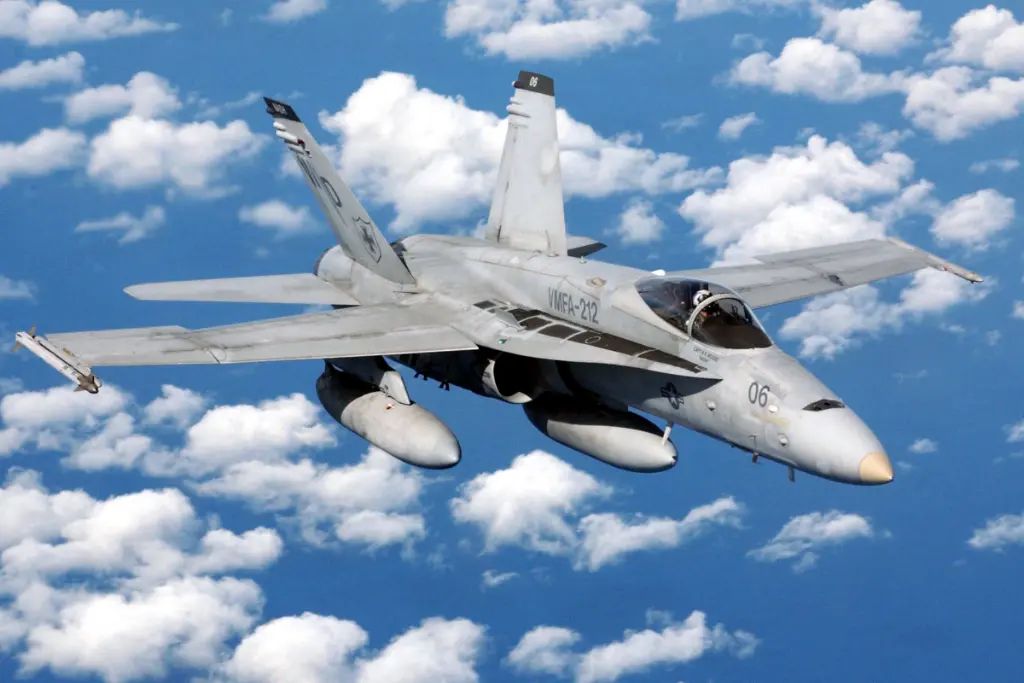
The F/A-18 Hornet is a twin-engine, multirole fighter aircraft developed by McDonnell Douglas (now Boeing) and Northrop. Introduced in 1983, the Hornet is capable of performing air superiority, ground attack, and reconnaissance missions. Its versatility, reliability, and carrier-based capability have made it a key asset for the U.S. Navy, Marine Corps, and allied nations.
Fact Sheet
| Role | Multirole fighter |
|---|---|
| Manufacturer | McDonnell Douglas / Northrop |
| First Flight | 1978 |
| Service Entry | 1983 |
| Crew | 1 (F/A-18A/C) or 2 (F/A-18B/D) |
Specifications
| Length | 17.1 m (56 ft) |
|---|---|
| Wingspan | 11.43 m (37.5 ft) |
| Height | 4.66 m (15.3 ft) |
| Empty Weight | 10,455 kg (23,050 lb) |
| Max Takeoff Weight | 23,541 kg (51,900 lb) |
| Powerplant | 2 × General Electric F404-GE-402 turbofans |
| Thrust | 17,700 lbf (79 kN) per engine |
| Max Speed | Mach 1.8 (1,915 km/h; 1,190 mph) |
| Service Ceiling | 15,240 m (50,000 ft) |
| Range | 1,253 mi (2,016 km) combat radius |
| Rate of Climb | ~50,000 ft/min (254 m/s) |
Avionics & Armament
| Main Radar | AN/APG-65 or AN/APG-73 radar |
|---|---|
| Avionics | Advanced avionics suite, targeting pods |
| Armament | One 20-mm M61A1 rotary cannon (570 rounds); Up to 9 external hardpoints for: – Air-to-air missiles (AIM-7, AIM-9, AIM-120) – Air-to-ground munitions (JDAMs, rockets, bombs) – External fuel tanks – Electronic warfare pods |
Notable Features
- Carrier-capable with folding wings for storage on aircraft carriers.
- Multirole capability for air-to-air and air-to-ground missions.
- Proven combat record in multiple conflicts.
- Advanced avionics for superior situational awareness.
- Widely used by the U.S. Navy, Marine Corps, and allied nations.
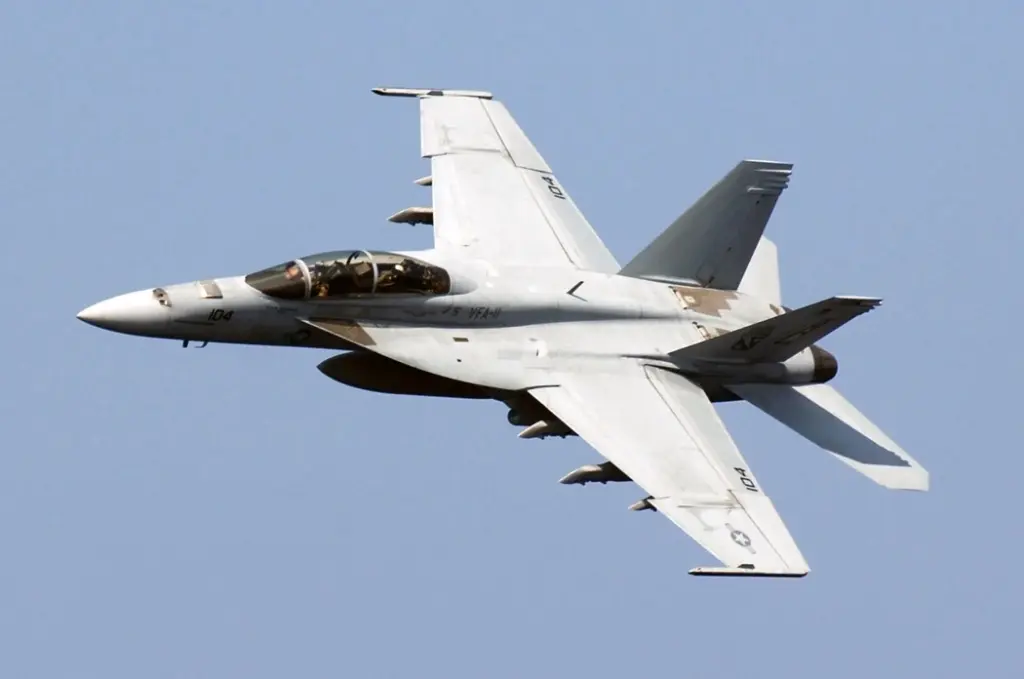
In the world of naval aviation, there are few aircraft as recognizable or as vital as the McDonnell Douglas (now Boeing) F/A-18 Hornet. This twin-engine, multi-role fighter has been the backbone of U.S. Navy and Marine Corps aviation for decades, a truly versatile machine capable of handling both air-to-air combat and air-to-ground strike missions with remarkable agility and effectiveness.
While often confused with its larger, more modern successor, the F/A-18E/F Super Hornet, the original “Legacy” Hornet (F/A-18A/B/C/D) holds its own significant place in history as a highly successful design that revolutionized how naval air wings operated.
From Lightweight Fighter to Naval Workhorse: The Hornet’s Journey
The F/A-18 Hornet’s story begins in the 1970s, stemming from the U.S. Navy’s need for a new fighter to replace its aging F-4 Phantoms and A-7 Corsairs. Interestingly, its roots are tied to the same “Lightweight Fighter” program that produced the F-16. The YF-17 Cobra, designed by Northrop, competed against the YF-16. While the YF-16 became the F-16 Fighting Falcon, the YF-17’s design was chosen by the Navy, which partnered with McDonnell Douglas to develop a version specifically adapted for demanding aircraft carrier operations.
The result was the F/A-18 Hornet, with its first flight in November 1978. It officially entered service with the U.S. Marine Corps in 1983 and the U.S. Navy in 1984. Its unique “F/A” designation truly reflected its dual role as a Fighter and Attack aircraft.
Built for the Bounding Main: Key Features
The Hornet’s design was meticulously crafted for the unique challenges of carrier-based aviation:
- Twin-Engine Reliability: Operating over vast oceans, the F/A-18’s twin General Electric F404 turbofan engines provide a crucial safety net. If one engine fails, the other can still bring the aircraft home. These engines also deliver significant power, allowing for excellent acceleration and maneuverability.
- Robust Carrier Design: Every part of the F/A-18, from its stronger landing gear to its arresting hook and folding wings, is built to endure the tremendous stresses of repeated catapult launches and arrested landings on an aircraft carrier.
- Excellent Maneuverability: The Hornet is known for its agility in the air. Its design, including the distinctive leading-edge extensions (LERX), helps generate extra lift and allows the aircraft to maintain control even at very high angles of attack, making it a formidable opponent in dogfights.
- Digital Fly-by-Wire: Early Hornets incorporated advanced digital fly-by-wire flight control systems. This meant that pilot inputs were translated by computers into precise commands for the flight control surfaces, making the aircraft easier to fly and more responsive than older mechanical systems.
- Multi-Function Displays: The F/A-18’s cockpit was ahead of its time, featuring multi-function displays (MFDs) that could show a variety of information (radar, maps, weapons status) on demand. This allowed pilots to process more information and manage their missions more effectively.
A True Multi-Role Master: What the Hornet Can Do
The F/A-18 Hornet truly lived up to its “F/A” designation, proving its versatility in combat from day one:
- Air-to-Air Combat: As a fighter, the Hornet could carry a mix of AIM-9 Sidewinder (infrared-guided, for close-range) and AIM-7 Sparrow (radar-guided, for medium-range) air-to-air missiles. Later C/D models integrated the more advanced AIM-120 AMRAAM missile for beyond-visual-range engagements. It also features an internal 20mm M61A1 Vulcan cannon for close-in encounters.
- Air-to-Ground Attack: As an attack aircraft, the Hornet could deliver a wide range of ordnance, including various unguided bombs, cluster bombs, and precision-guided munitions like laser-guided bombs (Paveway series) and AGM-65 Maverick missiles for anti-armor and ground attack. It could also carry AGM-84 Harpoon anti-ship missiles and AGM-88 HARM anti-radiation missiles for suppressing enemy air defenses.
- Reconnaissance and Electronic Warfare: With specialized pods, the F/A-18 could also perform tactical reconnaissance and rudimentary electronic warfare missions, adding to its flexibility.
A Storied Combat History
The F/A-18 Hornet has seen extensive combat across the globe, proving its mettle in numerous conflicts:
- Operation El Dorado Canyon (1986): F/A-18s participated in the air strikes against Libya, marking their first combat action.
- Operation Desert Storm (1991): This conflict was a showcase for the Hornet’s versatility. F/A-18s famously engaged and shot down two Iraqi MiG-21s in a single mission, then continued on to deliver their bombs on ground targets, demonstrating the “swing-role” capability in action.
- Operations in the Balkans (1990s): Hornets were active in operations over Bosnia and Kosovo, conducting strike and close air support missions.
- Operations in Afghanistan and Iraq (2000s onwards): The F/A-18 continued to be a workhorse, providing crucial air support and precision strike capabilities to ground forces.
The F/A-18 Hornet has consistently shown high reliability and combat effectiveness throughout its career.
Who Still Flies the Hornet?
While the U.S. Navy has largely transitioned to the larger and more capable F/A-18E/F Super Hornet, some U.S. Marine Corps squadrons still operate the F/A-18C/D Hornet, with plans for them to continue service until the early 2030s as the F-35B replacement slowly comes online.
Internationally, the F/A-18 Hornet remains a significant asset for several air forces around the world, often serving as their primary fighter:
- Australia (Royal Australian Air Force – RAAF): The RAAF was a major early export customer for the Hornet, operating both A and B models. They are now transitioning to the F-35A.
- Canada (Royal Canadian Air Force – RCAF): Operating the CF-18 Hornet (a Canadian variant), these aircraft are undergoing upgrades to extend their service life.
- Finland: The Finnish Air Force operates a fleet of F/A-18C/D Hornets, which are also being replaced by F-35As.
- Kuwait: Operates F/A-18C/D Hornets.
- Malaysia: Operates a small fleet of F/A-18D Hornets.
- Spain (Spanish Air and Space Force): Maintains a large fleet of EF-18 Hornets (Spanish designation).
- Switzerland: Operates a fleet of F/A-18C/D Hornets.
- Blue Angels: The famous U.S. Navy Flight Demonstration Squadron, the Blue Angels, proudly flew the F/A-18 Hornet for decades before transitioning to the larger F/A-18 Super Hornet in recent years.
The F/A-18 Hornet stands as a testament to successful aircraft design. Its adaptability, proven combat record, and long service life have made it a true legend, shaping naval aviation for generations and continuing to fly in the skies of many nations today.
Previous Article
Sukhoi Su-57Next Article
F-14 Tomcat