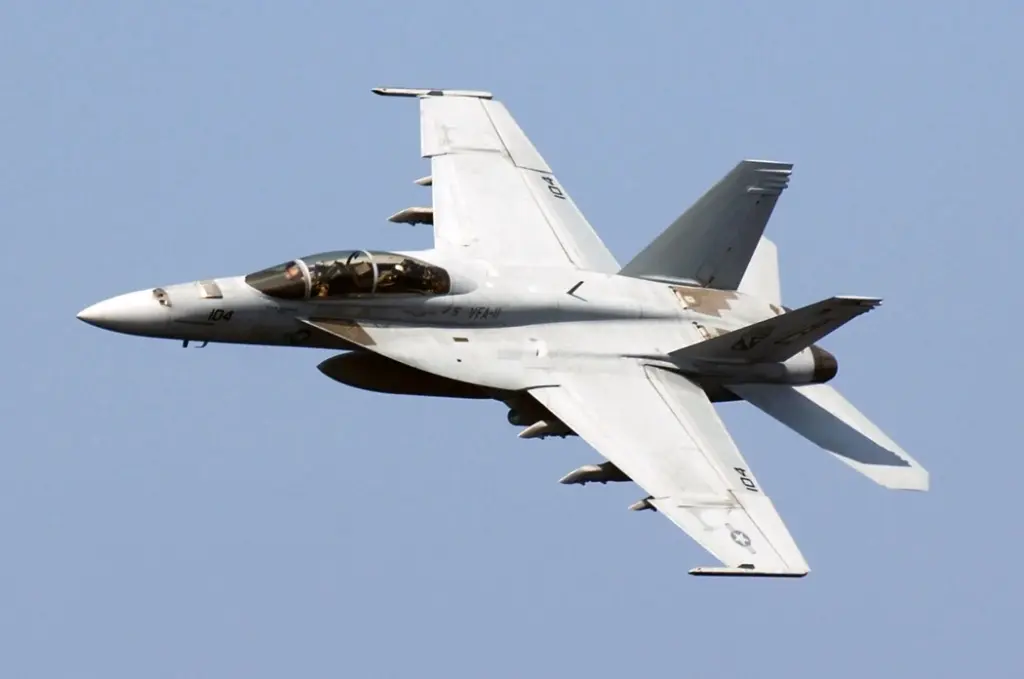
The F/A-18E/F Super Hornet is a twin-engine, carrier-capable multirole fighter aircraft developed by Boeing for the U.S. Navy. Introduced in 1999, the Super Hornet is an upgraded and larger version of the original F/A-18 Hornet, featuring increased range, payload capacity, and advanced avionics. It is capable of performing air superiority, ground attack, reconnaissance, and electronic warfare missions, making it a versatile platform for modern naval operations.
Fact Sheet
| Role | Carrier-based multirole fighter |
|---|---|
| Manufacturer | Boeing |
| First Flight | 1995 |
| Service Entry | 1999 |
| Crew | 1 (F/A-18E) or 2 (F/A-18F) |
Specifications
| Length | 18.31 m (60 ft 1 in) |
|---|---|
| Wingspan | 13.62 m (44 ft 8 in) |
| Height | 4.88 m (16 ft) |
| Empty Weight | 14,552 kg (32,100 lb) |
| Max Takeoff Weight | 29,937 kg (66,000 lb) |
| Powerplant | 2 × General Electric F414-GE-400 turbofans |
| Thrust | 22,000 lbf (98 kN) per engine with afterburner |
| Max Speed | Mach 1.8 (1,915 km/h; 1,190 mph) |
| Service Ceiling | 15,240 m (50,000 ft) |
| Range | 1,275 mi (2,055 km) combat radius |
| Rate of Climb | ~44,882 ft/min (228 m/s) |
Avionics & Armament
| Main Radar | AN/APG-79 AESA radar |
|---|---|
| Avionics | Advanced targeting pods, electronic warfare systems |
| Armament | One 20-mm M61A2 rotary cannon (578 rounds); Up to 11 external hardpoints for: – Air-to-air missiles (AIM-9, AIM-120) – Air-to-ground munitions (JDAMs, SDBs, Harpoon) – Electronic warfare pods – External fuel tanks |
Notable Features
- Carrier-capable with folding wings for storage on aircraft carriers.
- Multirole capability for air-to-air and air-to-ground missions.
- Advanced avionics for superior situational awareness and targeting.
- Increased range and payload compared to the original F/A-18 Hornet.
- Widely used by the U.S. Navy and allied nations.
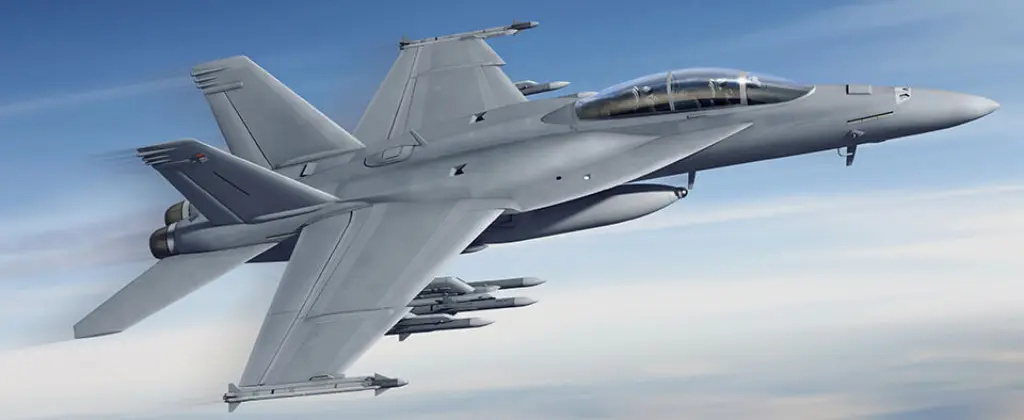
The Backbone of the Fleet: Understanding the F/A-18E/F Super Hornet
When you see a powerful jet launching from the deck of a U.S. Navy aircraft carrier, chances are you’re looking at the Boeing F/A-18E/F Super Hornet. This remarkable aircraft is the workhorse of carrier air wings, a true multi-role fighter designed to excel in everything from intense air combat to precision strikes against ground targets. It’s bigger, more powerful, and more capable than its predecessor, the “Legacy” F/A-18 Hornet, earning it the nickname “Rhino” among pilots.
Let’s explore the key features and capabilities that make the F/A-18E/F Super Hornet so vital to naval aviation today.
Evolution of a Legend: From Hornet to Super Hornet
The Super Hornet’s story is one of continuous improvement. In the 1980s, the F/A-18 Hornet (the A/B/C/D variants) proved to be an excellent and versatile fighter for the U.S. Navy and Marine Corps. However, as threats evolved and the Navy looked to replace its aging F-14 Tomcat interceptors and A-6 Intruder attack aircraft, a more capable platform was needed.
This led to the development of the F/A-18E/F Super Hornet in the 1990s. While it looks similar to the original Hornet, it’s essentially a new aircraft. The Super Hornet is about 20% larger with a longer fuselage and a larger wing area, allowing it to carry more fuel and weapons. It also features more powerful engines and an updated airframe, all designed to enhance its range, endurance, and payload capacity. The single-seat version is the F/A-18E, and the two-seat version (which includes a Weapon Systems Officer, or WSO, to help manage complex missions) is the F/A-18F. The first Super Hornets entered service with the U.S. Navy in 1999.
Built for the Carrier: Robust Design and Reliability
Operating from an aircraft carrier is one of the most demanding environments for any aircraft. The Super Hornet is engineered to withstand these extreme stresses:
- Twin Engines: The Super Hornet is powered by two reliable General Electric F414 turbofan engines. Having two engines provides an extra layer of safety, especially over vast stretches of ocean, and also contributes to its impressive thrust and speed (up to Mach 1.8).
- Strong Airframe: The Super Hornet’s structure is built tough to handle the repeated, jarring forces of catapult launches and arrested landings on a carrier deck. Its robust design is crucial for enduring the thousands of operational cycles it will experience over its lifespan.
- Exceptional Agility: Despite its larger size, the Super Hornet maintains excellent maneuverability thanks to its aerodynamic design, including prominent leading-edge extensions (LERX), which help generate lift at high angles of attack, and a digital fly-by-wire system for precise control. This agility is key in both air-to-air combat and for precise ground attacks.
The Ultimate Multi-Mission Machine: “Strike Fighter” Defined
The “F/A” in F/A-18 stands for Fighter/Attack, perfectly describing the Super Hornet’s core strength: its multi-role capability. It can seamlessly switch between air-to-air and air-to-ground missions, making it incredibly versatile:
- Air Superiority and Fighter Escort: With its powerful AN/APG-79 Active Electronically Scanned Array (AESA) radar, the Super Hornet can detect and track threats from long distances. It carries a mix of AIM-120 AMRAAM missiles for beyond-visual-range engagements and AIM-9X Sidewinder missiles for close-in combat. It also retains an internal 20mm M61A2 rotary cannon.
- Precision Strike and Close Air Support: The Super Hornet can carry a massive payload of up to 8,051 kg (17,750 lbs) across its 11 hardpoints. This includes a wide array of precision-guided munitions like JDAMs (Joint Direct Attack Munitions) and Paveway laser-guided bombs, as well as various air-to-surface missiles such as the AGM-65 Maverick and AGM-88 HARM (for taking out enemy radar). This allows it to support ground troops and hit specific targets with high accuracy.
- Reconnaissance and Electronic Warfare: Equipped with advanced sensor pods, the Super Hornet can gather crucial intelligence on enemy positions. Its close cousin, the EA-18G Growler, is a dedicated electronic warfare variant that can jam enemy communications and radar, making it harder for adversaries to fight back.
- Aerial Tanking: In a unique role, the F/A-18F two-seater can even be configured as an aerial refueling tanker, carrying external fuel tanks and a “buddy store” pod to refuel other aircraft mid-flight. This significantly extends the range of the carrier air wing.
The Latest and Greatest: Block III Super Hornet
The F/A-18E/F isn’t standing still; it’s constantly being upgraded. The latest version, the Block III Super Hornet, brings significant enhancements:
- Advanced Cockpit System: Features a large, touchscreen display (Large Area Display – LAD) that replaces multiple smaller screens, giving the pilot a more intuitive and comprehensive view of mission data and the battlefield.
- Conformal Fuel Tanks (CFTs): These sleeker fuel tanks fit snugly against the fuselage, adding more fuel capacity without taking up weapon stations under the wings. This boosts the Super Hornet’s range and endurance without increasing drag as much as traditional external tanks.
- Enhanced Networking (TTNT): Improved data links and computing power, including the Distributed Targeting Processor-Networked (DTP-N), allow for faster and more secure sharing of information with other aircraft and ground forces, boosting situational awareness for everyone involved.
- Reduced Radar Cross-Section (RCS): While not a full stealth aircraft like the F-35, the Block III incorporates features to further reduce its detectability by enemy radar, enhancing its survivability in contested environments.
- Extended Service Life: Structural enhancements mean the Block III Super Hornet is designed for a service life of 10,000 flight hours, ensuring it remains a viable platform for many more years.
A Global Presence and Proven Combat Record
The F/A-18E/F Super Hornet is a key component of the U.S. Navy’s carrier air wings, forming the backbone of their strike and air defense capabilities. It has also been exported to several close allies:
- Royal Australian Air Force (RAAF)
- Kuwait Air Force
The Super Hornet has an extensive combat record, participating in numerous operations since its introduction, including:
- Operation Iraqi Freedom (Iraq)
- Operation Enduring Freedom (Afghanistan)
- Operation Inherent Resolve (Iraq and Syria)
It has successfully conducted countless strike missions, provided close air support, and famously achieved an air-to-air kill against a Syrian Su-22 in 2017. Its reliability and versatility make it a trusted platform in real-world combat scenarios.
With a unit flyaway cost for newer Block III models reportedly around $66-70 million USD, the Super Hornet offers a robust and adaptable solution for air forces looking for advanced capabilities without the higher price tag or stricter export controls of stealth-focused fifth-generation aircraft.
The F/A-18E/F Super Hornet continues to evolve, proving its worth as a highly capable, adaptable, and essential part of modern naval aviation. It’s truly a testament to engineering excellence, ready to tackle the challenges of today and tomorrow’s skies.
Previous Article
F-35 Lightning IINext Article
FC-31 J-31 Gyrfalcon