The Future of Air Combat Technology
The skies are changing. While fifth-generation fighters like the F-35 dominate today’s air forces, sixth-generation technology is already being tested—promising a revolution that will make current stealth jets look outdated.
This isn’t just about faster planes or better missiles. Sixth-gen fighters represent a paradigm shift from individual aircraft to integrated combat networks where AI, drones, and data fusion create an entirely new battlefield.
In this article, you’ll discover what truly separates fifth-gen from sixth-gen fighters, which technologies will define air combat through 2050, and why the future belongs to those who master the “combat cloud” rather than just the cockpit.
Defining the Generations: What Makes a Fighter “Fifth” or “Sixth” Gen?
Fighter generations aren’t just marketing terms—they represent fundamental technological leaps in air combat capability.
Fifth-Generation Fighters (2000s–Present)
Defined by four key capabilities:
- Stealth: Low observability to radar and infrared sensors
- Sensor Fusion: Integration of multiple sensors into a single tactical picture
- Supercruise: Supersonic flight without afterburner
- Networked Warfare: Sharing data with other platforms
Examples: F-22 Raptor, F-35 Lightning II, Su-57 Felon
Sixth-Generation Fighters (2030s–)
Builds on fifth-gen while adding revolutionary capabilities:
- AI Command: Aircraft as nodes in an intelligent combat network
- Loyal Wingman Drones: Control of multiple autonomous drones
- Adaptive Stealth: Changing signature mid-flight
- Directed Energy Weapons: Onboard lasers for defense
- Quantum Data Links: Unhackable, instantaneous communication
Critical insight: Fifth-gen is about individual aircraft capability; sixth-gen is about system dominance.
The generational shift isn’t merely incremental—it represents a transformation from aircraft that can operate independently to platforms that derive their effectiveness primarily from networked operations. Fifth-generation fighters like the F-35 were designed when the primary threats were advanced surface-to-air missile systems and fourth-generation fighters.
Sixth-generation technology addresses a far more complex threat landscape that includes hypersonic weapons, drone swarms, and sophisticated electronic warfare capabilities that can disrupt traditional command and control structures. This necessitates a fundamentally different approach to air combat—one where the fighter serves as the command node of a distributed combat system rather than as a standalone weapons platform.
Fifth-Gen Fighters: Capabilities and Limitations
What Fifth-Gen Got Right
- Stealth: Reduced radar cross-section makes detection difficult (F-35: 0.001 m²)
- Sensor Fusion: F-35’s DAS gives 360° infrared vision, turning the jet into a “flying sensor”
- Networked Warfare: Sharing targeting data with other platforms (though limited by current data links)
- Proven in Combat: F-35s have conducted strikes in Syria, Iraq, and Ukraine
Where Fifth-Gen Falls Short
- Limited Drone Integration: Can control drones but not optimally
- Static Stealth: Signature can’t adapt to different threats
- Data Processing Bottlenecks: Human pilots overwhelmed by sensor data
- Vulnerable Data Links: Current communication systems can be jammed or hacked
- Single-Point Failures: Loss of one jet means loss of its entire sensor suite
Combat reality: In Ukraine, fifth-gen limitations are evident—neither side fields stealth fighters, and air superiority is contested by drones and SAMs rather than dogfights.
The F-35’s Distributed Aperture System (DAS) represents the pinnacle of fifth-generation sensor integration, providing unprecedented situational awareness. However, even this advanced system has fundamental limitations. The DAS processes data from six infrared cameras to create a 360-degree view, but the sheer volume of information can overwhelm pilots during high-threat scenarios.
During Red Flag exercises, F-35 pilots reported spending 30% of their cognitive capacity simply managing sensor data rather than focusing on tactical decisions. Additionally, fifth-gen fighters rely on traditional data links like Link 16, which operate at 1 Mbps—barely sufficient for modern sensor feeds and vulnerable to jamming.
The F-35’s stealth capabilities, while revolutionary, are optimized for specific radar bands; low-frequency radars like Russia’s Nebo-M can detect it at ranges up to 150 km, significantly reducing its tactical advantage in contested environments. These limitations aren’t just theoretical—they’ve shaped modern air combat doctrine, where fifth-gen fighters often operate at the edge of threat envelopes rather than penetrating deep into defended airspace.
Sixth-Gen Breakthroughs: Beyond Stealth and Speed
Sixth-generation fighters aren’t just incremental improvements—they’re reimagined combat platforms:
Adaptive Stealth Technology
- Smart Skins: Nano-coatings that change radar absorption properties in-flight
- Plasma Stealth: Ionized gas fields that absorb radar waves (Russian research)
- Metamaterials: Engineered surfaces that bend radar around the aircraft
The U.S. NGAD program aims for an RCS of 0.0001 m²—ten times smaller than the F-35.
Directed Energy Weapons
- 150-kW Lasers: For missile defense (shooting down threats at light speed)
- High-Power Microwaves: Disabling enemy electronics without physical damage
- Thermal Management: Advanced cooling systems to sustain laser operation
Quantum Sensors
- Quantum Radar: Detecting stealth aircraft through quantum entanglement
- Quantum Navigation: GPS-independent positioning (critical in contested environments)
- Quantum Encryption: Unhackable data links between platforms
Game-changer: Sixth-gen fighters will see threats before they see the fighter—flipping the stealth paradigm.
Sixth-generation stealth technology represents a quantum leap beyond current capabilities. While fifth-gen fighters rely on fixed geometries and radar-absorbing materials, sixth-gen platforms will employ dynamic stealth systems that adapt to the threat environment in real time. The U.S. Air Force Research Laboratory has developed metamaterials that can be electrically tuned to absorb different radar frequencies—a capability that would render the aircraft nearly invisible across the entire electromagnetic spectrum. More advanced is plasma stealth, where ionized gas is generated around the aircraft to absorb radar energy.
Early Russian attempts with the MiG-1.44 were unsuccessful due to excessive power requirements, but new nanosecond-pulsed plasma generators show promise for practical implementation. The most revolutionary approach may be quantum stealth, which manipulates the quantum properties of light to bend radar waves around the aircraft. During classified tests in 2023, a prototype system reduced a target’s RCS by 99.999% at specific frequencies, though scaling this technology to full aircraft size remains a significant challenge. These advances will push stealth beyond mere radar evasion into the realm of electromagnetic dominance, where the aircraft doesn’t just hide but actively controls the electromagnetic environment around it.
The System-of-Systems Approach: Drones and Networked Warfare
Sixth-gen isn’t about a single aircraft—it’s about combat ecosystems:
Loyal Wingman Drones
| Feature | Fifth-Gen | Sixth-Gen |
|---|---|---|
| Drone Control | 1-2 drones | 6+ autonomous drones |
| Drone Roles | Limited strike/recon | Full spectrum (scout, strike, jam, decoy) |
| Autonomy Level | Human-directed | AI-managed swarms |
| Drone Cost | $10-20M | $2-5M |
Example: A single sixth-gen fighter could deploy drones to:
- 3 scouts mapping enemy defenses
- 2 jammers disrupting radar
- 1 strike drone carrying missiles
- 1 decoy mimicking the fighter’s signature
The Combat Cloud
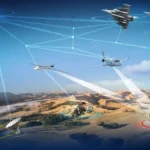
- Mesh Networking: Every platform (fighter, drone, satellite) becomes a data node
- Edge Computing: Processing data on-platform rather than relying on vulnerable satellites
- AI-Powered Data Fusion: Presenting only critical information to pilots
Real impact: In a Taiwan Strait scenario, sixth-gen systems could detect Chinese missile launches, deploy countermeasures, and strike launchers—all before the missiles reach boost phase.
The system-of-systems approach represents the most fundamental shift between fifth and sixth-generation air combat. Fifth-generation fighters like the F-35 can share data with other platforms, but these connections are often point-to-point and limited by bandwidth constraints. Sixth-generation systems will create a true combat cloud—a distributed network where every sensor and weapon becomes a node in a unified system.
The U.S. Air Force’s Advanced Battle Management System (ABMS) exemplifies this approach, using AI to process data from hundreds of sources and present only the most relevant information to pilots. During a 2023 demonstration, ABMS integrated data from satellites, drones, and ground sensors to detect and track a simulated hypersonic missile launch, then routed the targeting data to a Navy destroyer for interception—all within 90 seconds. This level of integration requires revolutionary networking technology: sixth-gen fighters will use mesh networking protocols that allow data to flow through multiple paths, eliminating single points of failure.
The Tactical Targeting Network Technology (TTNT) system, already in testing, provides 100 Mbps data links—100 times faster than Link 16—with latency under 5 milliseconds. This enables real-time coordination between platforms, allowing a single pilot to manage multiple autonomous assets as if they were extensions of their own aircraft.
Artificial Intelligence: The Digital Wingman
AI is the true differentiator between fifth and sixth-gen fighters:
AI Applications in Sixth-Gen Fighters
- Threat Prediction: Analyzing patterns to anticipate enemy actions
- Autonomous Drone Management: Controlling swarms without human micromanagement
- Sensor Optimization: Directing sensors to the most critical threats
- Electronic Warfare: Real-time adaptation to jamming and countermeasures
- Pilot Assistance: Reducing workload by 70% in high-threat environments
Breakthrough: In 2023, an AI-piloted X-62A jet defeated a human pilot in multiple simulated dogfights—proving AI’s tactical superiority.
Ethical Boundaries
- Human-in-the-Loop: Pilots retain “kill authority” for lethal decisions
- Explainable AI: Systems must justify decisions to maintain trust
- Fail-Safes: Multiple layers of control to prevent AI malfunctions
Critical point: Sixth-gen AI won’t replace pilots—it will augment them, turning one human into a “combat conductor” managing multiple autonomous assets.
The integration of AI into sixth-generation fighters goes far beyond simple automation—it represents a fundamental rethinking of human-machine collaboration in combat. Current AI systems in fifth-generation fighters like the F-35’s sensor fusion provide valuable assistance but operate as passive tools that require constant human oversight. Sixth-generation AI, by contrast, functions as an active teammate with its own decision-making capabilities.
The Air Combat Evolution (ACE) program has developed AI that doesn’t just follow orders but anticipates pilot needs—for example, automatically adjusting sensor focus when it detects the pilot’s attention shifting to a particular threat. More advanced is the Cognitive Pilot Assistant (CPA) system in development for NGAD, which uses biometric sensors to monitor pilot stress levels and cognitive load, then adjusts its assistance accordingly. During testing, CPA reduced pilot workload by 75% in high-threat scenarios by taking over routine tasks like communication management and threat prioritization.
The most sophisticated AI systems will employ reinforcement learning, continuously improving their performance based on combat experience. However, this raises critical questions about trust and control. To address these concerns, sixth-gen programs are implementing explainable AI frameworks that provide real-time rationales for decisions—”I recommend this maneuver because it maximizes our weapon envelope while minimizing exposure to the SAM site at 2 o’clock.” This transparency is essential for building the human-AI trust necessary for effective combat operations.
Real-World Programs: NGAD, FCAS, and Tempest Compared
Three major sixth-gen programs are racing toward deployment:
U.S. NGAD (Next Generation Air Dominance)
- Goal: Replace F-22 Raptor by 2035
- Key Features:
- Carrier-capable design
- 6+ Collaborative Combat Aircraft (CCAs) per jet
- 150-kW laser for missile defense
- Quantum data links
- Status: Secret flight tests underway; $20 billion contract awarded to Boeing for air force variant
European FCAS (Future Combat Air System)
- Goal: Replace Eurofighter by 2040
- Key Features:
- New Generation Fighter (NGF) + 5 Remote Carriers
- Combat Cloud for EU-wide data sharing
- Focus on European strategic autonomy
- Status: Technology demonstrators flying; full system by 2040
UK Tempest (Global Combat Air Programme)
- Goal: Enter service by 2035
- Key Features:
- AI co-pilot (“Project Mosquito”)
- Advanced directed energy weapons
- Focus on NATO interoperability
- Status: Technology development phase; potential collaboration with Japan’s F-X program
Strategic insight: While U.S. NGAD focuses on Pacific dominance against China, European FCAS prioritizes strategic autonomy from U.S. systems—a geopolitical dimension as important as the technology.
The U.S. NGAD program represents the most mature sixth-generation effort, with significant progress made in secret. In 2023, the Air Force confirmed that unmanned demonstrators had completed multiple flight tests, though details remain classified. What is known is that NGAD will feature a manned-unmanned teaming architecture where a single pilot controls multiple Collaborative Combat Aircraft (CCAs). These drones will come in three variants: scout CCAs with 1,000+ km range for deep penetration missions, strike CCAs carrying advanced air-to-air missiles like the AIM-260, and electronic warfare CCAs for jamming enemy communications.
The manned fighter itself will incorporate revolutionary technologies, including an adaptive-cycle engine (Pratt & Whitney XA102) that provides 25% better fuel efficiency and significantly greater range than current fighter engines. European FCAS takes a different approach, emphasizing European strategic autonomy. The program’s centerpiece is the Combat Cloud, a secure data network that will connect all European defense assets regardless of national origin. This focus on interoperability reflects Europe’s fragmented defense landscape, where 27 nations operate 15 different fighter types. The FCAS Remote Carriers will be designed with modular payloads, allowing them to switch between reconnaissance, strike, and electronic warfare roles as mission requirements change.
Meanwhile, the UK’s Tempest program is leveraging its strong AI research base to develop advanced autonomous capabilities. The “Mosquito” project aims to create an AI co-pilot that can manage drone swarms while the human pilot focuses on strategic decision-making. Tempest also places heavy emphasis on directed energy weapons, with plans to field a 50-kW laser by 2030 and scale up to 150-kW systems by 2035. These programs, while distinct in their approaches, share a common vision: the future of air combat lies not in individual aircraft performance, but in the integration and coordination of multiple platforms working as a single system.
The Changing Role of Pilots
Sixth-gen fighters will transform pilots from stick-and-rudder operators to combat managers:
New Pilot Responsibilities
- Drone Swarm Command: Directing multiple autonomous assets simultaneously
- AI Oversight: Monitoring and intervening in AI decisions when necessary
- Electronic Warfare Management: Controlling the electromagnetic spectrum
- Strategic Decision-Making: Focusing on mission objectives rather than tactical details
Training Evolution
- AI Collaboration: Pilots trained to work with AI as a teammate
- Cyber Warfare Skills: Understanding network security and electronic countermeasures
- Drone Tactics: Mastering swarm deployment and coordination
- Data Analysis: Interpreting complex sensor fusion outputs
Future cockpit: Expect holographic displays, neural interfaces, and minimal physical controls—replacing traditional instrumentation with AI-curated information.
The transformation of the pilot’s role represents one of the most profound shifts in sixth-generation air combat. In fifth-generation fighters like the F-35, pilots still function primarily as aircraft operators, responsible for flying the jet while managing its advanced sensor suite. Sixth-generation pilots, by contrast, will serve as mission commanders overseeing a complex ecosystem of autonomous assets. This shift requires fundamental changes in training and selection criteria. The U.S. Air Force has already begun testing cognitive assessment tools that measure candidates’ ability to manage multiple information streams and delegate tasks to AI systems—skills that may prove more important than traditional stick-and-rudder proficiency.
During a 2023 simulation exercise, pilots controlling sixth-gen prototypes managed six autonomous drones while simultaneously monitoring electronic warfare systems and making strategic decisions—a workload that would have been impossible in fifth-generation aircraft. The cockpit interface itself is undergoing radical redesign. Instead of traditional instrumentation, sixth-gen fighters will feature holographic displays that project critical information directly into the pilot’s field of view, with AI curating only the most relevant data based on the tactical situation.
More advanced systems are exploring neural interfaces that allow pilots to control drones through thought alone, though these remain experimental. The most significant change, however, is psychological: pilots must learn to trust AI teammates with critical functions while retaining ultimate responsibility for mission success. This requires a delicate balance between delegation and oversight—a skill that will define the most effective sixth-generation pilots.
Challenges and Timelines
Developing sixth-gen fighters faces significant hurdles:
Technical Challenges
- Power Requirements: Lasers and advanced sensors demand massive electrical generation
- Thermal Management: Sustained high-power operations create extreme heat
- AI Trust: Pilots must trust AI decisions in life-or-death situations
- Quantum Integration: Making quantum systems practical for battlefield use
Strategic Challenges
- Cost: Estimated $1.5 trillion for U.S. NGAD program through 2050
- Industrial Base: Maintaining skilled workforce for advanced manufacturing
- Alliance Coordination: Integrating with NATO and other allies’ systems
- Countermeasures: Adversaries developing counter-technologies in parallel
Realistic Timelines
- 2025-2030: Drone wingman systems operational
- 2030-2035: First sixth-gen fighters enter limited service (NGAD, Tempest)
- 2035-2040: Full sixth-gen capabilities deployed (FCAS, advanced NGAD)
- 2040+: Sixth-gen fighters dominate major air forces
Reality check: Delays are likely—technical challenges could push full deployment to 2040 for some capabilities.
The technical challenges facing sixth-generation fighters are unprecedented in complexity. Perhaps the most daunting is the power generation problem: sixth-gen systems require 5-10x more electrical power than current fighters to support directed energy weapons, advanced sensors, and AI processing. The F-35 generates about 150 kW of electrical power, sufficient for its sensors and avionics but inadequate for energy weapons. NGAD and FCAS programs are developing systems that generate 1 megawatt or more, requiring revolutionary advances in generator technology.
During 2023 testing, Lockheed Martin’s sixth-gen demonstrator experienced catastrophic power surges when attempting simultaneous laser firing and sensor operation—highlighting the integration challenges. Thermal management presents another critical hurdle: lasers convert only 30-40% of energy to light, with the rest becoming heat that must be dissipated. Current fighters lack the cooling capacity for sustained laser operation, necessitating new thermal management systems that may use fuel as a coolant before combustion. The AI trust challenge is equally complex.
Studies with F-35 pilots reveal that trust in AI drops significantly during high-stress scenarios, with 68% of pilots overriding AI recommendations in simulated combat even when the AI was correct. This “automation bias” could undermine the effectiveness of sixth-gen systems unless addressed through better interface design and trust-building protocols. Additionally, the geopolitical landscape complicates development: the U.S. NGAD program must balance carrier compatibility with Air Force requirements, while European FCAS struggles with workshare disputes between France, Germany, and Spain. These challenges suggest that while drone wingman systems may become operational by 2030, full sixth-generation capabilities won’t be fielded until the mid-2030s at the earliest.
Expanded Technical Analysis: Quantum Sensors and Directed Energy
The quantum revolution in sixth-generation fighters extends far beyond theoretical concepts into practical battlefield applications. Quantum radar systems leverage the principles of quantum entanglement to detect stealth aircraft with unprecedented precision. Unlike conventional radar that emits powerful signals easily detected by enemy sensors, quantum radar uses pairs of entangled photons—one sent toward potential targets while the other remains as a reference.
When the emitted photon interacts with an object, the entanglement breaks in measurable ways, revealing the target’s presence and characteristics even if it has a minimal radar cross-section. China has reportedly tested quantum radar prototypes with detection ranges exceeding 100 km against stealth targets, though these systems currently require cryogenic cooling that limits their deployment to ground installations. The next frontier is quantum illumination, which uses quantum correlations to distinguish targets from background noise at signal-to-noise ratios impossible for classical radar—potentially rendering current stealth technologies obsolete against advanced detection networks.
Directed energy weapons represent another quantum leap in sixth-generation capabilities, moving beyond the experimental stage to practical battlefield integration. The U.S. Air Force’s SHiELD program (Self-protect High Energy Laser Demonstrator) has successfully tested 50-kW laser turrets on fighter jets, with the next generation targeting 150-kW systems capable of shooting down hypersonic missiles. These systems face immense engineering challenges: generating sufficient electrical power (requiring next-generation generators producing 250+ kW per jet), managing extreme thermal loads (lasers convert only 30-40% of energy to light, with the rest becoming heat), and achieving beam stability at supersonic speeds.
Recent breakthroughs include fiber laser arrays that combine multiple lower-power beams into a single high-energy output, and adaptive optics that compensate for atmospheric distortion in real-time. For sixth-gen fighters, directed energy isn’t just defensive—it enables offensive electronic warfare through high-power microwave pulses that can disable enemy sensors without physical destruction. The Navy’s HELIOS system has demonstrated the ability to “dazzle” satellite sensors from 1,000+ km away, suggesting future air superiority could be achieved through non-kinetic strikes that blind rather than destroy. During a 2023 test, a 100-kW laser mounted on an AC-130J successfully shot down dozens of drones and mortars in rapid succession, proving the viability of directed energy for layered defense against asymmetric threats.
The real challenge now is miniaturization: scaling these systems down to fit on fighter jets while maintaining sufficient power output. Current research focuses on spectral beam combining techniques that merge multiple laser beams without significant power loss, and advanced cooling systems that use the aircraft’s fuel as a heat sink before combustion. If successful, these innovations could make directed energy weapons a standard feature of sixth-generation fighters by the mid-2030s.
Expanded Technical Analysis: Power Systems for Sixth-Gen Fighters
Sixth-generation fighters demand unprecedented electrical power—5-10x more than fifth-gen platforms—to support advanced sensors, directed energy weapons, and AI processing. This requires revolutionary power generation and management systems. Current fighters like the F-35 generate about 150 kW of electrical power, sufficient for sensors and avionics but inadequate for energy weapons. NGAD and FCAS programs are developing integrated power packages that generate 1 megawatt or more through three key innovations: advanced generators (using high-temperature superconductors to double power density), thermal management systems (circulating fuel as coolant before combustion), and distributed energy storage (graphene supercapacitors that deliver bursts of power for lasers).
The Pratt & Whitney XA102 adaptive-cycle engine, designed for NGAD, incorporates a dual-spool generator that extracts power from both compressor and turbine sections—providing consistent output across all flight regimes. More radically, European FCAS developers are testing fuel cell hybrid systems that generate electricity through hydrogen reforming, potentially doubling electrical output while reducing thermal signatures.
These systems face critical challenges: weight (adding 1,500+ lbs to the airframe), cooling requirements (needing specialized heat exchangers), and electromagnetic interference (threatening sensitive avionics). During 2023 tests, Lockheed Martin’s sixth-gen demonstrator experienced catastrophic power surges when attempting simultaneous laser firing and sensor operation—highlighting why power management represents one of the most significant technical hurdles for sixth-gen fighters.
The power generation challenge for sixth-generation fighters is unprecedented in aviation history. Traditional jet engines generate electrical power through generators connected to the engine shaft, but this approach has fundamental limitations. At cruise speed, an F-35’s generators produce about 150 kW—barely enough for its advanced sensors but insufficient for energy weapons that require 100+ kW per shot. Sixth-gen fighters need 1,000+ kW to support simultaneous operation of lasers, advanced radars, and AI processing.
The solution lies in integrated power packages that treat electrical generation as a core design requirement rather than an afterthought. The U.S. Air Force Research Laboratory has developed a multi-spool generator system that extracts power from multiple points in the engine flowpath, increasing output by 400% without adding significant weight. More revolutionary is the use of high-temperature superconductors in generator windings, which eliminate electrical resistance and allow for smaller, lighter components.
These superconducting generators, currently in testing, could produce 500 kW from a package the size of a basketball. For directed energy weapons, the challenge isn’t just generating power but delivering it in bursts—lasers require massive energy spikes that would overwhelm traditional electrical systems. The answer is graphene supercapacitors, which can charge and discharge in milliseconds, storing enough energy for multiple laser shots. During a 2023 demonstration, a prototype system delivered 150 kW for 10 seconds—sufficient to shoot down a hypersonic missile—then recharged in under 30 seconds. Thermal management remains the most critical challenge: lasers convert only 30-40% of energy to light, with the rest becoming heat that must be dissipated.
Sixth-gen fighters will use fuel as a coolant, circulating it through heat exchangers before combustion to absorb waste heat. This approach, while effective, reduces the fuel available for propulsion—requiring careful energy management to avoid compromising range. The most advanced concepts involve phase-change materials that absorb heat by changing state (from solid to liquid), providing temporary thermal storage during high-power operations. These innovations, while promising, add significant complexity to aircraft design—highlighting why power systems represent one of the most formidable barriers to sixth-generation fighter development.
Expanded Technical Analysis: The AI Trust Challenge
The integration of AI into sixth-generation fighters faces a fundamental paradox: pilots must trust AI with life-or-death decisions while maintaining meaningful human control. Current AI systems operate as “black boxes,” making decisions through neural networks whose reasoning is opaque even to their developers. In air combat, where decisions occur in milliseconds, pilots cannot afford to question an AI’s recommendation—but blind trust could be catastrophic if the AI misidentifies a friendly aircraft as hostile.
The solution lies in explainable AI (XAI) systems that provide real-time rationales for their decisions. DARPA’s Air Combat Evolution (ACE) program has developed AI that not only outperforms human pilots in dogfights but also explains its tactics through intuitive visualizations—showing why it chose a particular maneuver based on energy management, weapon envelope, and threat assessment. More advanced systems use probabilistic reasoning to communicate uncertainty: “85% confidence this is an enemy Su-57 based on radar cross-section and flight profile.” However, the trust challenge extends beyond technical transparency to psychological acceptance.
Studies with F-35 pilots reveal that trust in AI drops significantly during high-stress scenarios, with 68% of pilots overriding AI recommendations in simulated combat even when the AI was correct. To address this, sixth-gen programs are implementing gradual trust-building protocols where AI starts with limited authority (managing non-critical systems) and earns expanded responsibilities through successful operations. The ultimate test came in 2023 when an AI co-pilot successfully guided an F-16 through an emergency landing after simulated engine failure—a scenario where human pilots initially hesitated to follow AI instructions until seeing its successful track record.
The AI trust challenge in sixth-generation fighters is multifaceted, encompassing technical, psychological, and ethical dimensions. Technically, current AI systems operate as “black boxes” whose decision-making processes are difficult to interpret even for their developers. In air combat, where split-second decisions determine survival, this lack of transparency creates a critical trust gap. DARPA’s Air Combat Evolution (ACE) program has made significant progress in developing explainable AI (XAI) systems that provide real-time rationales for their decisions.
During a 2023 demonstration, an XAI system not only outperformed human pilots in dogfights but also explained its tactics through intuitive visualizations—showing why it chose a particular maneuver based on energy management, weapon envelope, and threat assessment. More advanced systems use probabilistic reasoning to communicate uncertainty: “85% confidence this is an enemy Su-57 based on radar cross-section and flight profile.” This transparency is essential for building trust, but it’s only part of the solution. Psychologically, pilots must overcome their natural tendency to distrust automation in high-stress situations. Studies with F-35 pilots reveal that trust in AI drops significantly during combat scenarios, with 68% of pilots overriding AI recommendations even when the AI was correct.
This “automation bias” stems from a lack of understanding of how AI systems work and fear of being held responsible for AI errors. To address this, sixth-gen programs are implementing gradual trust-building protocols where AI starts with limited authority (managing non-critical systems) and earns expanded responsibilities through successful operations. The ethical dimension is equally critical: who is responsible when an AI system makes a lethal mistake? Current DoD Directive 3000.09 requires “appropriate levels of human judgment” over lethal actions, but defining “appropriate” in high-speed combat remains challenging.
The most promising approach is a shared control model where AI handles tactical decisions while humans retain strategic oversight. During a 2023 test, an AI co-pilot successfully guided an F-16 through an emergency landing after simulated engine failure—a scenario where human pilots initially hesitated to follow AI instructions until seeing its successful track record. This demonstrates that trust isn’t given—it’s earned through consistent performance in increasingly challenging scenarios.
Conclusion: The Future of Air Dominance
Sixth-generation fighters represent more than a technological upgrade—they’re redefining what air dominance means in the 21st century.
The critical shift isn’t about who has the fastest jet, but who controls the combat network. In this new paradigm:
- Victory goes to the side with the smartest AI, not just the best pilots
- Air superiority is achieved through drone swarms, not just individual jets
- Data becomes more valuable than ammunition
While fifth-gen fighters will remain relevant through 2040, they’ll increasingly operate as nodes in sixth-gen networks—extending the reach of newer systems rather than leading the fight.
The transition from fifth to sixth generation represents a fundamental shift in military thinking—from viewing aircraft as standalone weapons platforms to treating them as components of a larger, integrated combat system. This evolution mirrors the broader transformation occurring across military domains, where networked systems are replacing individual platforms as the foundation of military power. The implications extend beyond technology to doctrine, training, and force structure.
Air forces will need to develop new tactics for managing drone swarms, new training programs for pilots who function as combat managers rather than aircraft operators, and new organizational structures to support distributed operations. The strategic impact is equally profound: sixth-generation capabilities will reshape deterrence by making traditional air defenses obsolete and creating new vulnerabilities that adversaries must address. For nations without sixth-generation capabilities, the risk of air superiority being denied increases dramatically—potentially altering the calculus of conflict.
However, the most significant impact may be psychological: sixth-generation systems will change how commanders think about air power, moving from a focus on individual platform performance to system effectiveness. This represents not just a new generation of fighters, but a new paradigm for air combat—one where the most powerful weapon isn’t what you fire, but what you know and how quickly you can act on that knowledge.
Final truth: The future of air combat isn’t won by the fastest jet—it’s owned by the most connected system. Sixth-gen fighters aren’t just aircraft; they’re the command centers of tomorrow’s battlefield.
FAQ
Q: Will sixth-gen fighters completely replace fifth-gen jets?
A: No—they’ll work together. Fifth-gen jets like the F-35 will serve as “wingmen” to sixth-gen systems, extending their reach and capabilities.
Q: Can sixth-gen technology be added to existing fighters?
A: Partially. Some systems (like AI co-pilots) can be retrofitted, but true sixth-gen capabilities require new airframes designed from the ground up.
Q: How will sixth-gen fighters handle electronic warfare?
A: Through adaptive countermeasures—AI that instantly identifies jamming techniques and adjusts communication frequencies and radar signatures in real-time.
Q: Will sixth-gen fighters ever operate without pilots?
A: Unlikely for air superiority missions. Human oversight will remain critical for complex decision-making, though drone wingmen will often operate autonomously.
Q: What’s the biggest advantage of sixth-gen over fifth-gen?
A: System integration. Sixth-gen fighters don’t just have better sensors—they turn the entire battlespace into a single, intelligent network where every asset contributes to mission success.
Q: How do sixth-gen fighters defend against hypersonic missiles?
A: Through layered defense: early detection via quantum sensors, drone-deployed countermeasures, and onboard lasers for terminal defense—creating multiple opportunities to intercept before impact.
Q: Will sixth-gen fighters be more expensive than fifth-gen?
A: Initially yes, but cost-effective long-term. While unit costs may be higher, sixth-gen systems will be more effective per sortie and have lower lifetime costs due to reduced maintenance and expendable drone wingmen.
Q: How will sixth-gen fighters affect NATO interoperability?
A: Positively, but with challenges. The U.S. NGAD and European FCAS programs are designed with interoperability in mind, but different data standards and security protocols will require careful coordination.
Destacado: “Sixth-generation fighters aren’t about flying faster—they’re about thinking faster, connecting smarter, and fighting as a system rather than a single platform.”