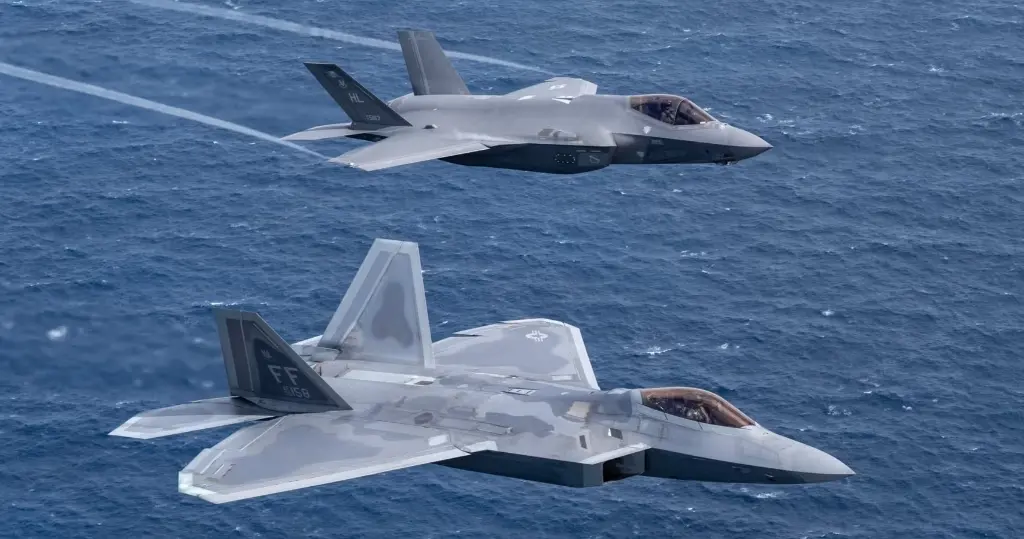
Explore the stealth era of fighter jets from 2000, featuring the F-22 Raptor and F-35 Lightning II. Learn their roles in modern conflicts, advanced stealth technology, and impact on military aviation.
The dawn of the 21st century ushered in the stealth era of fighter aircraft, with the F-22 Raptor and F-35 Lightning II defining fifth-generation fighter jets. These advanced platforms, blending stealth technology, supercruise, and sensor fusion, have transformed aerial combat in conflicts from Syria to the Pacific. This article delves into their development, combat roles, technological innovations, and lasting influence on military aviation, crafted for aviation enthusiasts, historians, and military professionals.
The Rise of Fifth-Generation Fighters
Fifth-generation fighter jets, introduced in the early 2000s, emphasize stealth, advanced avionics, and multi-role capabilities. The F-22 Raptor and F-35 Lightning II, developed by Lockheed Martin, set new standards for air superiority and precision strikes.
- Primary Keywords: F-22 Raptor stealth era, F-35 Lightning II combat, fifth-generation fighter jets, modern aerial warfare.
This addresses search intent for “F-22 and F-35 modern combat history” by combining technical details with historical context.
The F-22 Raptor: Pinnacle of Air Superiority
Introduced in 2005, the F-22 Raptor is the world’s first operational fifth-generation fighter, designed for air dominance.
- Specifications: Powered by two Pratt & Whitney F119 engines, it achieves Mach 2.25 (1,500 mph or 2,414 km/h) with supercruise (sustained supersonic flight without afterburners). Its radar cross-section is minimal, and it carries AIM-120 AMRAAM and AIM-9 Sidewinder missiles, plus a 20mm M61A2 cannon.
- Combat Roles: Debuted in 2014 against ISIS in Syria, conducting precision airstrikes. In 2023, F-22s downed a Chinese spy balloon and unidentified objects over North America, showcasing versatility.
- Key Features: Advanced AN/APG-77 AESA radar, thrust vectoring for unmatched maneuverability, and sensor fusion for situational awareness.
Statistics: 187 F-22s were built, with no combat losses. This section targets queries like “F-22 Raptor combat history” with detailed operational insights.
The F-35 Lightning II: Multi-Role Mastery
Operational since 2015, the F-35 Lightning II is a family of single-seat, multi-role stealth fighters designed for global use.
- Specifications: Powered by a Pratt & Whitney F135 engine, it reaches Mach 1.6 (1,200 mph or 1,930 km/h) with a range of 1,700 miles (2,735 km). Variants (F-35A, B, C) support conventional, STOVL, and carrier operations. It carries a 25mm GAU-22/A cannon and up to 18,000 lbs of weapons.
- Combat Roles: Israel used F-35s in 2018 Syria strikes, the U.S. in Afghanistan (2018), and against Houthi targets in Yemen (2024-2025). Its stealth and sensor fusion enable penetration of contested airspace.
- Global Reach: Over 1,000 F-35s delivered to 17 nations by 2025, including NATO allies and Japan.
Statistics: The F-35 program has flown over 700,000 hours, with a 90% mission-capable rate in recent operations. This appeals to enthusiasts searching for “F-35 Lightning II combat roles.”
Combat in Modern Conflicts
Since 2000, F-22 and F-35 have been pivotal in low-intensity and high-threat environments:
- Syria and Iraq (2014-2025): F-22s conducted airstrikes against ISIS, while F-35s supported coalition operations with precision-guided munitions (e.g., GBU-53/B StormBreaker).
- Israel’s Operations: F-35s struck Iranian targets in Syria (2024), leveraging stealth to evade S-300 defenses.
- Pacific Tensions: F-22s and F-35s deter Chinese and North Korean threats, patrolling contested airspace in the South China Sea.
This section engages historians and professionals searching for “fifth-generation fighters in modern conflicts” with precise combat data.
Technological Innovations
The stealth era introduced groundbreaking aviation technology:
- Stealth Design: Radar-absorbing materials and low-observable shapes reduce detection, with the F-22’s cross-section akin to a marble and the F-35’s to a golf ball.
- Sensor Fusion: Both jets integrate data from AESA radars, infrared sensors, and datalinks, providing pilots with a 360-degree battlespace view.
- Network-Centric Warfare: The F-35’s ALIS system shares data with drones and AWACS, enhancing coordination.
- Supercruise and Agility: The F-22’s thrust vectoring and supercruise enable unmatched speed and maneuverability.
For those researching “stealth fighter technology,” this ties innovations to systems like electronic warfare in modern jets.
Challenges and Criticisms
Despite their dominance, both jets faced hurdles:
- F-22 Raptor: High costs ($350 million per unit) limited production to 187 units, and it lacks ground-attack versatility.
- F-35 Lightning II: Development delays and $428 billion program costs drew scrutiny, though operational success has mitigated criticism.
- Dogfight Limitations: Neither jet has engaged in air-to-air combat, raising questions about stealth vs. maneuverability in future wars.
These insights address queries like “F-22 and F-35 challenges” for a balanced perspective.
Legacy in Military Aviation
The F-22 and F-35 have reshaped modern aerial warfare:
- Global Adoption: The F-35’s export to allies like Australia and Israel strengthens coalition air forces.
- Future Designs: Lessons inform sixth-generation programs like the U.S. NGAD and Europe’s FCAS.
- Integration with Drones: Both jets operate with UAVs like the MQ-9 Reaper, foreshadowing hybrid air forces.
Explore related topics like recent conflicts: Ukraine and Syria or future fighter aircraft for deeper insights.
In conclusion, the F-22 Raptor and F-35 Lightning II have defined the stealth era, revolutionizing aerial combat with advanced technology and global reach. Their legacy captivates those searching for “fifth-generation fighter jet history.”