The Gulf War of 1991 marked a turning point in military history—when stealth fighters, precision bombs, and satellite-guided warfare changed combat forever. Since then, fighter aircraft have evolved from dogfighting machines into networked, multi-role powerhouses shaping modern battlefields.
From Iraq to Ukraine, from Syria to Nagorno-Karabakh, fighter jets have played critical roles in air superiority, ground strikes, and intelligence gathering. But their use—and effectiveness—has changed dramatically.
In this article, you’ll discover how fighter aircraft have evolved over the last 30+ years, which models dominate today’s conflicts, and why air power is now more precise, connected, and contested than ever.
Desert Storm: The Birth of Modern Air Power
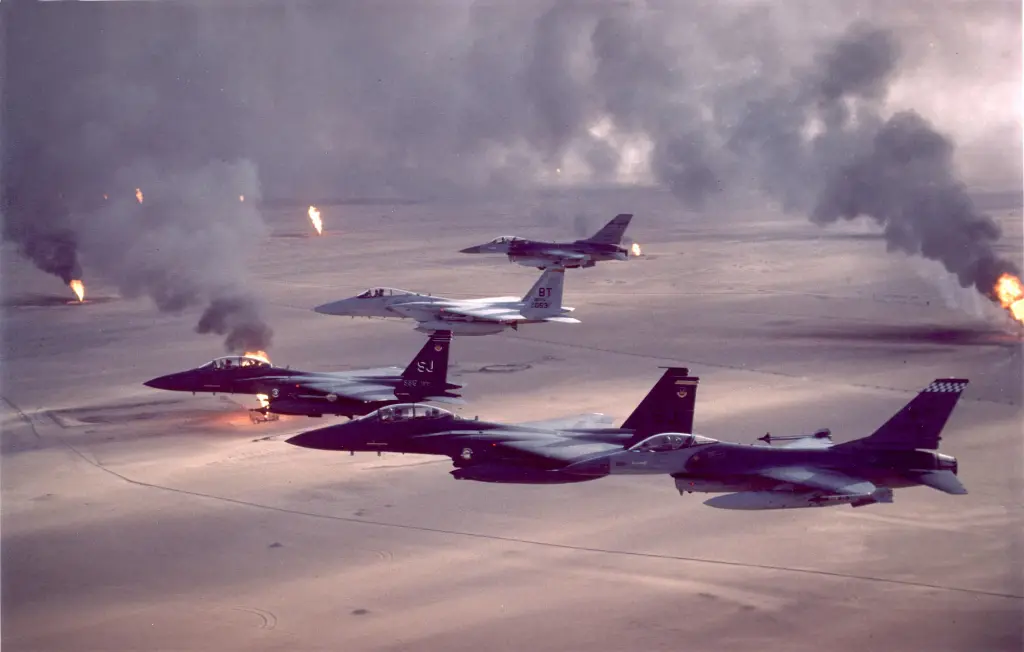
Operation Desert Storm (1991) was the first true showcase of fifth-generation warfare concepts—long before fifth-gen jets existed.
- Over 2,700 strike missions per day were flown by U.S. and coalition forces.
- The F-117 Nighthawk, a stealth fighter, struck high-value targets in Baghdad with near-impunity.
- F-15s dominated the skies, achieving a 38:0 air-to-air kill record.
- Laser-guided bombs reduced collateral damage and increased effectiveness.
This war proved that air superiority + precision = rapid victory.
Fighter jets weren’t just support—they were the spearhead of the campaign.
Kosovo and Afghanistan: Air Power with Precision
Kosovo (1999)
- NATO relied entirely on air power to force Serbian withdrawal.
- F-15s, F-16s, and F-117s conducted over 38,000 sorties.
- First large-scale use of GPS-guided JDAM bombs in bad weather.
Afghanistan (2001–2021)
- Fighters provided close air support (CAS) for ground troops.
- F-16s and A-10s used targeting pods to strike Taliban positions with minimal civilian harm.
- Real-time coordination with drones increased mission accuracy.
These conflicts showed that fighter jets could win campaigns without large ground invasions—but only when air defenses were weak.
Libya and Syria: Limited Interventions, Maximum Impact
Libya (2011)
- NATO enforced a no-fly zone using Rafale, Typhoon, and F-15E jets.
- Precision strikes helped rebel forces overthrow Gaddafi.
- No friendly losses—highlighting the advantage of standoff weapons and stealth.
Syria (2015–present)
- Russia deployed Su-35s and Su-34s to support Assad, conducting bombing raids.
- Israel used F-35s for deep strikes on Iranian targets—flying through dense air defenses.
- Turkey used F-16s in northern Syria against Kurdish forces.
In Syria, the skies became a proxy battlefield—with Russian, Israeli, Turkish, and U.S. jets operating in overlapping zones.
Key shift: Fighters now avoid direct combat, relying on long-range missiles and stealth to survive.
Ukraine War: Air Superiority Under Threat
Since 2022, Ukraine’s air force has faced the world’s most advanced integrated air defense system—Russia’s S-300, S-400, and S-500 networks.
- Ukrainian MiG-29s and Su-27s fly dangerous missions to protect cities and strike Russian positions.
- Most attacks use standoff weapons (like Storm Shadow) to avoid radar exposure.
- No-fly zone not enforced—highlighting limits of air power against peer adversaries.
Despite Western support, Ukraine still lacks F-16s in large numbers—and stealth capabilities.
Reality check: In high-threat environments, survivability matters more than firepower.
Nagorno-Karabakh: Drones Challenge Fighter Dominance
The 2020 war between Azerbaijan and Armenia revealed a shocking truth: fighter jets can be outmatched by drones.
- Azerbaijan used Turkish Bayraktar TB2 drones and Israeli loitering munitions.
- Armenian Su-25s and Su-30s were shot down or avoided flying due to drone threats.
- Air superiority was achieved without a single dogfight.
This conflict proved that cheap, smart drones can neutralize expensive air forces—if they’re unprepared.
Technological Evolution: Stealth, Sensors, and Smart Weapons
Fighter aircraft have evolved in four key areas:
✅ Stealth Design
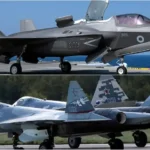
- F-22, F-35, and Su-57 reduce radar visibility.
- Allows penetration of enemy airspace without detection.
✅ Sensor Fusion
- F-35 integrates radar, infrared, and electronic signals into one display.
- Pilots see the battlefield like never before.
✅ Precision Munitions
- JDAM, SDB, and cruise missiles allow one jet to destroy multiple targets with minimal risk.
✅ Networked Warfare
- Fighters share data with AWACS, drones, and ground units in real time.
- Turn individual jets into battlefield command nodes.
Today’s fighter is less a weapon—and more a flying computer.
7. The Changing Role of Fighter Pilots
Pilots are no longer just stick-and-rudder aviators. They are now:
- Battle managers coordinating drones and missiles.
- Data analysts interpreting sensor feeds.
- Decision-makers in high-pressure, fast-moving environments.
Future pilots may control multiple AI drones from the cockpit—acting as mission commanders, not just flyers.
Conclusion: Air Power in the Age of Drones and Missiles
From Desert Storm to Ukraine, fighter aircraft remain essential—but their role has transformed.
They are no longer just about shooting down enemies—they’re about controlling information, delivering precision strikes, and surviving in contested skies.
While drones and missiles challenge their dominance, fighter jets still provide unmatched speed, range, and flexibility.
The future belongs to hybrid air forces that combine stealth fighters, AI drones, and long-range weapons—where the smartest network wins, not just the fastest jet.
Final thought: Air power hasn’t declined—it’s just gotten quieter, smarter, and more precise.
FAQ
Q: Why haven’t F-16s been used more in Ukraine?
A: They’ve only recently arrived (2024). Their use is limited to high-value missions to avoid losses.
Q: Can fighter jets win wars alone?
A: Rarely. They enable victories but require ground forces, intelligence, and logistics to succeed.
Q: Are dogfights still relevant?
A: Almost extinct. Over 90% of air kills since 1990 have been beyond visual range (BVR).
Q: Will drones replace fighter jets?
A: Not fully. Drones complement jets—but manned fighters still lead in high-threat, high-speed combat.
Destacado: “The skies are no longer ruled by speed alone—but by stealth, sensors, and the ability to strike first, unseen.”