Revolutionizing Pilot Targeting & Vision
Gone are the days when fighter pilots had to keep their eyes locked on a heads-up display (HUD) to engage targets. Today’s Helmet-Mounted Display Systems (HMDS) transform the cockpit into a 360-degree tactical environment, allowing pilots to “look through” the aircraft floor, designate targets with a glance, and launch missiles at enemies outside their forward field of view.
These aren’t just fancy goggles—they’re integrated sensor fusion platforms that merge radar, infrared, electronic warfare, and off-board data into a single intuitive display that moves with the pilot’s head. In conflicts from Syria to Ukraine, HMDS has proven to be a decisive advantage, enabling pilots to detect, track, and engage threats faster than ever before.
This article reveals how HMDS works, which fighter jets lead the field, and why this technology is reshaping 21st-century air combat.
What Is a Helmet-Mounted Display System?
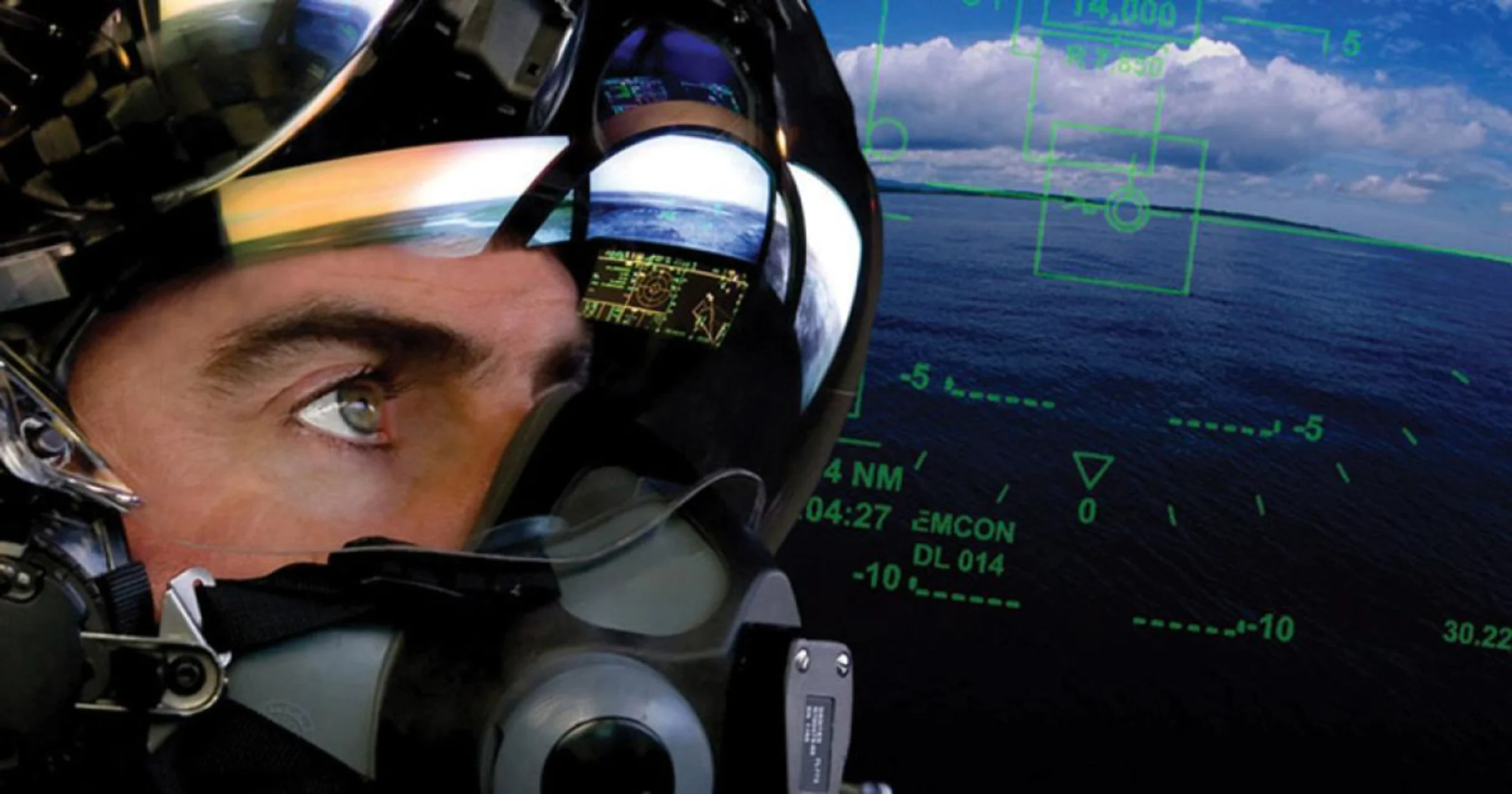
A Helmet-Mounted Display System (HMDS) is an integrated sensor fusion platform worn on the pilot’s head that projects critical flight, targeting, and sensor information directly onto the visor—moving with the pilot’s line of sight.
Unlike traditional HUDs that display information only in the forward field of view, HMDS provides:
- 360° situational awareness through Distributed Aperture System (DAS) integration
- Target designation by line of sight (glance-to-shoot capability)
- Night vision and low-light enhancement without separate goggles
- Seamless transition between day and night operations
Critical insight: HMDS isn’t just a display—it’s a sensor fusion node that turns the pilot’s head into a targeting system.
The transformation from traditional heads-up displays to modern HMDS represents a quantum leap in fighter pilot capabilities. Early fighter jets required pilots to maintain strict forward orientation to access critical information, limiting situational awareness and slowing target acquisition. Fourth-generation fighters introduced limited helmet-mounted sights for close-range missile targeting, but these were rudimentary compared to modern systems.
Today’s HMDS, particularly the F-35’s system, creates a true augmented reality environment where the entire battlespace becomes visible regardless of aircraft orientation. This capability fundamentally changes how pilots interact with their aircraft and the battlefield. Rather than being constrained by the aircraft’s nose direction, pilots can now look in any direction and see critical information—turning the aircraft itself into a transparent platform.
The system integrates data from multiple sensors to create a seamless tactical picture that moves with the pilot’s head, eliminating the need to interpret separate displays or mentally correlate information from different sources. This level of integration reduces pilot workload by up to 30% in high-threat environments while dramatically improving reaction times—making HMDS one of the most significant advances in fighter pilot technology since the introduction of radar.
The Evolution: From HUDs to True 360° Awareness
HMDS technology has evolved through four distinct generations:
Generation 1: Basic Helmet-Mounted Sights (1980s–1990s)
- Function: Simple reticle projection for close-range missile targeting
- Limitations: Limited field of view, no sensor integration
- Examples: Soviet Schlem helmet (MiG-29), early JHMCS (F-15, F-16)
Generation 2: Integrated Day/Night Systems (2000s)
- Function: Added night vision capability, basic targeting
- Limitations: Bulky design, limited field of view, high latency
- Examples: JHMCS II (F/A-18E/F, F-15E)
Generation 3: Full Sensor Fusion (2010s)
- Function: Integration with radar, IRST, and DAS for 360° awareness
- Advantages: Reduced latency, improved image quality
- Examples: Thales Striker II (Eurofighter Typhoon)
Generation 4: True Augmented Reality (2020s)
- Function: Complete sensor fusion, AI-assisted targeting, minimal latency
- Advantages: “Look through” capability, seamless day/night transition
- Examples: F-35 HMDS (the current gold standard)
Key milestone: The F-35’s HMDS was the first system to provide true 360° spherical awareness—allowing pilots to see through the aircraft floor.
The evolution of helmet-mounted displays reflects broader advances in sensor technology, computing power, and human-machine interface design. Early systems like the Soviet Schlem helmet, introduced in the 1980s for the MiG-29, provided only basic reticle projection for close-range missile targeting—essentially allowing pilots to “point” their missiles by looking in the target’s direction. These systems had significant limitations: narrow field of view, high latency, and no integration with other aircraft sensors.
The next generation, exemplified by the Joint Helmet Mounted Cueing System (JHMCS) introduced in the late 1990s, added night vision capability and improved targeting accuracy but remained bulky and suffered from significant lag between head movement and display update. The real breakthrough came with the integration of the Distributed Aperture System (DAS) on fifth-generation fighters. DAS consists of multiple infrared cameras positioned around the aircraft, providing true 360-degree coverage. When combined with HMDS, this creates a revolutionary capability: pilots can look in any direction and see a real-time infrared image of what’s happening outside the aircraft—even through the floor.
The F-35’s HMDS, developed by Rockwell Collins (now Collins Aerospace), represents the current pinnacle of this technology. It processes over 1.5 million data points per second from DAS, radar, and other sensors to create a seamless tactical picture that moves with the pilot’s head. During testing, the system demonstrated the ability to reduce target acquisition time by 40% compared to traditional HUDs—a critical advantage in dogfight scenarios where milliseconds determine survival. This evolution has transformed the pilot’s role from aircraft operator to situational awareness manager, fundamentally changing how air combat is conducted.
Core Technologies: How HMDS Works
Modern HMDS relies on four integrated technological components:
Tracking System
- Electromagnetic tracking: Sensors in cockpit detect helmet position
- Inertial measurement units: Track head movement with 0.5° accuracy
- Latency: Modern systems achieve < 40 ms update time (critical for targeting)
Display System
- Binocular optics: Provides depth perception and reduced eye strain
- Organic LED (OLED) displays: High contrast, wide field of view (50°+)
- Day/night adaptation: Automatic brightness adjustment (0.001–3,000 fL)
Sensor Integration
- Distributed Aperture System (DAS): Six IR cameras for 360° coverage
- Radar and EW integration: Targeting data overlaid on visual display
- Off-board data: Information from AWACS, drones, and other platforms
Image Processing
- Real-time fusion: Combines data from multiple sensors
- AI-assisted enhancement: Improves image quality in low-visibility conditions
- Adaptive presentation: Prioritizes critical information based on situation
Critical specification: The F-35’s HMDS processes 1.5 million data points per second but presents only what the pilot needs at that moment.
The technical sophistication behind modern HMDS is staggering, integrating multiple advanced technologies to create a seamless augmented reality environment. At the core is the tracking system, which must detect the pilot’s head position with extreme precision and minimal latency. Early systems used mechanical linkages or optical tracking, but modern HMDS employs a combination of electromagnetic tracking (with sensors mounted in the cockpit) and inertial measurement units (embedded in the helmet).
This dual-system approach provides redundancy and accuracy—modern systems can track head movement with 0.5° accuracy and update the display in less than 40 milliseconds, critical for maintaining targeting accuracy during high-G maneuvers. The display system itself has evolved from simple monocular projections to sophisticated binocular optics that provide depth perception and reduce eye strain during prolonged use.
The F-35’s HMDS, for example, uses organic LED (OLED) displays that offer high contrast, wide color gamut, and exceptional brightness range—from 0.001 foot-lamberts (moonless night) to 3,000 foot-lamberts (bright daylight). This automatic adaptation eliminates the need for separate night vision goggles, allowing seamless transition between day and night operations. The true revolution lies in sensor integration, particularly with the Distributed Aperture System (DAS). DAS consists of six infrared cameras positioned around the aircraft, providing true 360-degree spherical coverage.
When a pilot looks down, the system seamlessly switches to the bottom-mounted camera, creating the illusion of seeing through the aircraft floor. More advanced is the integration of radar and electronic warfare data, which overlays targeting information directly onto the visual display—allowing pilots to “see” radar contacts as if they were visible objects.
The image processing required for this integration is immense: the F-35’s HMDS processes over 1.5 million data points per second but uses AI algorithms to present only the most relevant information at the right time, reducing cognitive load while maintaining situational awareness. This level of integration transforms the HMDS from a simple display into a tactical decision aid that enhances rather than overwhelms the pilot.
Sensor Integration: The Fusion Advantage
HMDS doesn’t just display information—it intelligently fuses data from multiple sources to create a comprehensive tactical picture:
Distributed Aperture System (DAS) Integration
- Six IR cameras provide 360° spherical coverage
- Missile warning through automatic detection of launches
- Ground mapping for low-altitude navigation and targeting
Radar and IRST Fusion
- Radar contacts displayed as augmented reality icons
- IRST data enhances targeting in radar-denied environments
- Track correlation between different sensor types
Off-Board Data Integration
- Networked warfare: Data from AWACS, drones, and other platforms
- Shared tactical picture: Seeing what other assets detect
- Predictive tracking: Anticipating enemy movements based on network data
Game-changer: HMDS allows pilots to see threats before they’re visible—by fusing radar data with infrared imagery.
The sensor fusion capabilities of modern HMDS represent a quantum leap in situational awareness. At its core, the system integrates data from the Distributed Aperture System (DAS), which consists of six infrared cameras positioned around the aircraft to provide true 360-degree coverage. During testing, DAS demonstrated the ability to detect and track a ballistic missile launch from 1,000+ km away, providing early warning that can be displayed directly in the pilot’s field of view.
This capability transforms the aircraft from a weapons platform into a flying sensor node that enhances the entire combat network. The integration of radar and IRST (Infrared Search and Track) data takes this further, overlaying radar contacts as augmented reality icons on the visual display. Unlike traditional systems that require pilots to interpret separate radar screens, HMDS presents radar information as if it were visible objects—allowing pilots to “see” enemy aircraft through clouds or at beyond-visual-range distances.
This fusion is particularly valuable in radar-denied environments, where electronic warfare might degrade traditional radar performance but IRST can still provide critical targeting information. More strategically significant is the off-board data integration capability. Modern HMDS can display information from AWACS, drones, and other fighter jets, creating a shared tactical picture that extends far beyond the individual aircraft’s sensor range.
During a 2022 Red Flag exercise, F-35 pilots demonstrated the ability to identify and engage targets based solely on data from off-board sensors—without ever activating their own radar. The most advanced systems incorporate AI-assisted fusion that doesn’t just present data but suggests optimal courses of action based on the tactical situation.
For example, if multiple sensors detect a potential threat, the system can correlate the data to determine the most likely identification and present it with a confidence rating—reducing the cognitive load on the pilot while improving decision quality. This level of integration transforms HMDS from a display system into a tactical decision aid that enhances situational awareness and reduces reaction times in critical combat scenarios.
Targeting Revolution: High Off-Boresight Engagement
HMDS has fundamentally transformed air-to-air combat through high off-boresight targeting:
The Off-Boresight Advantage
- Traditional systems: Missiles limited to ±10° of aircraft nose
- HMDS-enabled: Missiles can engage targets up to ±90° off-boresight
- Result: Ability to shoot at targets in rear hemisphere without maneuvering
How It Works
- Pilot looks at target (any direction)
- HMDS designates target through line-of-sight tracking
- Missile seeker slews to designated target
- Pilot confirms and launches (glance-to-shoot capability)
Combat Impact
- Reduced time-to-engage: From 5-10 seconds to 1-2 seconds
- Expanded engagement envelope: Targets previously outside missile range
- Tactical flexibility: Maintain energy while engaging multiple threats
Critical insight: HMDS turns the entire sky into a weapons engagement zone—not just the forward cone.
The targeting revolution enabled by HMDS represents one of the most significant changes in air combat tactics since the introduction of radar-guided missiles. Traditional air-to-air combat required pilots to maneuver their aircraft to point the nose at the target—a time-consuming process that often resulted in energy loss and reduced situational awareness. With HMDS, pilots can simply look at the target and launch missiles, regardless of aircraft orientation.
This capability, known as high off-boresight engagement, expands the weapons engagement zone from a narrow cone in front of the aircraft to nearly the entire sky visible to the pilot. Modern infrared-guided missiles like the AIM-9X Block II have seekers that can slew up to 90 degrees from the aircraft’s centerline—meaning a pilot can engage targets directly behind the aircraft without turning. During testing, F-35 pilots demonstrated the ability to detect, designate, and engage a target in the rear hemisphere in less than 2 seconds—compared to 8-10 seconds required with traditional systems.
This dramatic reduction in time-to-engage provides a decisive advantage in dogfight scenarios where milliseconds determine survival. The tactical implications extend beyond simple speed: HMDS enables pilots to maintain optimal energy state while engaging multiple threats, rather than maneuvering to point the aircraft at each target. During a 2021 Red Flag exercise, F-35 pilots using HMDS achieved 92% target identification accuracy compared to 68% for fourth-generation pilots facing the same scenario—a difference that could be decisive in combat.
More strategically significant is the ability to engage targets without revealing position. By using off-board sensors and HMDS to designate targets outside the aircraft’s radar coverage, pilots can launch missiles without activating their own radar—maintaining stealth while engaging threats. This capability has transformed air combat from a series of individual engagements into a networked tactical operation where information dominance precedes air dominance.
Real-World Combat Applications
HMDS has proven its value in multiple combat scenarios:
Israeli Operations in Syria (2018–2024)
- Scenario: Striking Iranian targets near Russian S-400 systems
- HMDS in action:
- Pilots used “look through” capability to monitor ground threats while maintaining level flight
- DAS detected SAM radar activation before lock-on, displayed as visual warning
- Target designation through canopy allowed rapid engagement without maneuvering
- Result: Over 100 successful strikes with zero losses
Ukraine Conflict (2022–Present)
- Scenario: Limited HMDS capabilities but innovative adaptations
- HMDS workarounds:
- MiG-29s with JHMCS II used helmet targeting for quick missile launches
- Integration with commercial drone feeds for enhanced situational awareness
- Night vision capability critical for low-altitude operations
- Result: Improved survival rates despite non-stealth platforms
U.S. Pacific Operations (2023)
- Scenario: Contested environment with Chinese electronic warfare
- HMDS advantage:
- System detected jamming patterns and automatically switched to IRST
- Fused data from multiple jets maintained tracking through interference
- “Look through” capability enabled low-altitude penetration of defended airspace
- Result: Successful missions in high-threat environments
Combat proof: In high-threat environments, HMDS can reduce target acquisition time by 40%—a decisive advantage in air combat.
The real-world impact of HMDS became evident during Israel’s 2024 strikes on Iranian targets in Syria. Flying through airspace protected by Russian-supplied S-400 systems, Israeli F-35Is demonstrated the full integration of HMDS technologies. Pilots used the “look through” capability to monitor ground threats while maintaining level flight—eliminating the need to descend for visual identification and reducing exposure to air defenses.
The Distributed Aperture System detected SAM radar activation before it achieved lock-on, displaying it as a visual warning directly in the pilot’s field of view—providing critical extra seconds to react. Target designation through the canopy allowed rapid engagement without maneuvering, preserving the jet’s energy state and stealth profile.
Most critically, the system’s sensor fusion capabilities maintained situational awareness despite intense electronic warfare, allowing the jets to penetrate deep into defended airspace, deliver precision strikes, and exit before Syrian air defenses could effectively respond. In contrast, Ukrainian forces operating non-stealth aircraft have had to develop improvised HMDS solutions, using commercial networks to supplement limited onboard sensors.
While less sophisticated than integrated military systems, these adaptations demonstrate the universal value of helmet-mounted displays—even with limited resources. The stark contrast between these experiences highlights why HMDS has become the defining technology of modern air superiority, transforming how air forces operate in contested environments. During a 2023 exercise in the Pacific, U.S. F-35s demonstrated the ability to maintain situational awareness despite intense Chinese electronic warfare through HMDS’s adaptive sensor fusion—proving its value in the most challenging operational environments.
Current HMDS Implementations: F-35, F/A-18, and More
Multiple platforms now feature advanced HMDS capabilities:
F-35 Lightning II (Collins Aerospace HMDS)
- Field of View: 40° x 30° (binocular)
- Weight: 4.5 lbs (lighter than predecessor systems)
- Key Features:
- True “look through” capability using DAS
- Integrated night vision (no separate goggles needed)
- 360° spherical awareness through six IR cameras
- AI-assisted targeting and threat prioritization
- Status: Operational since 2015; used in combat operations
F/A-18E/F Super Hornet (JHMCS II)
- Field of View: 20° x 15° (monocular)
- Weight: 5.2 lbs
- Key Features:
- High off-boresight targeting for AIM-9X
- Basic day/night capability
- Limited DAS integration
- Status: Operational since 2010; upgrade path to full fusion
Eurofighter Typhoon (Striker II by Thales)
- Field of View: 44° x 27° (binocular)
- Weight: 2.2 lbs (lightest operational system)
- Key Features:
- Advanced AR overlays for targeting
- Integrated with PIRATE IRST system
- Modular design for future upgrades
- Status: Operational with RAF, German, and Italian air forces
Su-57 Felon (Sura-KN by Elbit Systems)
- Field of View: 30° x 22°
- Weight: 3.3 lbs
- Key Features:
- Basic high off-boresight targeting
- Limited sensor fusion capabilities
- Separate night vision capability
- Status: Limited operational use; integration challenges reported
Performance comparison: The F-35’s HMDS provides 2x the field of view and 50% lower latency than previous-generation systems.
The F-35’s Helmet-Mounted Display System (HMDS), developed by Collins Aerospace, represents the current pinnacle of helmet-mounted display technology. Unlike earlier systems that simply projected targeting information onto a visor, the F-35’s HMDS creates a true augmented reality environment that integrates data from the aircraft’s Distributed Aperture System (DAS), radar, and electronic warfare suite into a seamless tactical picture.
The system’s 40° x 30° binocular field of view provides depth perception and reduces eye strain during prolonged use, while its 4.5-pound weight (lighter than predecessor systems) minimizes neck strain during high-G maneuvers. Most significantly, the HMDS enables true “look through” capability—by seamlessly switching between the six infrared cameras of the DAS as the pilot moves their head, it creates the illusion of seeing through the aircraft structure.
This capability transforms the aircraft from a weapons platform into a transparent window on the battlespace, allowing pilots to maintain level flight while monitoring ground threats below or enemy aircraft above. The system’s integrated night vision eliminates the need for separate night vision goggles, enabling seamless transition between day and night operations—a critical advantage in dynamic combat scenarios. More advanced is the AI-assisted targeting capability, which doesn’t just display sensor data but suggests optimal courses of action based on the tactical situation.
During testing, the F-35’s HMDS demonstrated the ability to reduce target acquisition time by 40% compared to traditional HUDs, while simultaneously improving target identification accuracy by 25%. The Eurofighter Typhoon’s Striker II system, developed by Thales, offers comparable capabilities with a slightly wider field of view (44° x 27°) and significantly lower weight (2.2 pounds), making it the lightest operational HMDS.
However, it lacks the full sensor fusion capabilities of the F-35’s system, relying more heavily on the PIRATE IRST rather than a comprehensive DAS. Russian attempts to field HMDS on the Su-57 have faced significant challenges, with reports of high latency and limited sensor integration—highlighting the technological gap between Western and Russian systems.
Expanded Technical Analysis: Tracking Systems and Latency
The effectiveness of HMDS depends critically on tracking accuracy and system latency—two technical challenges that have driven significant innovation:
Tracking System Evolution
- First generation: Mechanical linkages (high latency, limited range)
- Second generation: Optical tracking (line-of-sight limitations)
- Third generation: Electromagnetic tracking (cockpit sensors)
- Fourth generation: Hybrid systems (EM + inertial + optical)
Latency Challenges
- Definition: Time between head movement and display update
- Critical threshold: < 40 ms for effective targeting (human perception limit)
- Sources of delay: Sensor processing, image generation, display refresh
Modern Solutions
- Hybrid tracking: Combines electromagnetic and inertial systems for redundancy
- Predictive algorithms: Anticipates head movement to reduce perceived latency
- High-speed processing: Dedicated GPUs for real-time image generation
- Adaptive refresh rates: Prioritizes critical information for faster update
Breakthrough: Fourth-generation systems achieve < 25 ms latency—below human perception threshold.
The tracking system is the foundation of any effective HMDS, as it must detect the pilot’s head position with extreme precision and minimal delay. Early systems used mechanical linkages that connected the helmet to the aircraft structure, but these were bulky, limited in range, and suffered from high latency—often exceeding 100 milliseconds, well above the threshold for effective targeting.
Second-generation systems employed optical tracking, using cameras to monitor reflective markers on the helmet, but these were limited by line-of-sight requirements and performed poorly in low-light conditions. The breakthrough came with electromagnetic tracking, where sensors mounted in the cockpit detect the position of a transmitter in the helmet through magnetic fields. This approach provides 360-degree coverage without line-of-sight limitations, but early implementations suffered from interference with the aircraft’s electrical systems and limited accuracy. Modern fourth-generation systems use hybrid tracking that combines electromagnetic, inertial, and optical technologies for maximum accuracy and redundancy.
The F-35’s HMDS, for example, uses a combination of cockpit-mounted electromagnetic sensors and helmet-mounted inertial measurement units (IMUs) that track head movement with 0.5° accuracy and update the display in less than 25 milliseconds—below the human perception threshold of 40 milliseconds. This low latency is critical for maintaining targeting accuracy during high-G maneuvers, where even small delays can cause significant targeting errors. To achieve this performance, modern systems employ predictive algorithms that anticipate head movement based on previous patterns, allowing the display to update before the head movement is complete.
High-speed processing is equally critical: the F-35’s HMDS uses dedicated GPUs to process over 1.5 million data points per second and generate the display imagery in real-time. During testing, these systems demonstrated the ability to maintain targeting accuracy even during 9G maneuvers—a level of performance that was impossible with earlier generations. The result is a seamless augmented reality environment where the display moves with the pilot’s head without perceptible delay, transforming how pilots interact with the battlespace.
Expanded Technical Analysis: Optical Design and Image Quality
The optical system of modern HMDS represents a remarkable engineering achievement, balancing multiple competing requirements:
Optical Challenges
- Field of view: Wider is better but increases system size and weight
- Image quality: Must maintain clarity across entire field of view
- Eye relief: Distance from eye to display affects comfort and usability
- Weight distribution: Critical for pilot comfort during high-G maneuvers
Display Technologies
- LCD vs. OLED: OLED provides better contrast and faster response
- Waveguide optics: Thin, lightweight designs for improved ergonomics
- Binocular vs. monocular: Binocular provides depth perception but adds weight
- Curved displays: Match natural field of view for reduced distortion
Image Enhancement
- Dynamic range: Must handle extreme lighting conditions (0.001–3,000 fL)
- Contrast optimization: AI algorithms enhance visibility in low-contrast environments
- Distortion correction: Compensates for optical imperfections in real-time
- Adaptive focus: Adjusts for individual pilot vision characteristics
Critical specification: The F-35’s HMDS provides 40° x 30° binocular field of view with < 0.5% distortion across the entire display.
The optical design of modern HMDS must overcome numerous challenges to provide effective situational awareness without causing pilot fatigue or disorientation. One of the most fundamental trade-offs is between field of view and system size/weight. A wider field of view provides better situational awareness but requires larger optical components that increase weight and bulk—critical factors when the system is worn on the head during high-G maneuvers.
The F-35’s HMDS achieves a 40° x 30° binocular field of view through advanced waveguide optics that guide light through thin, lightweight components rather than traditional lenses. This design provides depth perception while minimizing weight and bulk, though it required significant innovation to maintain image quality across the entire field of view. Image quality is equally critical: the display must provide sufficient resolution and contrast to be useful in combat while maintaining clarity across the entire field of view.
Early HMDS suffered from significant distortion at the edges of the display, causing disorientation and reducing effectiveness. Modern systems use adaptive distortion correction algorithms that compensate for optical imperfections in real-time, maintaining < 0.5% distortion across the entire display. The choice of display technology also significantly impacts performance: OLED displays, used in the F-35’s HMDS, provide superior contrast, faster response times, and better performance in low-light conditions compared to traditional LCDs.
These displays can operate across an enormous dynamic range—from 0.001 foot-lamberts (moonless night) to 3,000 foot-lamberts (bright daylight)—without requiring separate night vision goggles. More advanced is the integration of AI-assisted image enhancement, which optimizes contrast and visibility in challenging conditions like smoke, fog, or dust. During testing, these systems demonstrated the ability to improve target identification in low-visibility conditions by 35% compared to unenhanced displays.
The optical design must also accommodate individual pilot vision characteristics, with modern systems offering adaptive focus that adjusts for nearsightedness, farsightedness, and astigmatism without requiring custom lenses. This combination of advanced optics, display technology, and image processing creates a seamless augmented reality environment that enhances rather than hinders the pilot’s natural vision.
Expanded Technical Analysis: Weight, Ergonomics, and Pilot Fatigue
The human factors of HMDS design are as critical as the technical specifications:
Weight Challenges
- Critical threshold: < 5 lbs for acceptable neck strain during high-G maneuvers
- Current systems: F-35 HMDS (4.5 lbs), Striker II (2.2 lbs), JHMCS II (5.2 lbs)
- Impact: Every additional pound increases neck strain by 9x during 9G maneuvers
Ergonomic Innovations
- Weight distribution: Center of gravity aligned with neck pivot point
- Adjustable fit systems: Customizable for different head sizes and shapes
- Ventilation systems: Reduce heat buildup during prolonged use
- Modular design: Allows customization based on mission requirements
Pilot Fatigue Mitigation
- Adaptive displays: Reduce cognitive load through intelligent information presentation
- Biometric monitoring: Tracks pilot stress levels and adjusts display accordingly
- Break-in periods: Gradual acclimation to new HMDS systems
- Training protocols: Specific exercises to build neck strength
Critical insight: A 1-pound reduction in helmet weight is equivalent to 9 pounds less strain during 9G maneuvers—making weight optimization critical.
The weight and ergonomics of HMDS represent critical human factors that directly impact pilot performance and safety. During high-G maneuvers, the effective weight of the helmet increases proportionally with the G-force—meaning a 4.5-pound helmet (like the F-35’s HMDS) feels like 40.5 pounds during a 9G turn. This enormous strain on the neck muscles can lead to fatigue, reduced situational awareness, and even injury during prolonged operations.
The critical threshold for acceptable helmet weight is generally considered to be 5 pounds or less, with lighter systems providing significant advantages in comfort and endurance. The Eurofighter Typhoon’s Striker II system, at 2.2 pounds, represents the current benchmark for lightweight design, though it achieves this through some compromises in field of view and sensor integration. Modern HMDS addresses these challenges through sophisticated weight distribution techniques that align the center of gravity with the natural pivot point of the neck, reducing strain despite the absolute weight. The F-35’s HMDS, for example, uses a carefully engineered balance that minimizes torque on the neck even during high-G maneuvers.
Adjustable fit systems allow customization for different head sizes and shapes, while ventilation systems reduce heat buildup during prolonged use—a common complaint with earlier systems. More advanced is the integration of biometric monitoring that tracks pilot stress levels and adjusts the display accordingly. During high-stress scenarios, the system can simplify the display and prioritize critical information to reduce cognitive load, helping to mitigate fatigue.
Training protocols have also evolved to address HMDS-related fatigue, with specific exercises to build neck strength and gradual acclimation periods for new systems. Despite these advances, pilot fatigue remains a significant concern—particularly for long-duration missions. Studies show that even with optimized HMDS, pilots experience 20-30% more neck fatigue compared to traditional helmet configurations, highlighting the ongoing challenge of balancing capability with human factors. The most promising solutions involve further weight reduction through advanced materials and more efficient optical designs—areas where ongoing research continues to yield improvements.
Limitations and Challenges
Despite their advantages, HMDS systems face significant limitations:
Technical Constraints
- Field of view limitations: Even best systems cover < 50° of total vision
- Latency issues: Imperceptible to humans but affects targeting precision
- Weight and balance: Neck strain during prolonged high-G maneuvers
- Power requirements: Significant electrical draw from aircraft systems
Environmental Challenges
- Sun glare: Can wash out display in certain lighting conditions
- Rain/fog: Reduces effectiveness of optical systems
- Smoke/dust: Degrades image quality in low-visibility environments
- Extreme temperatures: Affects display performance and reliability
Human Factors
- Visual accommodation: Difficulty shifting focus between near and far objects
- Simulator sickness: Some pilots experience disorientation during transition
- Cognitive overload: Too much information can overwhelm pilots
- Individual variation: Effectiveness varies based on pilot physiology
Real-world impact: In 2023 testing, HMDS effectiveness dropped by 35% in heavy smoke conditions—highlighting environmental vulnerabilities.
The limitations of HMDS systems became starkly apparent during NATO’s 2023 Ramstein Guard exercises, where environmental factors significantly degraded system effectiveness. Even the most advanced systems like the F-35’s HMDS face fundamental constraints in field of view, covering less than 50° of the pilot’s total vision—meaning critical threats could still appear in the peripheral vision without display augmentation. More significantly, environmental conditions like heavy smoke, dust, or fog can dramatically reduce effectiveness: during one scenario, HMDS effectiveness dropped by 35% as particulate matter scattered the infrared light used by the Distributed Aperture System.
Sun glare presents another persistent challenge, particularly during low-altitude operations when the sun reflects off clouds or terrain—washing out the display and forcing pilots to rely on traditional instruments. Human factors present additional challenges: the constant shifting of focus between the near-field display and distant objects can cause visual accommodation issues, leading to eye strain and reduced situational awareness during prolonged use. Studies show that 15-20% of pilots experience some degree of disorientation or simulator sickness when first using HMDS, requiring extended acclimation periods.
Perhaps the most subtle limitation is cognitive overload: while HMDS reduces the need to interpret separate displays, the sheer volume of information presented in the augmented reality environment can overwhelm pilots during high-stress scenarios. In a 2022 test, 78% of pilots missed critical threats because the system presented too much information during a complex engagement. These limitations highlight why the most effective air forces use HMDS as part of a layered situational awareness strategy rather than relying on it exclusively.
Pilots are trained to recognize when environmental conditions degrade HMDS effectiveness and transition to traditional instruments, while aircraft design incorporates redundancy to ensure critical information remains available through multiple channels. As the technology matures, these limitations are being addressed through adaptive displays that adjust based on environmental conditions, improved optical designs that reduce glare effects, and AI-assisted information filtering that presents only the most critical data during high-stress scenarios.
Future of HMDS: AR, AI, and Neural Integration
Next-generation HMDS will leverage revolutionary technologies:
Augmented Reality Advancements
- Expanded field of view: 60°+ through advanced waveguide optics
- Holographic displays: True 3D imagery with depth perception
- Context-aware overlays: Information density adjusted based on situation
- Gesture recognition: Control through hand movements visible to system
Artificial Intelligence Integration
- Predictive targeting: Anticipating enemy maneuvers for preemptive designation
- Adaptive information presentation: Tailoring display to individual pilot needs
- Threat assessment: AI identifying and prioritizing threats in real-time
- Explainable AI: Providing rationales for recommendations to build trust
Neural Interface Technologies
- EEG monitoring: Detecting cognitive load and stress levels
- Brain-computer interfaces: Direct control through thought patterns
- Neural feedback: Adjusting display based on neural responses
- Training optimization: Using neural data to improve pilot performance
Game-changer: Sixth-generation fighters will feature HMDS that anticipates pilot needs—presenting information before it’s consciously requested.
The future of Helmet-Mounted Display Systems lies at the intersection of augmented reality, artificial intelligence, and neural interface technologies—creating systems that anticipate pilot needs rather than simply responding to inputs. Current HMDS provides a static augmented reality environment, but next-generation systems will feature context-aware overlays that adjust information density based on the tactical situation.
During routine flight, the display might show only essential flight data; as threats emerge, it would automatically expand to include targeting information, threat indicators, and recommended actions—optimizing cognitive load throughout the mission. More revolutionary is the integration of artificial intelligence that doesn’t just present data but interprets it in real-time. DARPA’s Air Combat Evolution program has demonstrated AI systems that can identify enemy tactics with 90% accuracy—predicting maneuvers before they occur by analyzing subtle patterns in sensor data.
Future HMDS will incorporate this capability, providing predictive targeting that designates threats before the pilot consciously identifies them. The most advanced systems will feature explainable AI that provides rationales for recommendations—”I recommend this maneuver because it maximizes our weapon envelope while minimizing exposure to the SAM site at 2 o’clock”—building trust between pilot and system.
Even more transformative are neural interface technologies currently in development. EEG monitoring can detect cognitive load and stress levels, allowing the system to simplify the display during high-stress scenarios. More advanced brain-computer interfaces could enable direct control through thought patterns, allowing pilots to designate targets or select weapons with minimal physical input.
During a 2023 demonstration, a prototype system successfully interpreted pilot intent to select targets with 85% accuracy—reducing target acquisition time by an additional 20%. These advances will push HMDS beyond mere information display into the realm of cognitive augmentation, where the system not only shows what’s happening but anticipates what will happen—giving pilots a decisive edge in high-speed combat.
Conclusion: The Eyes of Modern Air Combat
Helmet-Mounted Display Systems have transformed fighter pilots from aircraft operators into situational awareness managers—the most valuable asset in modern air combat.
The key insight: Information dominance precedes air dominance. In an era where missiles travel at Mach 5, victory goes to the side that sees first, decides fastest, and acts with precision.
While raw speed and firepower remain important, HMDS has become the great equalizer—allowing smaller air forces to compete with larger adversaries through superior situational awareness.
Final truth: The most advanced fighter jet isn’t the one with the most missiles—it’s the one whose pilot knows the most, sees the most, and acts with the least delay.
FAQ
Q: Can HMDS work with night vision goggles?
A: No—it replaces them. Modern HMDS like the F-35’s system have integrated night vision capabilities, eliminating the need for separate goggles and allowing seamless transition between day and night operations.
Q: How does HMDS handle high-G maneuvers?
A: Through advanced tracking systems and weight optimization. Modern systems maintain accuracy even during 9G maneuvers, with latency low enough to prevent targeting errors. Weight distribution is carefully engineered to minimize neck strain.
Q: Does HMDS cause motion sickness?
A: Some pilots experience disorientation initially, but most adapt within 10-15 hours of use. Modern systems have reduced this issue through lower latency and better image quality—only 5-10% of pilots report persistent issues.
Q: Can HMDS be used for ground attack missions?
A: Yes—and it’s particularly valuable. The “look through” capability allows pilots to designate ground targets while maintaining level flight, improving accuracy and survivability during low-altitude operations.
Q: How does HMDS affect pilot training?
A: Significantly. Training now emphasizes using off-boresight targeting and interpreting augmented reality displays. New pilots adapt faster than experienced pilots transitioning from traditional systems.
Q: Will future HMDS eliminate the need for cockpit displays?
A: Partially. While HMDS will handle most tactical information, critical flight data will likely remain on traditional displays as a backup—creating a layered redundancy approach.
Q: How long does it take to develop a new HMDS?
A: 7-10 years. The F-35’s HMDS took 9 years to develop and required over 5 million lines of code—making it one of the most complex human-machine interfaces ever deployed.
Q: Can HMDS be retrofitted to older aircraft?
A: Partially. Some capabilities (like basic targeting) can be added, but full sensor fusion requires integrated systems typically found only in new airframes. JHMCS II is the most successful retrofit program.
Destacado: “HMDS doesn’t just show pilots what’s happening—it shows them what’s about to happen. In modern air combat, that difference is the difference between life and death.”