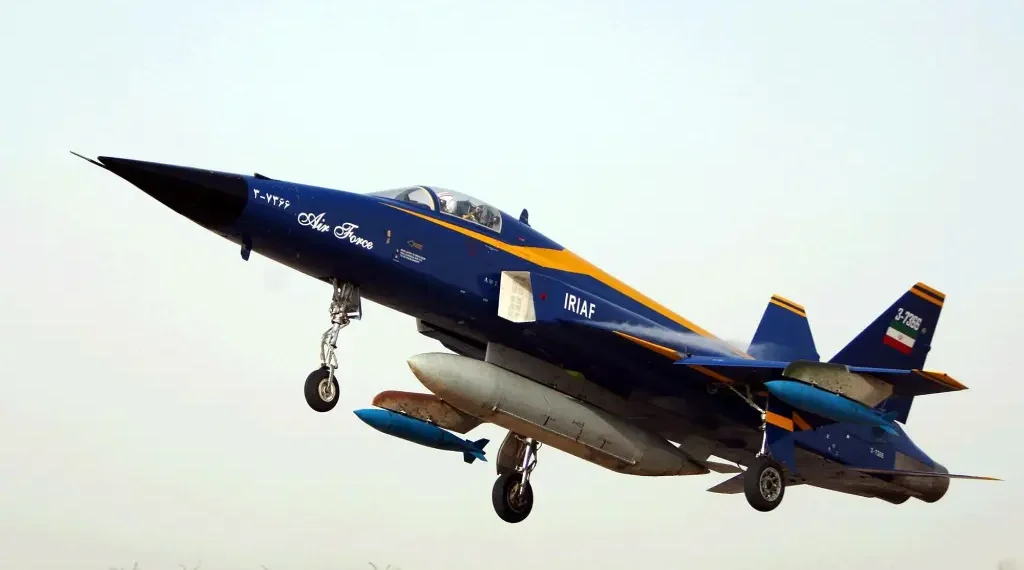
The HESA Saeqeh (“Thunderbolt”) is an Iranian-built, single-seat jet fighter developed by the Iran Aircraft Manufacturing Industrial Company (HESA). Based on the Northrop F-5, the Saeqeh features twin vertical stabilizers and upgraded avionics. First introduced in 2007, the Saeqeh is designed for air-to-air and air-to-ground missions, representing Iran’s efforts to develop an indigenous fighter aircraft.
Fact Sheet
| Role | Multirole fighter |
|---|---|
| Manufacturer | HESA (Iran Aircraft Manufacturing Industrial Company) |
| First Flight | 2004 |
| Service Entry | 2007 |
| Crew | 1 |
Specifications
| Length | 15.9 m (52 ft 2 in) |
|---|---|
| Wingspan | 8.13 m (26 ft 8 in) |
| Height | 4.0 m (13 ft 1 in) |
| Empty Weight | 4,500 kg (9,920 lb) |
| Max Takeoff Weight | 12,700 kg (28,000 lb) |
| Powerplant | 2 × General Electric J85-GE-21 turbojets |
| Thrust | 5,000 lbf (22.2 kN) per engine |
| Max Speed | Mach 1.6 (1,700 km/h; 1,056 mph) |
| Service Ceiling | 16,000 m (52,500 ft) |
| Range | 1,400 km (870 mi) combat radius |
| Rate of Climb | ~34,000 ft/min (173 m/s) |
Avionics & Armament
| Main Radar | Upgraded radar system (details classified) |
|---|---|
| Avionics | Modernized avionics suite |
| Armament | Two 20-mm M39 cannons; Up to 5 external hardpoints for: – Air-to-air missiles (AIM-9 Sidewinder or Iranian equivalents) – Air-to-ground munitions (bombs, rockets) – External fuel tanks |
Notable Features
- Indigenous development based on the Northrop F-5 platform.
- Twin vertical stabilizers for improved stability and control.
- Multirole capability for air-to-air and air-to-ground missions.
- Modernized avionics for enhanced combat effectiveness.
- Represents Iran’s efforts to achieve self-sufficiency in military aviation.
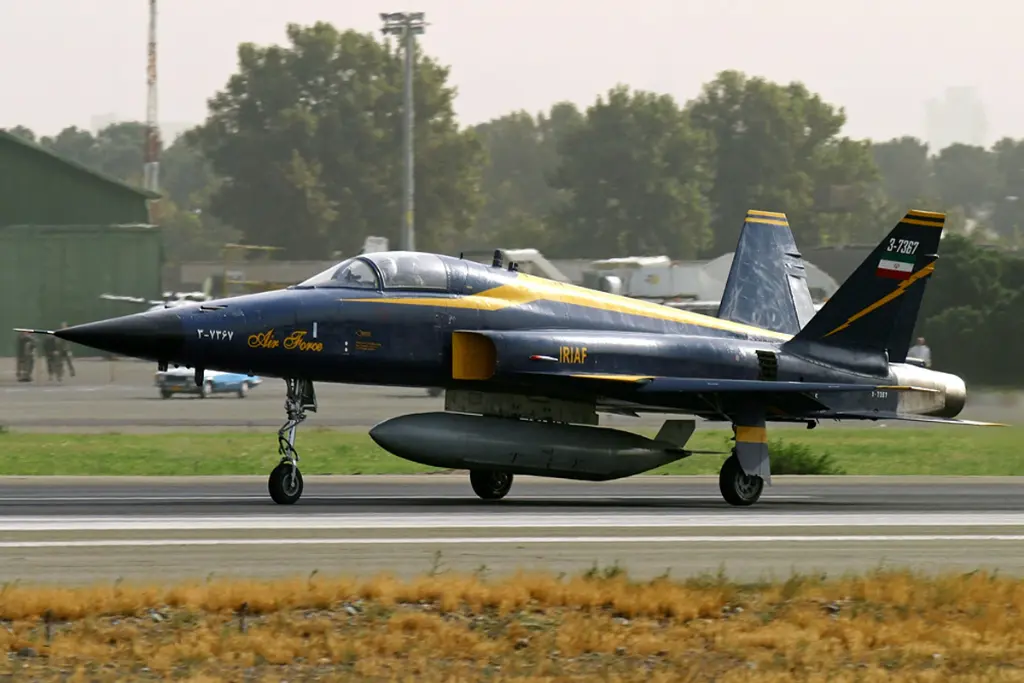
HESA Saeqeh: Iran’s Twin-Tailed F-5 Derivative
The HESA Saeqeh (Persian: صاعقه Sâ’eğe, “Thunderbolt”), sometimes referred to as Saeqeh-80, is an Iranian-built single-seat jet fighter developed by the Iran Aircraft Manufacturing Industrial Company (HESA). It is a highly modified and purportedly second-generation derivative of the American Northrop F-5 Freedom Fighter, a testament to Iran’s efforts to maintain and develop its military aviation capabilities despite international sanctions.
Saeqeh Development & Iranian Self-Sufficiency
The Saeqeh program emerged from the earlier HESA Azarakhsh project, which was also an Iranian-modified F-5. Facing an aging fleet of U.S.-origin aircraft (F-4, F-5, F-14) and limited access to new foreign military hardware, Iran has focused on indigenous reverse-engineering, maintenance, and modification of its existing platforms. The Saeqeh is a joint product of the Islamic Republic of Iran Air Force (IRIAF) and the Iranian Ministry of Defence.
The first prototype of the Saeqeh was reportedly shown making a test flight in July 2004. The aircraft officially entered service with the IRIAF on September 22, 2007, after successful testing in September 2007. Iranian officials have often claimed advanced capabilities for the Saeqeh, sometimes comparing it to more modern aircraft like the F/A-18 Hornet, though external analysis generally points to it being a significantly upgraded F-5. Production of the initial Saeqeh variants is believed to have been limited, with total numbers built cited around 5-12 aircraft before a shift to the HESA Kowsar.
Saeqeh Design Features: Distinctive Twin Tails
The most visually distinguishing feature of the HESA Saeqeh, setting it apart from the original F-5, is its twin vertical stabilizers (tail fins), canted outwards, reminiscent of the F/A-18 Hornet. This modification is reportedly intended to improve maneuverability and potentially reduce radar cross-section, though its effectiveness is debated by external analysts.
- Derived Airframe: The Saeqeh’s airframe largely resembles that of the Northrop F-5E, suggesting it is either a modification of existing F-5 airframes (which Iran possesses in significant numbers) or a reverse-engineered copy, rather than an entirely new design.
- Engine: It is believed to be powered by upgraded Iranian-built General Electric J85 afterburning turbojet engines, likely with some level of local modification or reverse-engineered components.
- Performance Claims: Iranian sources have claimed a range of 3,000 km (1,864 mi) and high maneuverability. Specific detailed performance specifications are rarely released by Iran and are often subject to speculation.
Saeqeh Avionics & Armament: Evolving Indigenous Systems
While specific details are scarce and often unverified, Iranian sources claim the Saeqeh incorporates improved avionics and weapon systems over the standard F-5.
- Radar System: It is reported to feature a Phazotron-NIIR N019 radar, known in Iran as “Baaz,” which is said to have a range of 80 km (50 miles) and the ability to track 10 targets and engage two simultaneously. This radar is typically associated with MiG-29s, suggesting either an acquisition or a reverse-engineered variant.
- Avionics Upgrades: The Saeqeh-2 variant (see below) reportedly includes more advanced electronic systems and avionics.
- Weaponry: The aircraft is designed to carry a range of air-to-air and air-to-ground ordnance, likely including:
- Air-to-Air Missiles: Assumed to retain compatibility with older AIM-9 Sidewinder infrared-guided missiles (which Iran possesses) and potentially indigenous Iranian AAMs.
- Air-to-Ground Munitions: Unguided bombs and rocket pods. Iranian media often shows Saeqehs armed with these simpler weapons. There are claims of integration with more advanced Iranian-developed precision-guided munitions.
- Internal Cannon: Likely retains the 20mm M39A2 cannons from the F-5.
Saeqeh Variants & Further Developments
The Saeqeh is part of a series of Iranian F-5 derivatives, with at least one confirmed variant:
- Saeqeh-1 (Single-Seat): The initial production model with the distinctive twin tails. Production of this variant is considered to have been limited, with roughly 5 units confirmed before shifting production.
- Saeqeh-2 (Two-Seat): Unveiled in 2015, this is a two-seat variant designed for both advanced training and combat roles. It reportedly features more advanced weapon systems, electronics, and avionics. It is believed that existing two-seat F-5F airframes in Iran’s inventory were converted to this standard. At least one Saeqeh-2 is confirmed to have been built.
- HESA Kowsar: While distinct from the Saeqeh, the Kowsar is another recent Iranian fighter (unveiled in 2018) that is also a direct derivative of the F-5. The Kowsar notably reverted to a single tail and features a glass cockpit, HUD, and advanced ballistic computers, suggesting a continuous evolution of F-5-based indigenous designs. Some sources consider the Kowsar to be a “third generation” F-5 derivative after Azarakhsh and Saeqeh.
Saeqeh Operators & Operational Status
- Iran (Islamic Republic of Iran Air Force – IRIAF): The sole operator.
- The Saeqeh forms a small part of the IRIAF’s diverse, but aging, fighter fleet. It is primarily used for training, air policing, and propaganda displays of Iranian indigenous defense capabilities.
- The primary operational unit is believed to be the 23rd Tactical Fighter Squadron based in Tabriz.
- The exact number of operational Saeqeh aircraft remains unclear due to Iran’s secrecy. Estimates range from less than a dozen to perhaps around 20 units across all variants before production shifted to Kowsar.
Saeqeh Combat History & Role in Iranian Airpower
The HESA Saeqeh has no confirmed combat history in actual warfare. Its operational activities, as reported by Iranian state media, have primarily involved:
- Military Exercises: Participating in various Iranian military exercises, conducting mock bombing missions and demonstrating its maneuverability.
- Air Shows & Parades: Regularly featured in military parades and air shows, serving as a symbol of Iran’s perceived self-sufficiency in defense.
The Saeqeh represents Iran’s determined effort to maintain and incrementally upgrade its fighter fleet using available resources and reverse-engineering capabilities. While its true combat effectiveness against modern adversaries is widely questioned by international defense analysts, it signifies Iran’s commitment to developing its indigenous aerospace industry.
Previous Article
Aero L-159 ALCANext Article
Consolidated B-24 Liberator