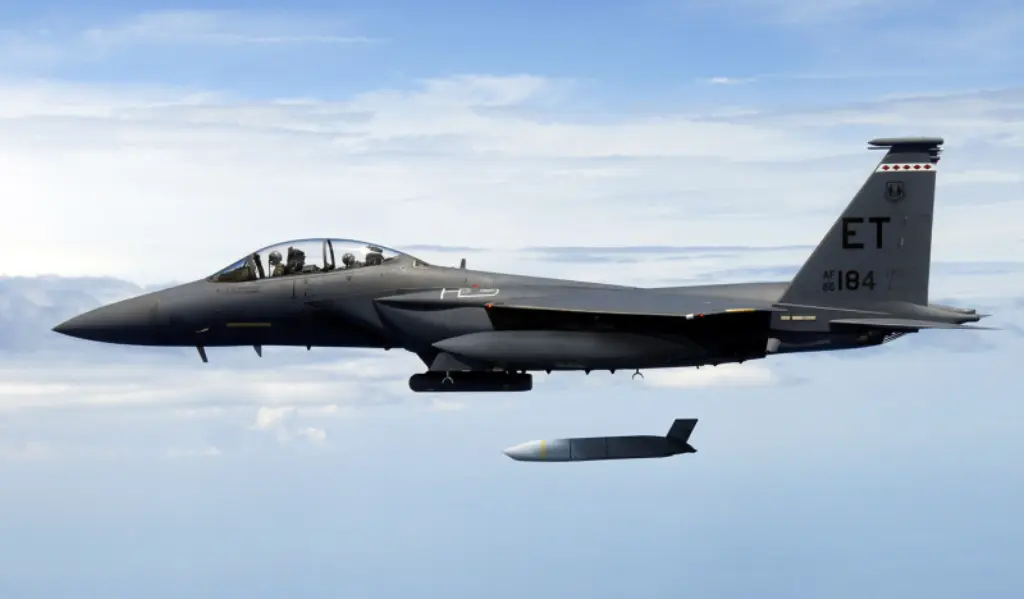
Cruise missiles are among the most precise and feared weapons in modern warfare. Capable of flying hundreds or thousands of kilometers to strike targets with pinpoint accuracy, they’ve reshaped how nations conduct long-range attacks.
In this article, you’ll learn how cruise missiles work, what makes them different from other missiles, and why they play a critical role in conflicts from Ukraine to the Middle East. Get ready to understand the engineering behind these silent, deadly hunters.
What Is a Cruise Missile?
A cruise missile is a guided missile that flies like a small unmanned aircraft to deliver a warhead to a specific target.
Unlike ballistic missiles, which arc high into space before diving down, cruise missiles fly within the atmosphere at low altitudes, following a flat trajectory.
They can travel subsonic or supersonic speeds, and some advanced models are stealthy, making them extremely hard to detect and intercept.
Key fact: The U.S. Tomahawk missile can fly over 1,600 km (1,000 miles) with an accuracy within 5 meters of its target.
Key Components and Design
Every cruise missile has four essential systems:
- Propulsion: Usually a jet engine (turbofan or turbojet) for sustained flight.
- Guidance System: GPS, inertial navigation, terrain mapping, and terminal seekers.
- Warhead: Can be conventional, bunker-busting, or nuclear.
- Airframe: Aerodynamic design with wings and control surfaces for stable flight.
These components allow the missile to stay airborne for hours, adjust course mid-flight, and hit moving or fixed targets with extreme precision.
How They Navigate: From GPS to Terrain Matching
Cruise missiles use multiple navigation methods to stay on course:
- Inertial Navigation System (INS): Tracks position using motion sensors—works without signals.
- GPS Guidance: Provides real-time location updates for high accuracy.
- TERCOM (Terrain Contour Matching): Compares ground elevation with stored maps to navigate.
- DSMAC (Digital Scene Matching): Uses camera images to identify the target area in the final phase.
This layered approach ensures the missile can reach its target even if GPS is jammed.
Example: The Tomahawk Block IV can reprogram its target mid-flight via satellite link—ideal for dynamic combat situations.
Flight Profile: Low, Fast, and Hard to Detect
Cruise missiles fly very low to the ground—sometimes just 10–50 meters above terrain—to avoid radar detection.
This nap-of-the-earth flight allows them to hide behind hills and buildings, making early warning difficult.
- Subsonic missiles (e.g., Tomahawk): Fly at ~880 km/h (Mach 0.7), quieter and more fuel-efficient.
- Supersonic missiles (e.g., Russian Kh-47M2 Kinzhal): Reach Mach 5–10, harder to intercept but less stealthy.
Their small radar cross-section and low altitude make them a serious challenge for air defenses.
Types of Cruise Missiles
| Missile | Country | Range | Speed | Notable Feature |
|---|---|---|---|---|
| Tomahawk | USA | 1,600+ km | Subsonic | GPS + TERCOM, reprogrammable |
| Kalibr | Russia | 1,500 km | Subsonic | Used in Syria and Ukraine |
| Storm Shadow / SCALP EG | UK/France | 560 km | Subsonic | Stealthy, bunker-penetrating |
| BrahMos | India/Russia | 290–800 km | Supersonic | Fastest cruise missile in service |
| JASSM | USA | 1,000+ km | Subsonic | Stealth design, AI-guided |
Each is tailored for specific missions—deep strikes, anti-ship roles, or tactical flexibility.
Real-World Use in Modern Conflicts
- Syria (2017–2018): U.S., UK, and France launched Tomahawks and Storm Shadows against chemical weapons sites.
- Ukraine War (2022–present): Russia uses Kalibr and Kh-101 missiles; Ukraine responds with Western-supplied Storm Shadows.
- Middle East (2024): Israel uses air-launched cruise missiles to strike Iranian targets in Iran and Lebanon.
Impact: Cruise missiles allow nations to strike deep behind enemy lines without risking pilots or aircraft.
However, their use has also led to civilian casualties when guidance fails or intelligence is flawed.
Defenses Against Cruise Missiles
Stopping a cruise missile is extremely difficult due to its low altitude and small size.
Common defense layers include:
- Radar networks: Low-frequency radars to detect low-flying objects.
- Interceptor missiles: Like Patriot or NASAMS, designed to hit small, fast targets.
- Electronic warfare: Jamming GPS or navigation signals.
- Fighter patrols: Jets with radar can detect and destroy incoming missiles.
Despite these, no system is 100% effective—especially when missiles attack in swarms.
Conclusion: The Future of Precision Strike
Cruise missiles are a cornerstone of modern military power—offering long range, precision, and flexibility without risking human pilots.
Future developments include hypersonic cruise missiles, AI-guided targeting, and stealthier, smarter designs that can evade even the most advanced defenses.
As conflicts grow more complex, the ability to strike fast and accurately from afar will remain a decisive advantage.
FAQ
Q: How is a cruise missile different from a ballistic missile?
A: Cruise missiles fly like planes within the atmosphere; ballistic missiles follow a high arc outside the atmosphere and re-enter at high speed.
Q: Can cruise missiles hit moving targets?
A: Yes—modern versions like the Naval Strike Missile (NSM) can target ships at sea using infrared or radar seekers.
Q: Are cruise missiles nuclear-capable?
A: Some are—like the U.S. AGM-86 and Russia’s Kh-102—designed to carry nuclear warheads.
Q: Why are they so hard to stop?
A: They fly low, slow, and small—blending into ground clutter and often evading radar until it’s too late.
Destacado: “A cruise missile doesn’t just fly to a target—it thinks its way there, adjusting every second to ensure destruction with precision.”