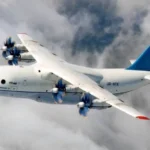
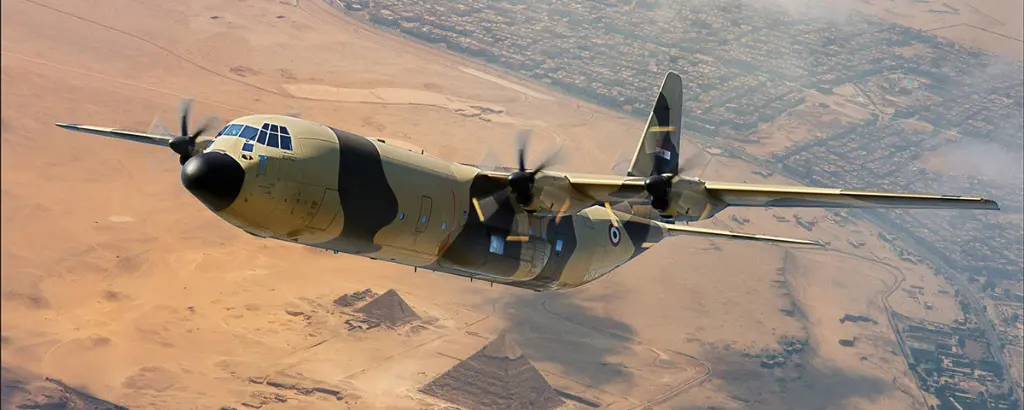
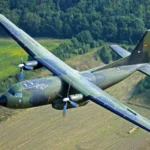
The Lockheed C-130J Hercules is an advanced version of the legendary C-130 military transport aircraft, featuring new engines, avionics, and systems. Widely used by air forces around the world, the C-130J excels in tactical airlift, airdrop, medical evacuation, and humanitarian missions. Its first flight was in 1996 and it remains in production today.
Fact Sheet
| Role | Tactical Military Transport |
|---|---|
| Manufacturer | Lockheed Martin |
| First Flight | April 5, 1996 |
| Service Entry | 1999 |
| Crew | 2 pilots, 1 loadmaster (standard configuration) |
| Capacity | Up to 92 passengers, 64 paratroopers, or 19,000 kg (42,000 lb) of cargo |
Specifications
| Length | 29.3 m (96 ft 1 in) |
|---|---|
| Wingspan | 40.4 m (132 ft 7 in) |
| Height | 11.9 m (39 ft 1 in) |
| Max Takeoff Weight | 74,389 kg (164,000 lb) |
| Engines | 4 × Rolls-Royce AE 2100D3 turboprops (4,637 shp each) |
| Max Speed | 671 km/h (417 mph) |
| Range | 3,334 km (2,073 mi) with max payload |
| Service Ceiling | 8,615 m (28,280 ft) |
Notable Features
- Modern glass cockpit and digital avionics
- Powerful new engines and six-bladed propellers
- Short takeoff and landing capability
- Versatile for cargo, troop transport, medical evacuation, and airdrop missions
- Operated by over 20 countries worldwide
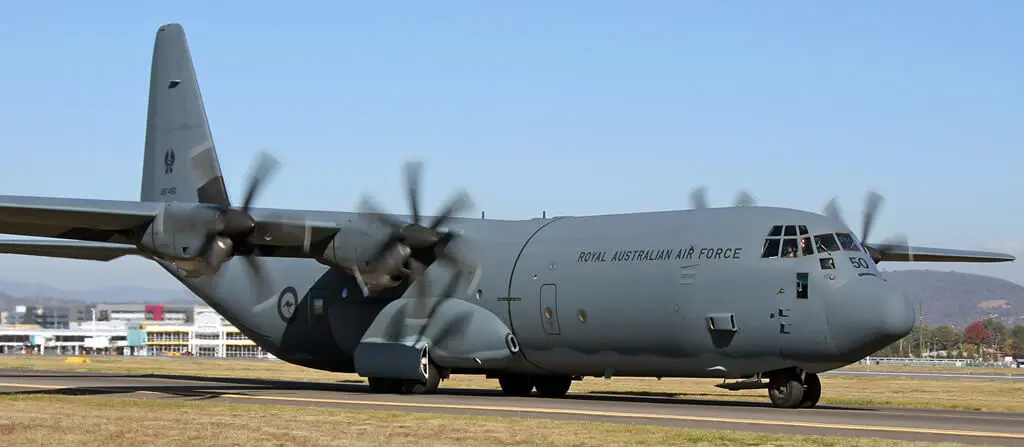
Lockheed C-130 Hercules
The Lockheed C-130 Hercules is a four-engine turboprop military transport aircraft that has become an icon of tactical airlift and versatility. Since its first flight in 1954, it has been in continuous production for over 70 years, a feat unmatched by any other military aircraft. Its rugged design, exceptional performance, and adaptability have made it a workhorse for air forces and civilian operators in over 70 countries.
Key Features and Capabilities
The C-130’s design was a game-changer, focused entirely on the tactical airlift mission. Key features that have ensured its longevity include:
- Short Takeoff and Landing (STOL): The aircraft’s powerful turboprop engines and high-lift wing design allow it to take off and land on short, unprepared runways, including dirt, sand, or snow. This capability makes it ideal for operating in remote and austere environments.
- Rear Loading Ramp: The C-130 features an innovative rear loading ramp and door that is at truck-bed height. This allows for rapid and efficient roll-on/roll-off loading of vehicles, cargo, and personnel, even without specialized ground equipment.
- Versatile Cargo Bay: The large, unpressurized cargo hold can be quickly reconfigured. It can carry a variety of payloads, including vehicles, troops, airdrop platforms, and palletized cargo.
- Multi-Mission Adaptability: The airframe’s robust and flexible design has enabled the development of over 70 different variants for specialized missions, including:
- AC-130 Gunship: A heavily armed ground-attack aircraft.
- KC-130 Tanker: Used for aerial refueling of helicopters and fixed-wing aircraft.
- HC-130 Combat King: A combat search and rescue platform.
- WC-130 Hurricane Hunter: Used for weather reconnaissance, flying directly into tropical storms.
- LC-130 Skibird: Equipped with skis for polar operations.
C-130J Super Hercules
The latest and most advanced version is the C-130J Super Hercules. It features significant upgrades that improve on its predecessor’s performance while reducing operational costs. The C-130J has new Rolls-Royce AE 2100 turboprop engines with six-bladed composite propellers, a modern two-pilot flight station with digital avionics, and an advanced cargo handling system. These improvements allow it to fly faster, higher, and farther, while also reducing crew requirements from five to just three.
Operational History and Status
The C-130 has been involved in every major military operation since the mid-20th century. It has performed countless humanitarian aid missions, disaster relief efforts, and combat support roles across the globe.
Today, the C-130 remains a vital asset for air forces and relief agencies worldwide. With new C-130Js still in production and legacy models undergoing extensive modernization, the Hercules fleet is expected to remain in service for decades to come, continuing its legacy as one of aviation’s true workhorses.
Previous Article
Transall C-160Next Article
Antonov An-70