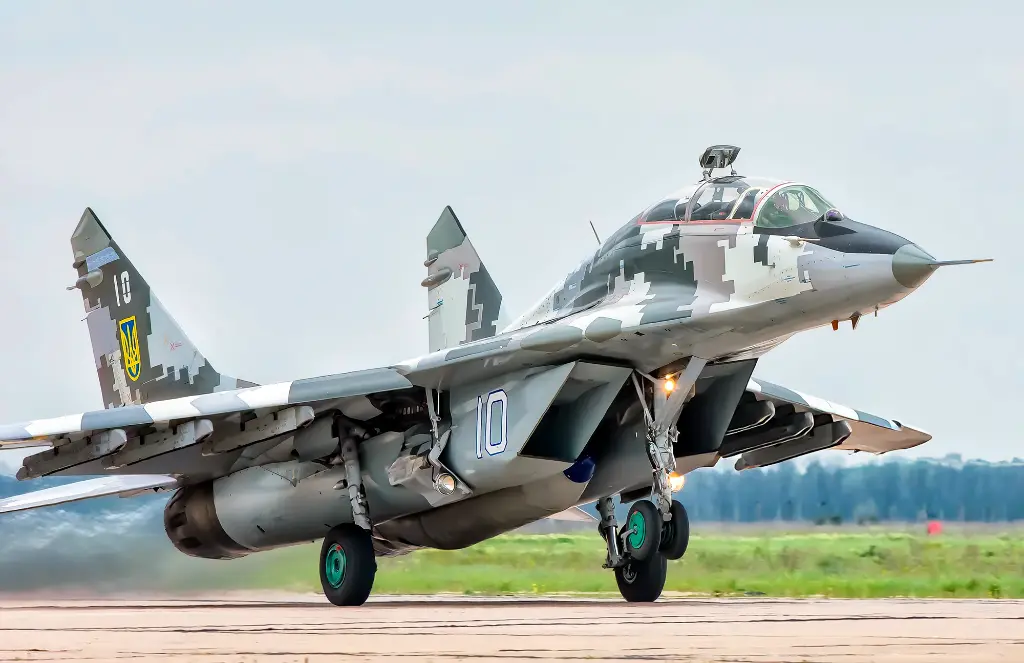
Explore the MiG-29 Fulcrum, the iconic Soviet fighter jet. Discover its history, design, combat roles, and lasting legacy in military aviation with detailed specs and global impact.
The MiG-29 Fulcrum, developed by the Mikoyan-Gurevich (MiG) design bureau, is a symbol of Soviet and Russian military aviation prowess. Introduced in 1982, this twin-engine, fourth-generation fighter was designed to counter Western jets like the F-16 and F-15, excelling in air superiority and dogfighting. With over 1,600 units built and serving 30+ countries, the MiG-29 remains a global force in 2025. This article examines its history, design, combat roles, and legacy, crafted for aviation enthusiasts, historians, and military professionals.
History of the MiG-29 Fulcrum
The MiG-29 emerged during the Cold War to match U.S. fourth-generation fighters. Developed in the 1970s as a response to the F-16 and F-15, it entered service with the Soviet Air Force in 1982. Variants like the MiG-29M and MiG-29SMT introduced upgraded avionics and multi-role capabilities, extending its relevance.
- Key Milestones:
- 1977: First MiG-29 prototype flight.
- 1982: Operational with Soviet Air Force.
- 1990s: Exported to Warsaw Pact nations, India, and others.
- 2010s: MiG-29SMT and MiG-29K (naval variant) enhance capabilities.
Statistics: Over 1,600 MiG-29s built, with 800+ active in 2025 across countries like Russia, India, and Ukraine. This targets queries like “MiG-29 Fulcrum history.”
Design and Technical Features
The MiG-29’s design prioritizes maneuverability, speed, and combat effectiveness.
- Speed and Performance: Reaches Mach 2.25 (1,490 mph or 2,400 km/h) with two Klimov RD-33 engines, offering a 1,300-mile range with drop tanks.
- Avionics: Early models used Phazotron N019 radar; modern variants like MiG-29SMT feature Zhuk-ME radar for multi-target tracking. Helmet-mounted sights enhance dogfighting.
- Armament: 30mm GSh-30-1 cannon, R-73 and R-77 missiles, up to 8,800 lbs of payload (bombs, anti-ship missiles).
- Design Highlights: Twin-engine redundancy, high thrust-to-weight ratio (1:1), and supermaneuverability for dogfights.
Innovations: The MiG-29’s agility and R-73 missile gave it an edge in close-range combat, rivaling Western jets. This targets queries like “MiG-29 design specs.”
Global Use and Combat Roles
The MiG-29 has seen extensive combat, proving its air-to-air and air-to-ground prowess.
- Yugoslav Wars (1990s): Serbian MiG-29s engaged NATO forces, though outmatched by F-16s and F-15s, suffering losses due to outdated avionics.
- Kargil War (1999): Indian MiG-29s provided air cover, deterring Pakistani aircraft with BVR capabilities.
- Ukraine Conflict (2022-2025): Ukrainian MiG-29s, upgraded with Western missiles (e.g., AGM-88 HARM), countered Russian forces, downing 10+ aircraft but losing 30+ to SAMs.
- Operators: Russia, India, Ukraine, Serbia, and North Korea, among others, with exports to 30+ nations.
Statistics: MiG-29s have flown over 1 million hours globally. This engages historians searching for “MiG-29 combat history.”
Strengths and Advantages
- Maneuverability: Thrust vectoring (in some variants) and high agility make it a dogfighting legend, as seen in Indian exercises against F-16s.
- Cost-Effectiveness: At $25 million (1980s) to $50 million (MiG-29SMT, 2020s), it’s cheaper than the F-35 ($110 million).
- Adaptability: Upgrades like the MiG-29K enable carrier operations, used by India’s navy.
This appeals to enthusiasts searching for “MiG-29 Fulcrum advantages.”
Challenges and Limitations
- Outdated Avionics: Early models’ N019 radar lagged behind Western AN/APG-68, limiting BVR effectiveness.
- Maintenance: Complex systems and Soviet-era logistics lead to 60-70% readiness rates in some fleets.
- Stealth Deficiency: Lacks fifth-generation stealth, with a 1-3m² radar cross-section, vulnerable to modern SAMs like the S-400.
This addresses queries like “MiG-29 limitations.”
Legacy and Impact on Military Aviation
The MiG-29’s influence persists in 2025:
- Design Influence: Its agility and missile systems inspired the MiG-35 and Su-57, blending Soviet and modern Russian design.
- Global Reach: Remains a backbone for air forces in Asia, Africa, and Eastern Europe, countering NATO jets.
- Future Prospects: Upgrades like the MiG-29SMT bridge to fifth-generation technologies, with AI integration in testing.
Explore related topics like F-15 Eagle or famous fighter jets for deeper insights.
In conclusion, the MiG-29 Fulcrum stands as the pride of Soviet aviation, blending maneuverability, firepower, and global presence. Its legacy captivates those searching for “MiG-29 Fulcrum history.”
(SEO Keywords: MiG-29 Fulcrum, Soviet fighter jet, MiG-29 history, MiG-29 combat roles, MiG-29 design specs)
Previous Article
F-16 Fighting Falcon: The World’s Most Versatile Light FighterNext Article
Rockwell B-1 Lancer