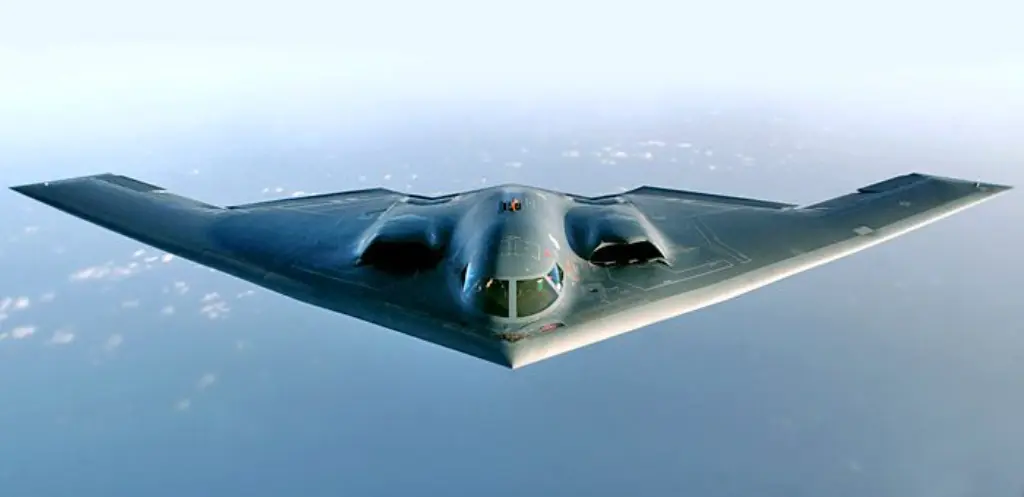
The Northrop Grumman B-2 Spirit, often simply called the “Stealth Bomber,” is one of the most distinctive and technologically advanced aircraft ever built. Its iconic flying wing design, which blends the airframe and wing into a single, seamless structure, is a masterpiece of stealth engineering. The B-2 was designed to penetrate sophisticated anti-aircraft defenses and deliver both conventional and nuclear weapons to targets anywhere in the world.
A Cold War Icon with a Modern Mission
Development of the B-2 began under the highly classified “Advanced Technology Bomber” (ATB) program in the late 1970s. Its mission was to strike deep into the heart of the Soviet Union, a mission that became less relevant with the end of the Cold War. The initial plan to build over 130 aircraft was drastically cut to just 21 airframes.
- Entry into Service: The first B-2 was publicly unveiled in 1988, and it officially entered service in 1997 with the U.S. Air Force.
- Active Fleet: As of mid-2025, the U.S. Air Force operates a fleet of 19 B-2s. One aircraft was lost in a crash in 2008, and another was likely retired after a crash in 2022. All B-2s are assigned to the 509th Bomb Wing at Whiteman Air Force Base, Missouri.
- Dual-Role Capability: The B-2 is a multi-role heavy bomber capable of delivering a wide range of conventional and nuclear weapons. Its massive internal payload bays can carry up to 40,000 pounds of ordnance, including up to 80 GPS-guided JDAMs (Joint Direct Attack Munitions) or two 30,000-pound GBU-57 Massive Ordnance Penetrator (MOP) bunker-buster bombs. It is the only aircraft currently certified to carry the MOP in a stealth configuration.
- Global Reach: The B-2’s unrefueled range is approximately 6,000 nautical miles (9,600 km), which can be extended to over 10,000 nautical miles (16,000 km) with a single aerial refueling, giving it true intercontinental strike capability. B-2s have demonstrated this by flying long-duration, non-stop combat missions from Missouri to Kosovo, Afghanistan, and other locations.
Stealth Technology: More Than a Flying Wing
The B-2’s effectiveness is derived from its unique combination of stealth features:
- Low-Observability: The B-2’s flying wing design and composite materials drastically reduce its radar, infrared, visual, and acoustic signatures. Many aspects of its low-observability process remain classified, but its stealth is a primary reason it can penetrate the most sophisticated air defenses.
- Electronic Warfare Suite: It is equipped with advanced electronic intelligence and jamming capabilities to further evade detection and degrade enemy defenses.
- High-Altitude Operations: Its stealth allows it to operate at high altitudes (up to 50,000 feet), which not only increases its range but also gives its sensors a better field of view for targeting and surveillance.
Recent News and Modernization Efforts
Despite its age, the B-2 remains a critical component of the U.S. strategic arsenal and is continuously being upgraded to maintain its operational relevance against modern threats.
- Continuous Upgrades: The B-2 fleet is undergoing a series of ongoing modernization programs focused on safeguarding its penetrating strike capability and improving its lethality. These include upgrades to its communications and survivability, with new secure, jam-resistant satellite communication systems and improved low-observable materials and coatings.
- JASSM-ER Integration: The B-2 has successfully test-launched the AGM-158B JASSM-ER (Joint Air-to-Surface Standoff Missile – Extended Range), clearing the way for full integration of this long-range cruise missile.
- Operational Deployments: The B-2 continues to be used in high-profile, high-stakes combat operations. In a recent example, B-2 bombers were involved in a large-scale strike on Iranian nuclear facilities, demonstrating the aircraft’s ability to operate in contested airspace.
- Trump’s “New” B-2: In mid-2025, President Donald Trump made a public statement about ordering a “large number” of an “enhanced” version of the B-2. However, Northrop Grumman and the Pentagon have not confirmed any new production line. Industry analysts suggest his comments likely referred to a major modernization and upgrade package for the existing fleet, rather than new aircraft production, as restarting the B-2 production line would be prohibitively expensive and time-consuming.
The Future: The B-21 Raider
The B-2’s legacy will eventually be carried on by its successor, the Northrop Grumman B-21 Raider. The B-21 is designed as a more affordable, maintainable, and digitally integrated stealth bomber, incorporating lessons learned from the B-2 program. The B-21 is expected to begin replacing the B-2 fleet in the early 2030s, with all B-2s slated for retirement by 2032.
The B-21’s design is heavily influenced by the B-2, but it is expected to be even stealthier and to serve as a command and control hub for a future fleet of uncrewed aircraft. The B-2 will continue to serve as the nation’s premier stealth bomber until the Raider is fully operational in sufficient numbers.