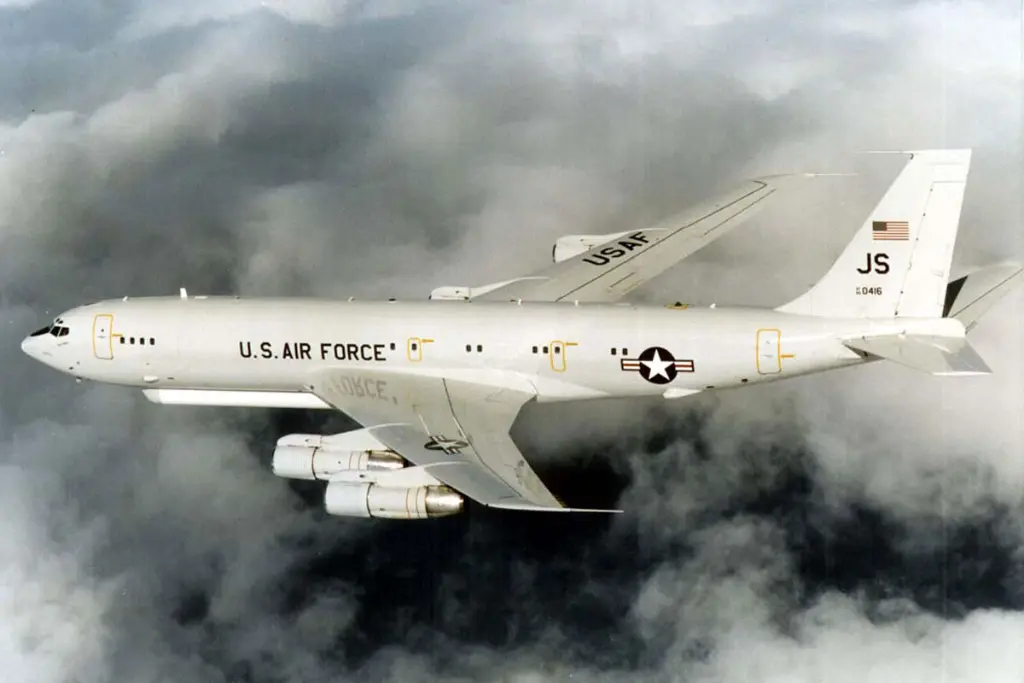
The Northrop Grumman E-8C Joint STARS (Joint Surveillance Target Attack Radar System) is an airborne battle management, command and control, intelligence, surveillance, and reconnaissance (ISR) aircraft. Based on the Boeing 707 airframe, the E-8C provides real-time ground surveillance to detect, track, and classify moving and stationary targets on the battlefield, supporting both air and ground commanders.
Fact Sheet
| Role | Airborne Ground Surveillance & Battle Management |
|---|---|
| Manufacturer | Northrop Grumman (airframe by Boeing) |
| First Flight | December 1988 (prototype) |
| Service Entry | 1997 |
| Crew | Up to 21 (flight and mission crew) |
| Number Built | 17 |
Specifications (E-8C)
| Length | 152 ft 11 in (46.61 m) |
|---|---|
| Wingspan | 145 ft 9 in (44.42 m) |
| Height | 42 ft 6 in (12.95 m) |
| Empty Weight | 171,000 lb (77,564 kg) |
| Max Takeoff Weight | 336,000 lb (152,407 kg) |
| Powerplant | 4 × Pratt & Whitney JT3D-3B turbofans (18,000 lbf each) |
| Max Speed | 587 mph (945 km/h) |
| Range | 2,500 mi (4,000 km) with 9-hour loiter |
| Service Ceiling | 42,000 ft (12,800 m) |
Radar & Systems
| Radar | AN/APY-7 side-looking phased array radar |
|---|---|
| Detection Range | Over 250 km (155 mi) for ground targets |
| Other Systems | Battle management, secure communications, data links |
Notable Features
- Provides real-time ground surveillance and targeting data
- Can track thousands of ground vehicles simultaneously
- Supports air and ground commanders with battle management
- Key asset for joint and coalition operations
- Distinguishable by its large radar canoe under the forward fuselage
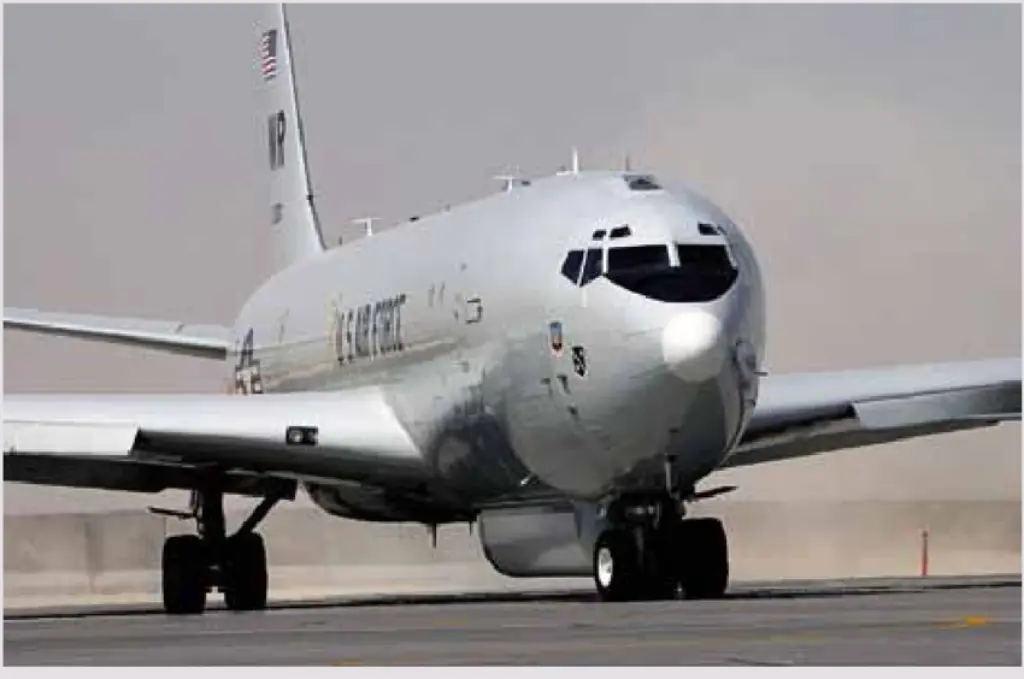
The E-8C Joint Surveillance Target Attack Radar System (Joint STARS) was a key airborne battle management platform for the U.S. Air Force. Known for the distinctive, 27-foot-long canoe-shaped radome mounted under its fuselage, the E-8C provided a unique ground surveillance capability for military commanders.
Role and Capabilities
Built on a modified Boeing 707 airframe, the E-8C’s primary mission was to detect, track, and classify ground targets in all weather conditions, day or night. Its key capabilities included:
- Ground Moving Target Indicator (GMTI): This powerful radar could detect moving vehicles and even dismounted troops from hundreds of miles away, providing an unparalleled view of the ground battlespace.
- Battle Management: The E-8C’s crew of more than 20 specialists, including mission crew members and ground surveillance officers, analyzed the radar data in real time. They could then direct air and ground assets to engage targets, making the E-8C a crucial command and control node for ground operations.
- Intelligence, Surveillance, and Reconnaissance (ISR): Beyond tracking, the E-8C could also identify and classify targets, providing crucial intelligence on enemy forces.
Retirement and Legacy
The E-8C Joint STARS fleet was a workhorse of U.S. military operations for decades, serving in every major conflict since its introduction in 1991, including the Gulf War, the wars in Iraq and Afghanistan, and operations in Syria.
However, based on an aging airframe that was difficult and expensive to maintain, the Air Force began a phased retirement of the E-8C fleet in the early 2020s. The program officially ended on September 24, 2023, with the final operational aircraft being sent to the “boneyard” at Davis-Monthan Air Force Base in Arizona.
The E-8C’s retirement marked a significant shift in U.S. military strategy. Instead of a single, large, expensive platform for ground surveillance, the E-8C’s mission is now being transitioned to a more dispersed, “family of systems” approach. This includes a mix of:
- High-Altitude Drones: Platforms like the MQ-4C Triton and the RQ-4 Global Hawk, equipped with advanced surveillance pods.
- Next-Generation Aircraft: Newer platforms like the E-7 Wedgetail are being developed with multi-mission capabilities that can handle some of the E-8C’s former roles.
- Space-Based Systems: The military is increasingly relying on commercial and military satellites to provide persistent ground surveillance.
While the E-8C’s unique capabilities in a single platform will be missed by some, its retirement signals a new era for ground surveillance that relies on network-centric warfare and a more resilient, multi-platform approach to battle management. The E-8C’s legacy of “seeing the un-seeable” on the ground remains a crucial chapter in the history of airborne surveillance.
Previous Article
Boeing E-3 SentryNext Article
Beechcraft MC-12W Liberty