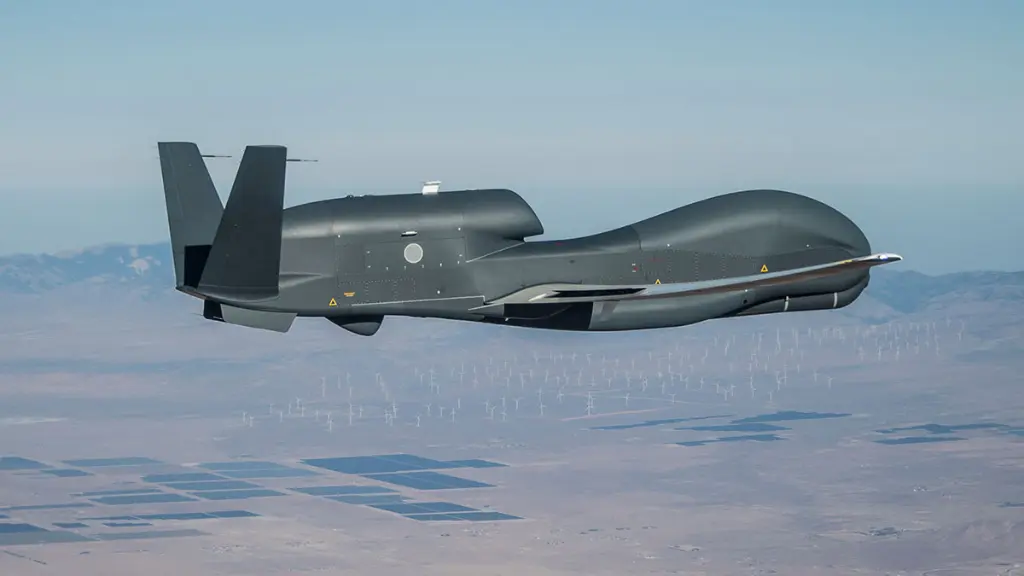
The Northrop Grumman RQ-4 Global Hawk is a high-altitude, long-endurance unmanned aerial vehicle (UAV) used for intelligence, surveillance, and reconnaissance (ISR) missions. Operated by the United States Air Force and allied nations, the Global Hawk provides broad-area, real-time imagery and signals intelligence over large distances and for extended periods.
Fact Sheet
| Role | High-Altitude Long-Endurance ISR UAV |
|---|---|
| Manufacturer | Northrop Grumman |
| First Flight | February 28, 1998 |
| Service Entry | 2001 |
| Crew | Unmanned (ground control crew) |
| Number Built | Over 50 |
Specifications (Block 40)
| Length | 47.6 ft (14.5 m) |
|---|---|
| Wingspan | 130.9 ft (39.9 m) |
| Height | 15.3 ft (4.7 m) |
| Empty Weight | 14,950 lb (6,781 kg) |
| Max Takeoff Weight | 32,250 lb (14,628 kg) |
| Powerplant | 1 × Rolls-Royce AE 3007H turbofan (7,600 lbf) |
| Max Speed | 357 mph (575 km/h) |
| Range | 14,000 mi (22,530 km) |
| Endurance | Over 32 hours |
| Service Ceiling | 60,000 ft (18,300 m) |
Sensors & Systems
| Sensors | Synthetic aperture radar (SAR), electro-optical/infrared (EO/IR), signals intelligence (SIGINT) |
|---|---|
| Communications | Satellite and line-of-sight data links |
| Other Systems | Onboard processing, real-time data transmission |
Notable Features
- Unmanned, high-altitude, long-endurance ISR platform
- Can survey vast areas in a single mission
- Provides near real-time imagery and intelligence
- Used for military and humanitarian missions worldwide
- Operated by USAF, NATO, and other allied nations
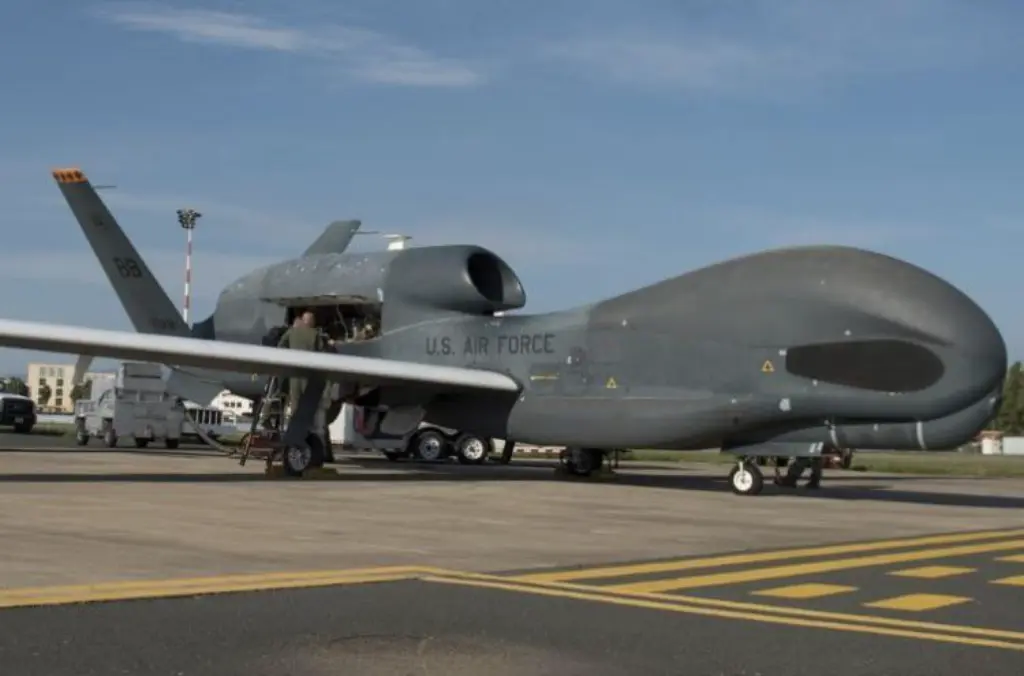
RQ-4 Global Hawk: The Eye in the Sky
The RQ-4 Global Hawk is a high-altitude, long-endurance (HALE) unmanned aerial vehicle (UAV) used for intelligence, surveillance, and reconnaissance (ISR). It’s known for its massive wingspan, which is larger than that of a Boeing 737, allowing it to stay airborne for over 30 hours at altitudes up to 60,000 feet. The aircraft’s mission is to collect and transmit high-resolution imagery and electronic intelligence to ground forces in real time.
Capabilities and Operational Role
The Global Hawk has been a crucial asset for the U.S. Air Force and its allies, providing persistent, all-weather surveillance over large areas. Its advanced sensor suite includes:
- Synthetic Aperture Radar (SAR): This radar can “see” through clouds and storms to create high-resolution maps of the ground.
- Electro-Optical (EO) and Infrared (IR) Sensors: These provide detailed imagery and real-time video, enabling the drone to track moving targets.
- Signals Intelligence (SIGINT): The aircraft can intercept and analyze enemy communications and electronic signals.
The Global Hawk has been a workhorse in modern conflicts, flying missions in support of operations in Afghanistan and Iraq. More recently, it has been used for surveillance missions over the Black Sea during the Russian invasion of Ukraine.
Retirement and the Future
Despite its impressive capabilities, the U.S. Air Force has decided to retire the majority of its Global Hawk fleet. The main reasons for this are its high operational and maintenance costs, which are now considered prohibitive. Its large size and lack of stealth also make it vulnerable to advanced anti-air defenses in a high-intensity conflict.
The Global Hawk’s mission is being transitioned to a more cost-effective and resilient “family of systems” approach. This includes:
- Next-Generation Stealth Drones: Classified, stealthy UAVs like the Northrop Grumman RQ-180 are taking over high-threat reconnaissance missions.
- Satellite Systems: The military is increasingly relying on a new generation of military and commercial satellites to provide persistent surveillance.
Interestingly, the legendary U-2 Dragon Lady spy plane, which the Global Hawk was initially designed to replace, is now receiving funding to fly until 2026. While the Global Hawk’s service is winding down, its legacy of pioneering long-endurance, unmanned ISR missions is secure.