The Sky’s Sonic Sentinel: Unveiling the Convair B-58 Hustler
When you think of fast planes, maybe a sleek fighter jet or a modern stealth bomber comes to mind. But long before drones and hypersonic missiles, there was a revolutionary aircraft that broke speed records and redefined what bombers could do. That plane was the Convair B-58 Hustler—the first operational bomber capable of flying at Mach 2, twice the speed of sound.
In this article, we’ll take a deep dive into the B-58 Hustler’s incredible story. From its futuristic design to its Cold War mission, you’ll learn why this jet was so groundbreaking—and why it didn’t last as long as expected. Buckle up—this is a ride through history at nuclear speed.
Why the B-58 Hustler Was So Special
The Convair B-58 Hustler wasn’t just another bomber. It was a technological marvel of the 1960s. Built by Convair for the U.S. Air Force, it was designed to fly higher, faster, and farther than any bomber before it.
Its biggest claim to fame? It could reach Mach 2, or about 1,325 miles per hour (2,130 km/h). That’s faster than a speeding bullet. At that speed, the B-58 could cross the United States in under two hours.
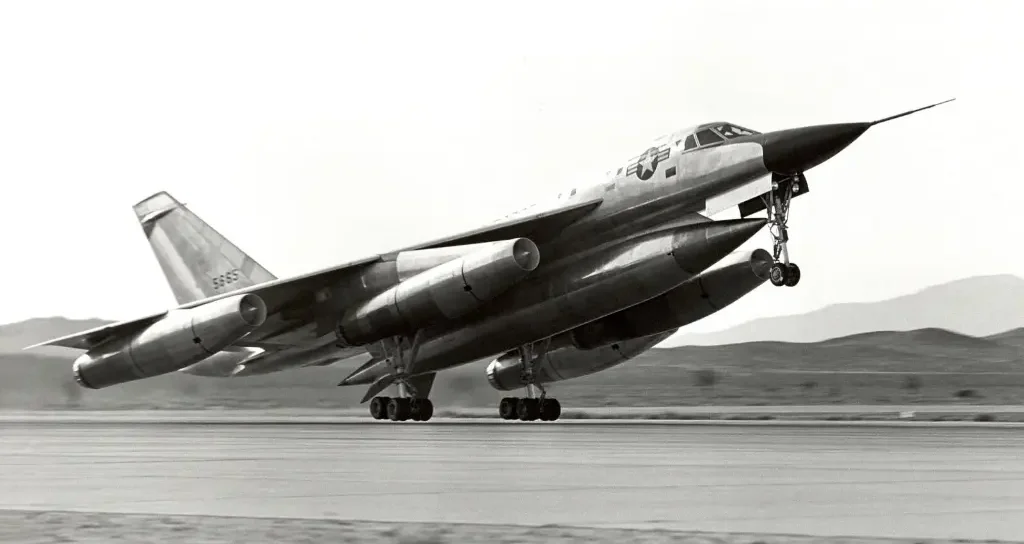
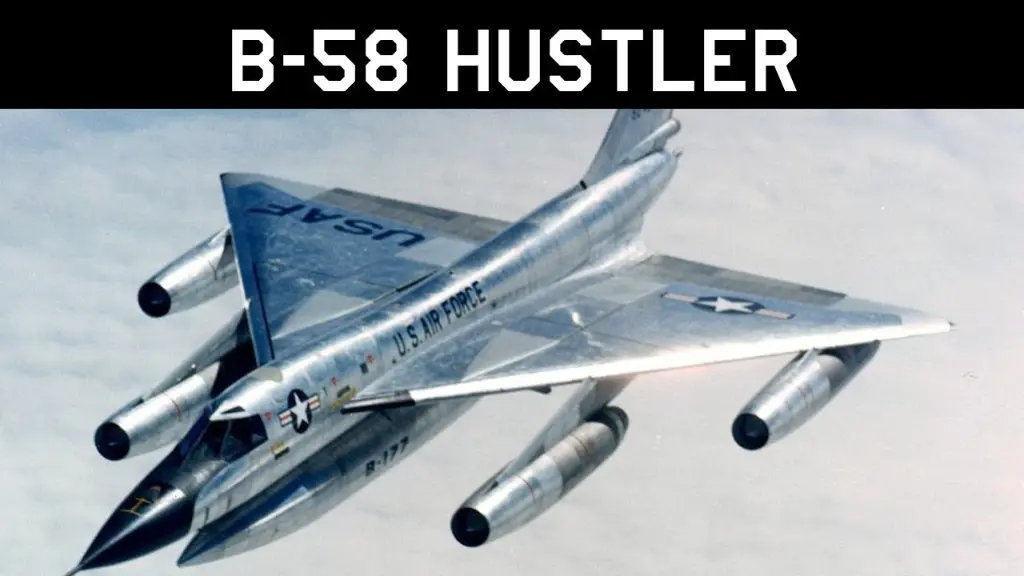
But speed wasn’t its only talent. The Hustler also flew at altitudes over 60,000 feet, making it nearly untouchable by enemy fighters and early surface-to-air missiles. Its sleek, delta-wing design looked like something from the future—and in many ways, it was.
Born in the Cold War: The Need for Speed
To understand the B-58, you have to go back to the Cold War. In the 1950s, the U.S. and Soviet Union were locked in a tense standoff. Both sides built massive nuclear arsenals, and the U.S. needed a way to deliver bombs deep into Soviet territory—fast and safely.
Early bombers like the B-36 and B-47 were slow and vulnerable. The U.S. needed a bomber that could outrun threats, not just outgun them. So, in 1951, the Air Force asked aircraft companies to design a supersonic strategic bomber.
Convair answered the call with a radical design: a slim, needle-nosed jet with a delta wing and four powerful engines. It was unlike anything seen before. The result? The B-58 Hustler, which made its first flight in 1956.
A Jet Like No Other: Design and Innovation
The B-58’s design was all about speed and efficiency. Here’s what made it stand out:
- Delta Wing: This wide, triangular wing provided great lift at high speeds and altitudes.
- Streamlined Fuselage: The long, narrow body cut through the air like a dart.
- Four Jet Engines: Mounted in pods under the wings, they gave the Hustler incredible thrust.
- Crew Capsule: Instead of individual seats, the three-man crew (pilot, navigator, and defense systems officer) rode in a pressurized escape capsule—a world first.
That capsule wasn’t just for comfort. In an emergency, the entire crew could eject together in one unit, surviving at supersonic speeds. It was a bold solution to a deadly problem.
The B-58 also used advanced materials like honeycomb aluminum panels to stay light and strong. Even its fuel system was cutting-edge, using complex pumps to balance fuel as the plane burned through thousands of gallons per hour.
Speed Records and Air Force Pride
The B-58 wasn’t just fast—it was record-breaking. Throughout the late 1950s and early 1960s, Hustler crews shattered speed and distance records.
In 1961, a B-58 named Firefly flew from Los Angeles to New York in just 2 hours and 15 minutes—averaging over Mach 2. That’s faster than today’s commercial flights, even with modern jets.
In 1963, another Hustler set a world record by flying over 6,600 miles without landing, proving it could strike targets across the globe. These feats weren’t just for show—they proved the B-58 could do its job: deliver nuclear weapons deep in enemy territory before defenses could react.
The Air Force loved the B-58. It was a symbol of American technological superiority during the Cold War. Pilots who flew it called it a “hot rod” of the sky—dangerous, demanding, but thrilling.
The Challenges of Flying a Supersonic Bomber
Despite its speed and power, the B-58 Hustler had serious drawbacks.
First, it was expensive. Each plane cost over $7 million in the 1960s—about $65 million today. Operating costs were sky-high, too. The B-58 burned fuel so fast it often needed mid-air refueling just to reach its target.
Second, it had limited range. Even with refueling, it couldn’t carry enough fuel to strike distant targets and return without help. This made missions complex and risky.
Third, maintenance was a nightmare. The advanced systems required constant attention. Ground crews needed specialized training, and parts were hard to replace.
Finally, the crew workload was intense. Flying at Mach 2 for hours was physically and mentally exhausting. Pilots had to manage extreme heat, pressure changes, and precise navigation—all while preparing for a nuclear mission.
These challenges made the B-58 hard to operate—and even harder to justify.
Why the B-58 Was Retired Early
By the mid-1960s, the world was changing. The Soviet Union developed better surface-to-air missiles that could reach high altitudes. Suddenly, flying high and fast wasn’t enough to stay safe.
At the same time, the U.S. began investing in intercontinental ballistic missiles (ICBMs). These rockets could deliver nuclear warheads faster and cheaper than any bomber.
The B-52 Stratofortress, though slower, was more reliable, had longer range, and could carry more weapons. It could also fly at low altitudes to avoid radar—a tactic the B-58 couldn’t match due to its design.
So, in 1970, just 14 years after it entered service, the B-58 Hustler was retired. Only 86 were ever built, and just a few remain on display in museums today.
Legacy of the B-58 Hustler
Even though it didn’t last long, the B-58 Hustler left a lasting mark on aviation history.
It proved that supersonic flight was possible for large military aircraft. The lessons learned from the B-58 helped shape future jets, including the SR-71 Blackbird and even modern stealth bombers.
Its escape capsule, advanced materials, and delta-wing design influenced aircraft engineering for decades.
And let’s not forget the sheer audacity of the B-58. It was a machine built for one purpose: to go faster than anyone thought possible. In an era of fear and tension, it gave the U.S. a powerful edge—and a symbol of what American innovation could achieve.
Final Thoughts: A Supersonic Legend
The Convair B-58 Hustler wasn’t perfect. It was expensive, complex, and eventually outpaced by new technology. But for a brief, shining moment, it ruled the skies at Mach 2.
It was the first operational Mach 2 bomber, a pioneer of speed, and a Cold War icon. Pilots who flew it remember it with awe. Engineers who built it still marvel at its design.
Today, the B-58 reminds us that progress often comes with trade-offs. Speed, power, and innovation are thrilling—but they must be balanced with practicality and purpose.
So the next time you hear about a new hypersonic jet or a stealth bomber, remember the Hustler. It was the original speed demon of the nuclear age—and it paved the way for everything that came after.