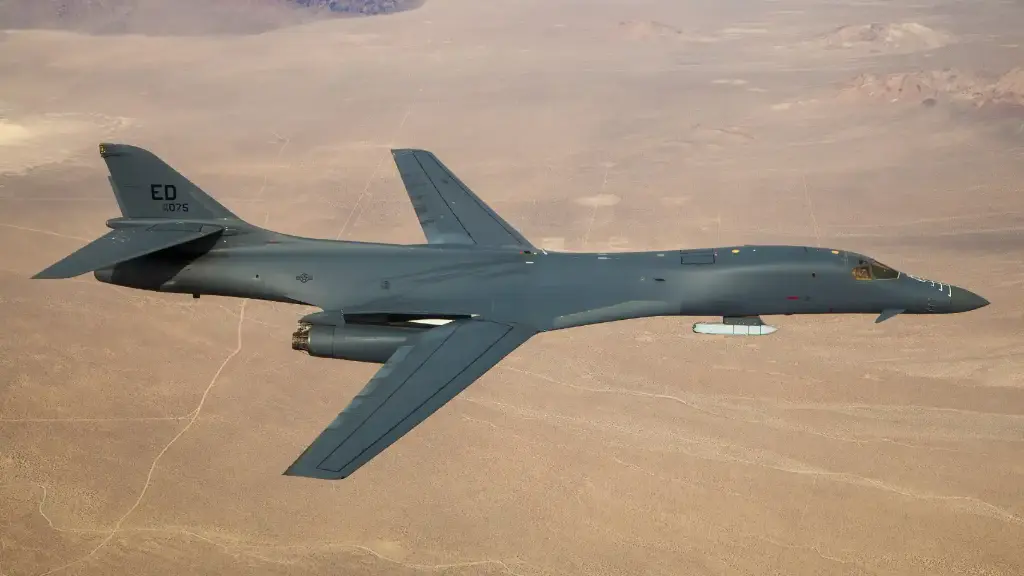
The Rockwell B-1 Lancer is a supersonic variable-sweep wing heavy bomber used by the United States Air Force. It was first envisioned in the 1960s as a platform for nuclear strike missions and entered service in 1986. The B-1B is known for its long range, high speed, and large payload capacity, making it a versatile asset for both nuclear and conventional missions.
Fact Sheet
| Role | Strategic Bomber |
|---|---|
| Manufacturer | Rockwell International (now Boeing) |
| First Flight | December 23, 1974 |
| Service Entry | 1986 |
| Crew | 4 (pilot, co-pilot, offensive systems officer, defensive systems officer) |
| Number Built | 104 |
Specifications (B-1B Model)
| Length | 146 ft (44.5 m) |
|---|---|
| Wingspan | 137 ft (41.8 m) wings spread, 79 ft (24.1 m) wings swept |
| Height | 34 ft (10.4 m) |
| Wing Area | 1,950 sq ft (181.2 m²) |
| Empty Weight | 192,000 lb (87,100 kg) |
| Loaded Weight | 326,500 lb (148,100 kg) |
| Max Takeoff Weight | 477,000 lb (216,400 kg) |
| Powerplant | 4 × General Electric F101-GE-102 turbofan engines (30,000+ lbf each with afterburner) |
| Max Speed | Mach 1.25 (918 mph, 1,480 km/h) at altitude |
| Cruise Speed | Mach 0.84 (617 mph, 993 km/h) |
| Range | 7,455 mi (11,997 km) |
| Service Ceiling | 60,000 ft (18,000 m) |
| Rate of Climb | N/A |
Armament & Defensive Equipment
| Guns | None |
|---|---|
| Bomb Load | Up to 75,000 lb (34,000 kg) |
| Aiming Equipment | AN/APQ-164 offensive radar system |
Notable Features
- Variable-sweep wings for optimal performance at different speeds and altitudes
- Large internal payload capacity for a variety of conventional and nuclear weapons
- Long range and high speed for strategic missions
- Advanced avionics and electronic warfare systems
- Used extensively in Operation Enduring Freedom and other conflicts
The Rockwell B-1 Lancer, known as “The Bone,” is a supersonic, variable-sweep wing, heavy bomber operated by the U.S. Air Force. Although initially designed for a nuclear role, it has been used exclusively as a conventional bomber since the mid-1990s and remains a core component of the bomber fleet.
Current Status and Role
As of mid-2025, the U.S. Air Force operates a fleet of 45 B-1Bs, primarily based at Dyess Air Force Base, Texas, and Ellsworth Air Force Base, South Dakota. The B-1’s main role is to provide a long-range, rapid-strike capability for conventional precision missions. It has the largest conventional payload of any bomber in the U.S. inventory, capable of carrying up to 75,000 lbs of ordnance internally.
The B-1’s speed and large payload capacity make it a versatile asset. It’s often deployed in Bomber Task Force (BTF) missions to various locations worldwide, like the recent deployment to Europe where B-1Bs flew over Riga, Latvia, with allied fighter jets to demonstrate NATO’s unity. These deployments showcase the aircraft’s ability to operate from different bases and integrate with allied forces, reinforcing deterrence and global power projection.
Modernization and Upgrades
Despite its age, the B-1 is continuously receiving upgrades to extend its service life and ensure its relevance in modern warfare. The Air Force is focused on two main areas:
- Payload Expansion: New external pylons are being developed to allow the B-1 to carry heavier, longer-range weapons, including hypersonic missiles like the AGM-183A ARRW. This upgrade is critical to its future role as a standoff weapon carrier. It is also the only Air Force aircraft certified to carry the AGM-158C Long-Range Anti-Ship Missile (LRASM).
- Avionics and Communications: Upgrades under programs like the B-1 Embracing Agile Scheduling Team (BEAST) are modernizing the B-1’s systems with new Identification Friend or Foe (IFF), Link 16 tactical data links, and improved secure communications. These enhancements reduce pilot workload and improve situational awareness on the modern digital battlefield.
The Future
The B-1B is planned to be retired by 2036, to be replaced by the new Northrop Grumman B-21 Raider stealth bomber. The B-21 is designed to be stealthier, more maintainable, and digitally integrated, which will be critical for a future of contested airspace.
Despite this, the B-1 is still being relied upon to carry out high-profile missions. The Air Force is even regenerating one retired B-1, nicknamed “Lancelot,” to replace a damaged aircraft and maintain the fleet’s congressionally mandated size. This demonstrates the B-1’s continued importance as a conventional “bomb truck” until the B-21 is fully operational in sufficient numbers.
You can learn more about the B-1’s upgrades in a video about a new “super B-1 Lancer.” The video, titled “Finally: US Tests the NEW Super B-1 Lancer After Massive Upgrade,” can be found here:

Previous Article
MiG-29 Fulcrum: The Pride of Soviet AviationNext Article
Douglas A-26 Invader