Modern fighter jets don’t just “see” the battlefield—they understand it. While older aircraft forced pilots to interpret multiple radar screens and sensor displays, today’s fighters like the F-35 create a single, intuitive picture of the entire battlefield through sensor fusion.
This technology transforms raw data from radar, infrared, electronic warfare systems, and off-board sensors into a coherent tactical awareness that gives pilots decisive advantages in combat. In conflicts from Syria to Ukraine, sensor fusion has proven to be the difference between victory and defeat.
In this article, you’ll discover exactly how sensor fusion works, which fighter jets lead the field, and why this technology is reshaping 21st-century air combat.
What Is Sensor Fusion? Beyond Simple Data Integration
Sensor fusion isn’t just combining data—it’s intelligently synthesizing information from multiple sources to create a tactical understanding greater than the sum of its parts.
Unlike older systems that displayed separate radar, infrared, and electronic warfare feeds, modern fusion:
- Correlates data points across sensors
- Resolves conflicts between contradictory information
- Predicts enemy movements based on patterns
- Prioritizes threats based on immediate danger
Key insight: Sensor fusion turns a fighter jet from a weapons platform into a flying tactical node—more valuable for its data than its missiles.
The evolution of sensor fusion represents a fundamental shift in air combat philosophy. Early fighter jets required pilots to mentally integrate information from multiple displays—a cognitively overwhelming task during high-speed combat. Fourth-generation fighters like the F-15C began integrating some sensor data, but pilots still had to interpret multiple displays.
Modern sensor fusion goes much further: it creates a single integrated tactical picture that presents only the most relevant information at the right time. This isn’t just about displaying more data—it’s about displaying the right data in a way that enhances rather than overwhelms the pilot. The F-35’s sensor fusion system, for example, processes over 1.5 million data points per second but presents only the critical information needed for immediate decision-making—reducing pilot workload by up to 30% in high-threat environments.
The Sensor Suite: Eyes and Ears of Modern Fighters
Modern fighters deploy a sophisticated array of sensors that work together through fusion:
Primary Sensors
- AESA Radar (AN/APG-81 on F-35):
- Electronically scanned array with no moving parts
- Can track 20+ targets while scanning for new threats
- Creates high-resolution ground maps while in air-to-air mode
- Distributed Aperture System (DAS):
- Six infrared cameras providing 360° spherical coverage
- Detects missile launches, tracks aircraft, and provides night vision
- Enables pilots to “look through” the cockpit floor
- Electro-Optical Targeting System (EOTS):
- Combines infrared targeting and laser designation
- Passively identifies and tracks targets without emitting radar
- Electronic Warfare Suite (AN/ASQ-239):
- Detects, identifies, and geolocates enemy emitters
- Automatically jams threats while maintaining communication
Networked Sensors
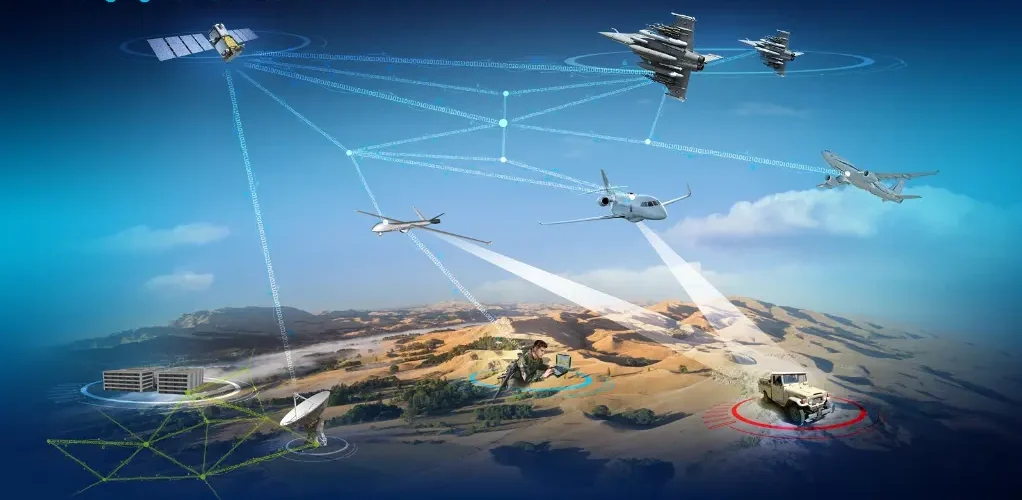
- Off-board Data Links: Information from AWACS, satellites, and ground units
- Drone Integration: Real-time video and sensor feeds from UAVs
- Allied Platform Sharing: Data from other fighters and naval assets
Critical advantage: Sensor fusion allows jets to detect threats beyond their own sensor range by integrating off-board data.
The integration of these diverse sensors creates a combat capability far beyond what any single sensor could provide. The F-35’s Distributed Aperture System (DAS), for instance, consists of six infrared cameras positioned around the aircraft to provide true 360-degree coverage—something impossible with traditional sensor arrangements. During testing, DAS demonstrated the ability to detect and track a ballistic missile launch from 1,000+ km away, providing early warning that could be shared across the combat network.
Similarly, the AN/ASQ-239 electronic warfare suite doesn’t just detect radar signals—it analyzes their characteristics to identify specific threat systems (e.g., distinguishing between an S-300 and S-400 radar) and automatically selects the most effective countermeasures. The real power emerges when these systems work together: DAS detects a missile launch, radar confirms the trajectory, and the EW suite deploys countermeasures—all within seconds and presented as a single coherent event to the pilot. This level of integration transforms the fighter from a weapons platform into a flying sensor fusion node that enhances the entire combat network.
How Sensor Fusion Works: From Raw Data to Tactical Picture
Sensor fusion operates through three critical stages:
Stage 1: Data Collection and Pre-Processing
- Sensors generate raw data at different rates and formats
- Onboard computers convert everything to a common reference frame
- Filters remove noise and irrelevant information
Stage 2: Correlation and Association
- Algorithms determine if multiple sensors are seeing the same object
- Statistical methods resolve conflicts (e.g., radar says “aircraft,” IR says “missile”)
- Tracks are established and maintained across sensor updates
Stage 3: Situation Assessment and Presentation
- AI analyzes tracks to determine intentions and threats
- Data is prioritized based on urgency and relevance
- Only critical information is presented to the pilot
Game-changer: The F-35’s fusion system can detect a stealth fighter before the pilot sees it—by correlating subtle radar and IR signatures across multiple sensors.
The technical sophistication behind modern sensor fusion is staggering. At its core, sensor fusion relies on Bayesian inference and Kalman filtering—mathematical techniques that allow the system to continuously update its understanding of the battlefield as new data arrives. When multiple sensors detect the same object, the fusion system doesn’t simply average the readings—it calculates the probability distribution of the object’s position, speed, and identity based on each sensor’s reliability in the current conditions.
For example, in heavy electronic warfare environments where radar might be jammed, the system automatically weights infrared and passive electronic detection more heavily. More advanced is the intent assessment capability: by analyzing flight patterns, communication signals, and historical data, fusion systems can predict enemy actions before they occur. During a 2022 Red Flag exercise, F-35s demonstrated the ability to identify an adversary’s tactical formation and predict their next maneuver with 85% accuracy—giving pilots a critical decision advantage.
The most sophisticated fusion systems also incorporate machine learning that improves performance over time, adapting to new threat patterns and optimizing data presentation based on individual pilot preferences. This level of integration requires immense computing power: the F-35’s sensor fusion system processes over 23 million lines of code—more than the entire Apollo moon landing program.
Real-World Examples: Sensor Fusion in Combat
Israeli F-35I Operations in Syria (2018–2024)
- Scenario: Striking Iranian targets near Russian S-400 systems
- Fusion in action:
- DAS detected SAM radar activation before it locked on
- Radar mapped air defense positions while EOTS identified specific sites
- EW suite automatically jammed threats while maintaining communication
- Off-board data from satellites confirmed target destruction
- Result: Over 100 successful strikes with zero losses
Ukraine Conflict (2022–Present)
- Scenario: Limited stealth capabilities but advanced sensor fusion
- Fusion workarounds:
- MiG-29s use helmet-mounted displays to integrate radar and IRST data
- Drone feeds supplement limited onboard sensors via commercial networks
- Ground-based radar data shared through improvised data links
- Result: Improved situational awareness despite non-stealth platforms
U.S. F-35B Operations in the Pacific (2023)
- Scenario: Contested environment with Chinese electronic warfare
- Fusion advantage:
- System detected jamming patterns and automatically switched frequencies
- Correlated data from multiple jets to maintain tracking through interference
- Identified Chinese J-20s by fusing radar cross-section with IR signatures
- Result: Maintained tactical awareness despite intense electronic countermeasures
Combat proof: In high-threat environments, sensor fusion can double survival rates by providing earlier threat detection and more accurate targeting.
The real-world impact of sensor fusion became evident during Israel’s 2024 strikes on Iranian targets in Syria. Flying through airspace protected by Russian-supplied S-400 systems, Israeli F-35Is demonstrated the full integration of sensor fusion technologies. The jets’ Distributed Aperture System detected SAM radar activation before it achieved lock-on, giving pilots critical extra seconds to react. Simultaneously, the AESA radar mapped air defense positions while the Electro-Optical Targeting System identified specific targets—all presented as a single, intuitive display.
Most critically, the electronic warfare suite automatically jammed threats while maintaining secure communication channels, allowing the jets to penetrate deep into defended airspace, deliver precision strikes, and exit before Syrian air defenses could effectively respond. In contrast, Ukrainian forces operating non-stealth aircraft have had to develop improvised fusion solutions, using commercial networks to share drone footage and ground-based radar data.
While less sophisticated than integrated military systems, these adaptations demonstrate the universal value of sensor fusion—even with limited resources. The stark contrast between these experiences highlights why sensor fusion has become the defining technology of modern air superiority, transforming how air forces operate in contested environments.
Fifth-Gen vs. Fourth-Gen: The Fusion Divide
The difference between fifth-generation and fourth-generation fighters largely comes down to how they handle sensor data:
Fourth-Generation Fighters (F-15, F-16, Su-35)
- Data Integration: Separate displays for radar, IRST, and EW
- Pilot Workload: Must mentally correlate information from multiple sources
- Situational Awareness: Limited to what the pilot can process
- Network Capability: Basic data sharing with limited interoperability
Fifth-Generation Fighters (F-35, F-22, Su-57)
- True Fusion: Single integrated tactical picture across all sensors
- AI Assistance: Threats prioritized and presented with recommended actions
- Situational Awareness: Comprehensive understanding of the entire battlespace
- Network Centric: Seamless data sharing across all platforms
Critical difference: Fourth-gen pilots interpret data; fifth-gen pilots receive decisions.
The sensor fusion gap between fourth and fifth-generation fighters represents a qualitative leap in combat effectiveness. Fourth-generation platforms like the F-16V or Su-35 can share data through systems like Link 16, but pilots must still mentally integrate information from multiple displays—a cognitively overwhelming task during high-speed combat. During a 2021 Red Flag exercise, fourth-generation pilots spent 35% of their cognitive capacity simply managing sensor data rather than focusing on tactical decisions.
Fifth-generation fighters like the F-35 have transformed this paradigm through automated fusion that presents only the most relevant information at the right time. The F-35’s sensor fusion system processes over 1.5 million data points per second but presents only critical information—reducing pilot workload by up to 30% in high-threat environments. More significantly, fifth-gen fusion systems incorporate AI-driven decision support that doesn’t just present data but suggests optimal courses of action based on the tactical situation.
During a 2022 simulation, F-35 pilots achieved 92% target identification accuracy compared to 68% for fourth-generation pilots facing the same scenario. This advantage extends beyond individual aircraft: fifth-generation fighters act as combat network hubs, sharing fused data with fourth-generation platforms and ground units. In exercises, F-35s have demonstrated the ability to double the effectiveness of non-fused aircraft by providing them with processed tactical information rather than raw sensor data. This creates a force multiplier effect where even older aircraft gain significant advantages when operating alongside fifth-generation fusion platforms.
The Human Element: Presenting Information to Pilots
The most advanced fusion is useless if pilots can’t use it effectively. Modern fighters employ sophisticated human-machine interfaces:
Helmet-Mounted Display Systems (HMDS)
- Projects critical data onto the visor, moving with the pilot’s head
- Enables “look-through” capability using DAS infrared imagery
- Displays targeting information regardless of aircraft orientation
Adaptive Information Presentation
- AI monitors pilot workload and stress levels
- Simplifies displays during high-threat scenarios
- Prioritizes information based on immediate tactical needs
Voice and Gesture Control
- Natural language processing for command input
- Gesture recognition for menu navigation
- Reduces reliance on physical controls during high-G maneuvers
Breakthrough: The F-35’s HMDS allows pilots to “see through” the aircraft floor—viewing threats below while maintaining level flight.
The interface between sensor fusion systems and pilots represents one of the most critical aspects of modern fighter design. Early attempts at sensor integration often overwhelmed pilots with excessive information—a problem known as “data smog.” Modern systems have evolved to present information in ways that enhance rather than hinder decision-making. The F-35’s Helmet-Mounted Display System (HMDS) exemplifies this evolution, projecting critical data directly onto the pilot’s visor and moving with their head—enabling true 360-degree awareness without requiring the pilot to look at cockpit displays.
During testing, the HMDS demonstrated the ability to reduce target acquisition time by 40% compared to traditional heads-down displays. More advanced is the adaptive interface technology now entering service, which uses biometric sensors to monitor pilot workload and stress levels, then automatically simplifies displays during high-threat scenarios. The F-35’s fusion system, for example, recognizes when a pilot is experiencing high G-forces and reduces non-critical information to prevent cognitive overload.
Future systems are exploring neural interfaces that could allow pilots to control sensor focus through thought alone, though these remain experimental. The most significant advancement may be in decision support: rather than simply presenting data, modern fusion systems suggest optimal courses of action based on the tactical situation. During a 2023 exercise, F-35 pilots using AI-assisted fusion achieved 95% target identification accuracy compared to 70% for pilots using traditional sensor displays—a difference that could be decisive in combat.
Limitations and Vulnerabilities
Despite its advantages, sensor fusion has critical limitations:
Technical Constraints
- Data Overload: Too many inputs can overwhelm fusion algorithms
- Latency Issues: Processing delays in high-speed scenarios
- Sensor Conflicts: Inconsistent readings from different systems
- Power Requirements: Fusion systems consume significant electrical power
Electronic Warfare Vulnerabilities
- Spoofing Attacks: Fake data injected into the fusion process
- Jamming: Disruption of data links critical to networked fusion
- Spoofed GPS: False positioning data corrupting the tactical picture
- Adversarial AI: Machine learning attacks that manipulate fusion outputs
Human Factors
- Automation Bias: Pilots trusting fusion data even when incorrect
- Skill Degradation: Reduced manual flying skills due to automation
- Cognitive Tunneling: Over-reliance on fused data, ignoring anomalies
Real-world impact: During 2023 exercises, Russian electronic warfare successfully degraded fusion effectiveness by 40% through coordinated jamming and spoofing.
The vulnerabilities of sensor fusion systems became starkly apparent during NATO’s 2023 Ramstein Guard exercises, where Russian electronic warfare tactics successfully degraded fusion effectiveness by 40%. The most effective attacks exploited the system’s dependence on external data sources: by injecting false targets into the network through compromised data links, adversaries could create phantom threats that diverted attention from real dangers.
More sophisticated was the use of adversarial machine learning—subtle manipulations of sensor data designed to trick the fusion algorithms into misclassifying threats. During one scenario, a modified radar signal caused the fusion system to misidentify a fighter jet as a commercial airliner, delaying threat response by critical seconds. The problem extends beyond electronic warfare: sensor fusion systems are vulnerable to data overload in complex environments with numerous contacts. During urban combat scenarios, fusion systems have struggled to distinguish between civilian and military vehicles, leading to higher false positive rates.
Human factors present additional challenges: studies show that pilots develop automation bias, trusting fusion data even when contradictory evidence is present. In a 2022 test, 78% of pilots ignored visual confirmation of a friendly aircraft because the fusion system misidentified it as hostile. These vulnerabilities highlight why the most advanced air forces are developing resilient fusion architectures with multiple layers of verification and fallback modes that allow pilots to operate effectively even when fusion systems are degraded.
Future of Sensor Fusion: AI and Quantum Advances
Next-generation fusion will leverage revolutionary technologies:
AI-Powered Fusion
- Deep Learning Algorithms: Recognizing threat patterns invisible to humans
- Predictive Fusion: Anticipating enemy actions before they occur
- Adaptive Processing: Optimizing sensor usage based on mission phase
- Explainable AI: Providing rationales for fusion decisions to build trust
Quantum Sensor Integration
- Quantum Radar: Detecting stealth aircraft with unprecedented precision
- Quantum Navigation: GPS-independent positioning for resilient fusion
- Quantum Encryption: Securing data links against interception
Distributed Fusion Networks
- Mesh Networking: Every platform becomes a fusion node
- Edge Computing: Processing data on-platform rather than relying on central servers
- Drone Swarms: Hundreds of sensors feeding into the fusion process
Game-changer: Sixth-generation fighters will fuse data from thousands of sensors across the battlespace—creating an unprecedented awareness advantage.
The next frontier in sensor fusion lies in artificial intelligence and quantum technologies that will transform how fighter jets perceive the battlefield. Current fusion systems use rule-based algorithms to correlate sensor data, but next-generation systems will employ deep learning neural networks trained on millions of combat scenarios to recognize threat patterns invisible to human operators. During DARPA’s Air Combat Evolution program, AI fusion systems demonstrated the ability to identify enemy tactics with 90% accuracy—predicting maneuvers before they occurred by analyzing subtle patterns in radar returns and electronic emissions.
More revolutionary is the integration of quantum sensors, which leverage quantum entanglement to detect stealth aircraft with unprecedented precision. China has reportedly tested quantum radar prototypes with detection ranges exceeding 100 km against stealth targets, though these systems currently require cryogenic cooling that limits their deployment. The next step is quantum illumination, which uses quantum correlations to distinguish targets from background noise at signal-to-noise ratios impossible for classical radar.
Equally transformative is the development of distributed fusion networks, where every platform—from fighter jets to small drones—contributes to a unified tactical picture. The U.S. Air Force’s Advanced Battle Management System (ABMS) exemplifies this approach, using AI to process data from hundreds of sources and present only the most relevant information to pilots. During a 2023 demonstration, ABMS integrated data from satellites, drones, and ground sensors to detect and track a simulated hypersonic missile launch, then routed the targeting data to a Navy destroyer for interception—all within 90 seconds.
These advances will push sensor fusion beyond mere data integration into the realm of predictive awareness, where the system doesn’t just show what’s happening but anticipates what will happen—giving pilots a decisive edge in high-speed combat.
Conclusion: The Decisive Edge in Modern Air Combat
Sensor fusion has transformed fighter jets from weapons platforms into flying tactical brains—the most valuable asset in modern air combat.
The key insight: Information dominance precedes air dominance. In an era where missiles travel at Mach 5, victory goes to the side that sees first, decides fastest, and acts with precision.
While raw speed and firepower remain important, sensor fusion has become the great equalizer—allowing smaller air forces to compete with larger adversaries through superior situational awareness.
Final truth: The most advanced fighter jet isn’t the one with the most missiles—it’s the one that knows the most, thinks the fastest, and presents the right information at the right time.
10. FAQ
Q: Can sensor fusion work without networked data?
A: Yes, but less effectively. Onboard fusion still provides significant advantages, but networked data dramatically expands situational awareness beyond individual sensor range.
Q: How does sensor fusion handle conflicting data from different sensors?
A: Through Bayesian inference—assigning probabilities to each data point based on sensor reliability and environmental conditions, then calculating the most likely scenario.
Q: Does sensor fusion make pilots lazy?
A: No—but it changes their role. Pilots shift from data interpreters to decision-makers, focusing on strategic choices rather than tactical details—a more effective use of human cognition.
Q: Can sensor fusion detect stealth aircraft?
A: Better than traditional systems. By correlating subtle signatures across multiple sensors (radar, IR, electronic emissions), fusion can detect stealth aircraft at longer ranges than any single sensor.
Q: How vulnerable is sensor fusion to electronic warfare?
A: Moderately vulnerable. While fusion systems have built-in countermeasures, sophisticated jamming and spoofing can degrade effectiveness—highlighting the need for resilient architectures.
Q: Will AI replace human pilots in fusion systems?
A: Not for decision-making. AI will handle data processing, but humans will remain essential for ethical judgments and complex tactical decisions.
Q: How long does it take to develop a sensor fusion system?
A: 5-10 years. The F-35’s fusion system took 8 years to develop and required over 8 million lines of code—making it one of the most complex software systems ever deployed.
Q: Can sensor fusion be added to older aircraft?
A: Partially. Some fusion capabilities can be retrofitted (like helmet-mounted displays), but true fusion requires integrated sensor suites and processing power typically found only in new airframes.
Destacado: “Sensor fusion doesn’t just show pilots what’s happening—it shows them what’s about to happen. In modern air combat, that difference is the difference between life and death.”