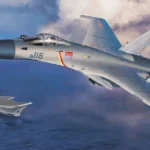
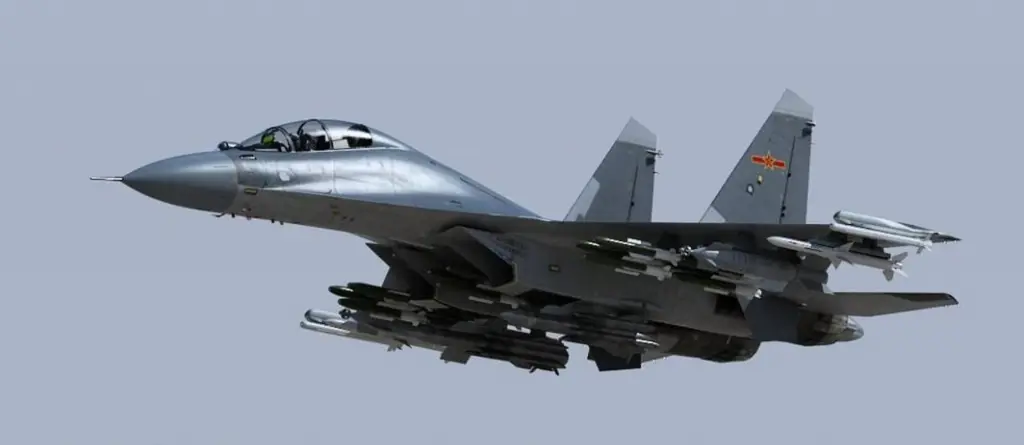
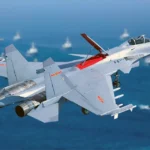
The Shenyang J-16 is a twin-engine, multirole fighter-bomber developed by Shenyang Aircraft Corporation for the People’s Liberation Army Air Force (PLAAF). Based on the Russian Sukhoi Su-30, the J-16 has been domestically produced and upgraded with Chinese avionics, weapons systems, and engines. First introduced in 2013, the J-16 is designed for air superiority, ground attack, and electronic warfare missions, making it a versatile platform for modern combat scenarios.
Fact Sheet
| Role | Multirole fighter-bomber |
|---|---|
| Manufacturer | Shenyang Aircraft Corporation |
| First Flight | 2011 |
| Service Entry | 2013 |
| Crew | 2 (pilot and weapons systems officer) |
Specifications
| Length | 21.9 m (72 ft) |
|---|---|
| Wingspan | 14.7 m (48 ft 3 in) |
| Height | 6.36 m (20 ft 10 in) |
| Empty Weight | 17,700 kg (39,021 lb) |
| Max Takeoff Weight | 34,000 kg (74,957 lb) |
| Powerplant | 2 × WS-10A turbofans |
| Thrust | 27,560 lbf (122.6 kN) per engine with afterburner |
| Max Speed | Mach 2.0 (2,120 km/h; 1,320 mph) |
| Service Ceiling | 17,300 m (56,800 ft) |
| Range | ~1,800 mi (2,900 km) combat radius |
| Rate of Climb | ~55,000 ft/min (280 m/s) |
Avionics & Armament
| Main Radar | Active Electronically Scanned Array (AESA) radar |
|---|---|
| Avionics | Advanced avionics suite, electronic warfare systems |
| Armament | One 30-mm cannon; Up to 12 external hardpoints for: – Air-to-air missiles (PL-10, PL-15) – Air-to-ground munitions (bombs, rockets) – Precision-guided bombs – External fuel tanks |
Notable Features
- Multirole capability for air-to-air, air-to-ground, and electronic warfare missions.
- Advanced avionics for superior situational awareness.
- High payload capacity for extended combat missions.
- Domestic upgrades with Chinese-made engines and systems.
- Continuously upgraded with new variants for enhanced capabilities.
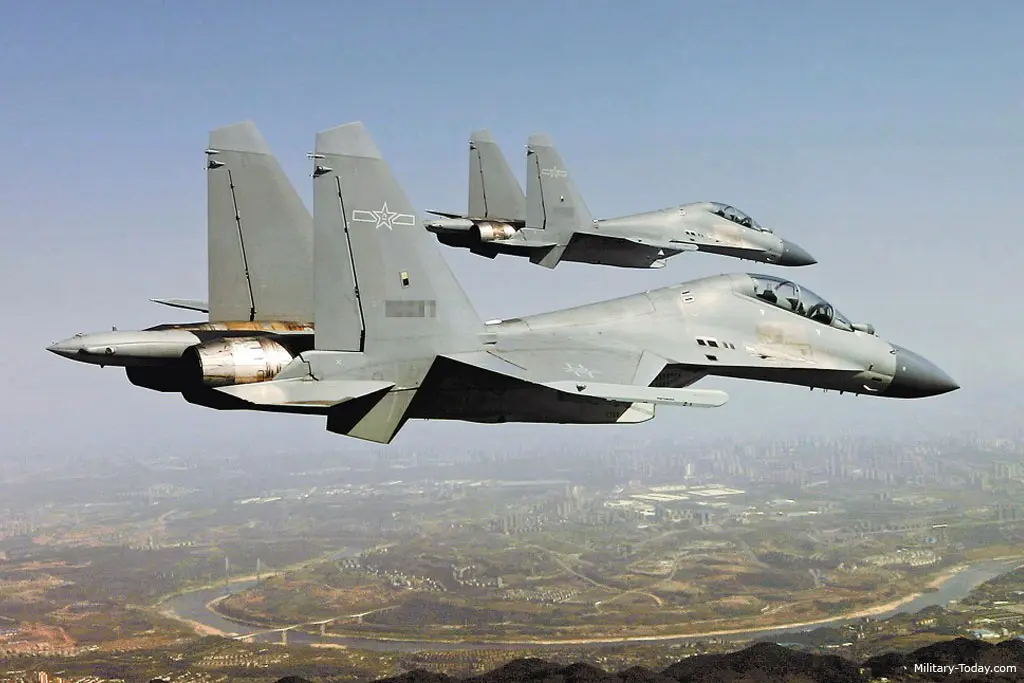
The Shenyang J-16 (Chinese: 歼-16; NATO reporting name: Flanker-N) is a highly advanced, twin-engine, tandem-seat, multirole strike fighter built by the Shenyang Aircraft Corporation (SAC) for the People’s Liberation Army Air Force (PLAAF). It represents a significant evolution of the “Flanker” family, moving beyond the air superiority focus of its J-11 predecessors to become a true “strike fighter” capable of both air-to-air and precision air-to-ground missions.
Development History
The J-16’s development stems from China’s experience with the Russian Sukhoi Su-30MKK, which it imported in the early 2000s. The Su-30MKK was a multirole variant of the Su-27, specifically designed for China with enhanced ground-attack capabilities. Building on the knowledge gained from operating the Su-30MKK and its own J-11B (an indigenized Su-27), Shenyang Aircraft Corporation began developing a domestic equivalent with even more advanced features.
The J-16 is often described as being derived from the J-11BS (the two-seat version of the J-11B). It first flew around 2011-2012, with initial production units reaching the PLAAF in August 2014. It achieved full operational service in 2015 and was officially revealed to the public during the PLAAF’s 90th-anniversary parade in 2017.
Key Features and Capabilities
The J-16 is considered a “4.5 generation” fighter, incorporating many technologies from fifth-generation aircraft, particularly in its avionics and weaponry:
- Multirole Strike Fighter: Unlike the J-11’s primary air superiority role, the J-16 is designed from the outset for robust multirole capabilities. It can conduct air-to-air combat, precision strike against ground and sea targets, and electronic warfare.
- Two-Seat Crew: The tandem two-seat configuration (pilot in front, Weapon Systems Officer – WSO – in the rear) is crucial for managing the complex sensors and weapons payload during demanding strike missions.
- Advanced AESA Radar: A defining feature of the J-16 is its Active Electronically Scanned Array (AESA) radar. This provides superior detection range, multi-target tracking capabilities, high resolution ground mapping, and enhanced resistance to jamming compared to older mechanically scanned or PESA radars. Reports suggest its radar is larger and more capable than that of the F-15EX.
- Indigenous Engines: The J-16 is powered by two Shenyang WS-10B “Taihang” afterburning turbofan engines. While earlier WS-10 variants had reliability issues, the WS-10B is considered much more mature and reliable, providing ample thrust for the heavy aircraft.
- Enhanced Airframe and Materials: The J-16 utilizes a greater proportion of composite materials in its airframe, reducing weight and improving structural integrity. Some units have received radar-absorbent paint to reduce their radar signature, enhancing their suppression of enemy air defenses (SEAD) capability.
- “Glass Cockpit” and Advanced Avionics: Both cockpits feature modern multi-function displays (MFDs) and a Helmet-Mounted Display (HMD) system, improving situational awareness and pilot-aircraft interface. It also includes an Infrared Search and Track (IRST) system and advanced electronic warfare (EW) suites.
- Heavy Payload and Diverse Armament: The J-16 boasts an impressive 12 external hardpoints (compared to 10 on the J-11) and can carry a massive payload of up to 12,000 kg (26,455 lb), making it comparable to the F-15E Strike Eagle or Su-30SM. Its armament includes:
- Air-to-Air Missiles: PL-10 (short-range IIR), PL-12 (medium-range active radar-guided), and the potent PL-15 (long-range active radar-guided). There are also reports of compatibility with the PL-17 ultra-long-range air-to-air missile (with a reported range of 400 km).
- Air-to-Surface Missiles: KD-88 (standoff land-attack), YJ-12 (supersonic anti-ship), YJ-83K (anti-ship), AKF-98.
- Precision-Guided Bombs: Various laser-guided (LS-500J, LT-2) and satellite-guided (GB series, FT-1) bombs.
- Rockets: Unguided rocket pods.
- Anti-Radiation Missiles (ARMs).
- Internal Cannon: A 30mm GSh-30-1 cannon.
- Targeting Pods: Such as the YINGS-III targeting pod.
J-16D (Electronic Warfare Variant)
A highly specialized variant, the J-16D, first flew in December 2015 and was officially unveiled in 2021. This dedicated electronic warfare (EW) aircraft is China’s equivalent to the U.S. Navy’s EA-18G Growler.
- Primary Role: Suppression of Enemy Air Defenses (SEAD) and electronic attack.
- Modifications: It replaces the IRST and internal 30mm cannon with internal EW equipment. It features distinctive large wingtip EW pods and can carry additional external jamming pods and anti-radiation missiles.
- Team Integration: The J-16D is designed to operate in conjunction with other J-16s and other PLAAF assets, providing electronic escort and jamming support to enable strike packages to penetrate enemy airspace.
Role in the PLAAF
The J-16 has become a cornerstone of the PLAAF’s combat power. With over 350 airframes estimated to be in service as of 2024, it is reportedly the most widely deployed heavy multi-role fighter by a single air force globally. Its roles include:
- Deep Strike: Its long range and heavy payload capacity allow it to conduct deep precision strikes against ground targets.
- Anti-Ship Operations: With anti-ship missiles, it can engage naval targets at long ranges.
- Air Superiority: Its powerful radar and long-range air-to-air missiles make it a formidable air-to-air platform, complementing the stealthy J-20.
- Electronic Warfare (J-16D): Providing critical SEAD and electronic attack support for offensive operations.
- Information Sharing and Network-Centric Operations: Its advanced avionics and data links enable it to operate effectively as a networked asset, sharing information across the battlefield.
The J-16 represents a critical step for China’s aviation industry, demonstrating its capability to design and produce advanced, indigenous multi-role fighters that can contend with the world’s best.
Combat History
As of mid-2025, the Shenyang J-16 has no confirmed combat kills in actual warfare. Its operational history primarily involves:
- Exercises and Training: Extensive participation in PLAAF exercises, refining its multi-role capabilities.
- Air Patrols and Intercepts: Frequent patrols in sensitive areas, including the East China Sea and South China Sea, where they have been involved in intercepts of foreign reconnaissance aircraft. One notable incident in May 2022 involved a J-16 intercepting an Australian P-8 Poseidon surveillance aircraft in international airspace, releasing flares and chaff into its flight path, with some reportedly ingested by the P-8’s engines.
The J-16 is a testament to China’s rapid advancements in military aviation, serving as a versatile and potent asset in its rapidly modernizing air force.
Previous Article
Shenyang J-11Next Article
Shenyang J-15