Explore the 4.75-generation fighter jet debate: Are jets like the F/A-18E/F Super Hornet and Su-35S a distinct category or marketing hype? Analyze their avionics, stealth, and role in military aviation.
The 4.75-generation fighter jet label sparks debate among analysts, with some arguing it represents a meaningful evolution of 4.5-generation fighters, while others dismiss it as a marketing ploy to bridge fourth-generation and fifth-generation capabilities. Aircraft like the U.S. F/A-18E/F Super Hornet, Russian Su-35S Flanker-E, and upgraded F-15EX Eagle II feature advanced avionics and near-stealth designs, but do they warrant a distinct category? This article examines the technical advancements, combat roles, and arguments surrounding the 4.75-generation label, crafted for aviation enthusiasts, historians, and military professionals.
The Origin of the 4.75-Generation Label
The 4.75-generation term emerged in the 2000s as manufacturers and air forces sought to differentiate upgraded 4.5-generation fighters from their predecessors without claiming full fifth-generation status (e.g., F-35’s stealth and sensor fusion). It reflects incremental improvements in avionics, electronic warfare (EW), and weapon systems, driven by budget constraints and the need to counter fifth-generation threats.
Defining Characteristics of 4.75-Generation Fighters
4.75-generation fighters are often upgraded variants of 4.5-generation jets, blending advanced technology with fourth-generation airframes.
- Examples:
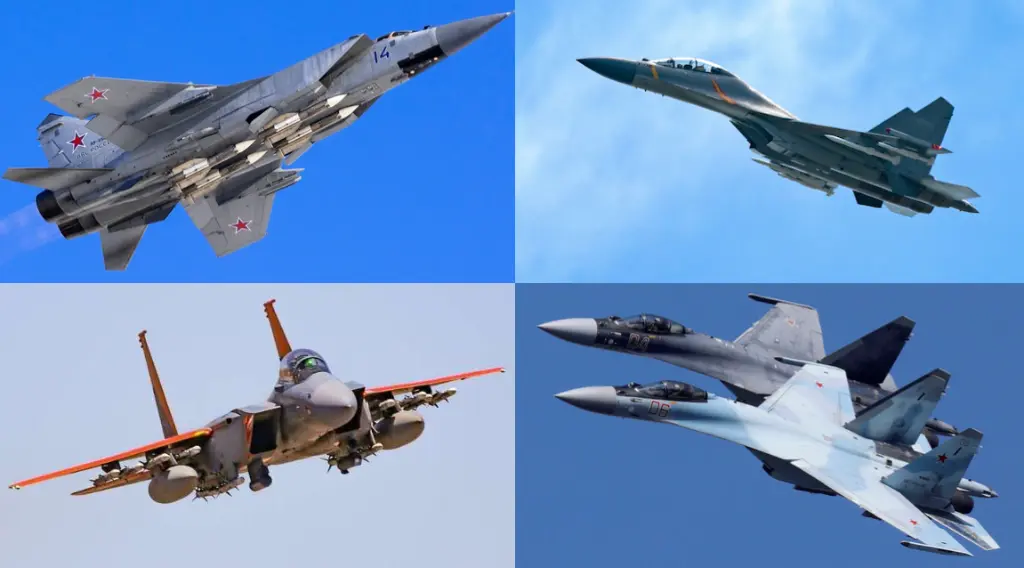
- F/A-18E/F Super Hornet (United States): Operational since 1999, it reaches Mach 1.8 (1,190 mph or 1,915 km/h) with GE F414 engines. Features AN/APG-79 AESA radar, AIM-120D missiles, and reduced radar cross-section. Over 600 serve the U.S. Navy and Australia.
- Su-35S Flanker-E (Russia): Introduced in 2014, it achieves Mach 2.25 (1,490 mph or 2,400 km/h) with Saturn AL-41F1S engines. Equipped with Irbis-E radar, R-77 missiles, and thrust vectoring. Around 150 serve Russia and China.
- F-15EX Eagle II (United States): Operational in 2021, it reaches Mach 2.5 (1,875 mph or 3,018 km/h) with F110 engines. Features APG-82 AESA radar and advanced EW. Over 50 ordered by the U.S. Air Force by 2025.
- Key Features:
- AESA Radars: Comparable to fifth-generation systems (e.g., F-35’s AN/APG-81), offering multi-target tracking and jam resistance.
- Near-Stealth: Reduced radar cross-sections via coatings and design tweaks, though not fifth-generation stealth (e.g., Super Hornet’s 1m² vs. F-35’s 0.001m²).
- Advanced EW: Systems like the Super Hornet’s ALQ-214 counter modern SAMs (e.g., S-400).
- Weapon Systems: Long-range missiles (e.g., AIM-120D) and precision munitions (e.g., JDAM) enhance BVR and strike roles.
Statistics: The Super Hornet’s $70 million unit cost (2020s) contrasts with the F-35’s $110 million, highlighting affordability. This targets queries like “F/A-18 Super Hornet 4.75-generation features.”
Combat Roles and Performance
4.75-generation fighters excel in modern conflicts, leveraging upgrades to rival fifth-generation jets in specific scenarios.
- F/A-18E/F in Middle East (2014-2025): U.S. Navy Super Hornets flew 10,000+ sorties against ISIS in Syria and Iraq, using AESA radar for precision strikes and EW to evade SAMs.
- Su-35S in Ukraine (2022-2025): Russia’s Su-35S conducted air patrols and strikes, downing Ukrainian aircraft but suffering 20+ losses to SAMs, exposing stealth limitations.
- F-15EX in Testing: Designed for Indo-Pacific operations, it integrates with F-35s, focusing on heavy payload delivery (22,000 lbs) and BVR combat.
This engages historians searching for “Su-35S Ukraine combat performance” with detailed data.
Arguments for a Distinct 4.75-Generation Category
Proponents argue 4.75-generation is a valid classification due to significant upgrades:
- Technological Leap: AESA radars and EW systems rival fifth-generation capabilities, as seen in the Super Hornet’s AN/APG-79 matching F-35’s radar range.
- Cost-Effectiveness: Upgraded airframes (e.g., F-15EX at $90 million) offer 80% of fifth-generation performance at lower costs.
- Operational Relevance: Their multi-role versatility supports modern missions, like Super Hornet’s carrier-based strikes in Yemen (2024).
- Bridge to Sixth-Generation: 4.75-generation jets test technologies (e.g., AI-assisted targeting) for programs like NGAD.
This appeals to analysts searching for “4.75-generation fighter justification.”
Arguments Against the 4.75-Generation Label
Critics argue the term is marketing-driven, not a distinct category:
- Overlap with 4.5-Generation: Upgrades like AESA radars already define 4.5-generation jets (e.g., Rafale, Typhoon), blurring distinctions.
- Lack of Stealth: 4.75-generation jets lack true stealth (e.g., Su-35S’s 1-3m² radar cross-section vs. F-22’s 0.0001m²), limiting survivability against fifth-generation jets.
- Industry Hype: Manufacturers like Boeing use “4.75” to market upgrades (e.g., F-15EX) without justifying a new category.
- No Consensus: Analysts lack standardized criteria, with Russia classifying Su-35S as “4++” and the U.S. avoiding “4.75” for F-15EX.
This addresses queries like “4.75-generation fighter marketing debate.”
Impact on Military Aviation
The 4.75-generation debate shapes military aviation:
- Procurement Decisions: Nations like Qatar and India opt for 4.75-generation jets (e.g., F-15EX, Su-35S) for cost and capability balance.
- Tactical Integration: These jets complement fifth-generation fleets, as seen in U.S. Air Force’s F-15EX/F-35 pairing.
- Future Development: Their technologies inform sixth-generation programs like FCAS, particularly in AI and EW.
Explore related topics like fifth-generation fighters or fighter aircraft generations for deeper insights.
Conclusion: Reality or Marketing?
The 4.75-generation label reflects real technological advancements, particularly in AESA radars and EW, but its distinction from 4.5-generation is debated due to overlap and lack of true stealth. While jets like the F/A-18E/F Super Hornet and Su-35S offer cost-effective, versatile platforms, the term may serve as a marketing tool to prolong fourth-generation relevance. This debate captivates those searching for “4.75-generation fighter reality vs marketing.”