In the early 1980s, several European countries dreamed of creating a next-generation fighter jet that would surpass anything they had before. The United Kingdom, Germany, France, Italy, and Spain joined forces under the Future European Fighter Aircraft (FEFA) program to design a supersonic jet with agile handling and modern weapons.
France eventually left the program to pursue their own fighter (the Dassault Rafale), but the remaining four nations pressed forward. This collaboration set the stage for a historic joint venture, uniting Airbus, BAE Systems, and Leonardo—the backbone of Europe’s aerospace industry. The result was the formation of Eurofighter GmbH, a company dedicated to managing this ambitious project.
Uniting for Innovation
- Why Collaborate? Creating an advanced fighter was extremely expensive and complicated. By working together, Europe’s best engineers and resources could be pooled, reducing individual costs and risks while sharing benefits like advanced technology and jobs.
- Partner Nations: United Kingdom, Germany, Italy, and Spain.
- Major Industry Players: Airbus (Germany and Spain), BAE Systems (UK), Leonardo (Italy).
The Long Road to Flight: How the Typhoon Was Developed
Building a fighter jet is no quick project—it took decades for the Typhoon to go from an idea to a reality. Key milestones included prototype design, rigorous testing, and international cooperation.
Key Development Milestones
- 1983: Official launch of the FEFA program and production contract for the original prototype.
- 1986: The British Aerospace EAP technology demonstrator, a key influence on Typhoon’s design, completed its first flight.
- 1994: The first Eurofighter Typhoon development aircraft (DA1) soared into the skies over Germany, marking a major breakthrough.
- 1998: The name “Typhoon” was officially adopted, and the first production contracts were signed.
- 2003-2005: The Typhoon entered operational service with the core European air forces.
Decades of joint development, flight tests, and design improvements ensured the Typhoon was ready to meet the demanding needs of modern air combat.
Design That Stands Out: Sleek Shape, Agile Performance
The Eurofighter Typhoon isn’t just powerful—it looks the part. Its design blends bold aerodynamics and innovative control systems.
Distinctive Features
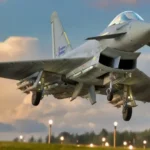
- Canard-Delta Wing: The jet’s delta-shaped wings and forward canards (small winglets) give it exceptional maneuverability, especially during high-speed dogfights or complex aerial maneuvers.
- Twin Engines: Powered by two Eurojet EJ200 turbofans, the Typhoon can reach speeds of up to Mach 2 (more than twice the speed of sound), with rapid acceleration and impressive climb rates.
- Stealth Elements: Only 15% of the Typhoon’s surface is made of metal—the rest uses radar-absorbent materials to help it remain undetected by enemy radar during covert operations.
- Carefree Handling: Advanced flight control systems enable pilots to handle sharp turns and challenging maneuvers with ease, supporting both safety and high agility.
The Power Inside: Technology and Avionics
A modern fighter jet is packed with electronic wizardry. The Typhoon stands out thanks to its integrated avionics, advanced sensors, and cutting-edge systems.
Advanced Flight Deck
- Digital Fly-by-Wire Controls: Pilots control the jet not with direct hydraulic connections, but electronically—meaning smoother, faster responses and improved safety.
- Multifunction Displays (MFDs): Information is shown through high-resolution screens, giving the pilot quick access to radar, weapon status, mission maps, and diagnostics.
- Direct Voice Input (DVI): Some Typhoon variants allow pilots to control systems simply by speaking commands, further reducing workload in high-pressure situations.
Super Sensors: Eyes and Ears of the Typhoon
- CAPTOR Radar (AESA): The heart of the Typhoon’s sensor suite is the Active Electronically Scanned Array radar. CAPTOR-E gives long-range target tracking, wide coverage for air and ground threats, and rapid updates to keep pilots informed in battle.
- PIRATE IRST: The Passive Infra-Red Airborne Tracking Equipment lets Typhoons “see” targets using infrared emissions, tracking enemy planes even when they’re not emitting radar signals.
- Sensor Fusion: All onboard and offboard data is blended for the pilot, offering a clear, actionable tactical picture. This means less confusion and faster decisions.
- Defensive Aids Sub-System (DASS): The Praetorian/DASS actively monitors threats, automatically deploying countermeasures like chaff and flares, jamming enemy radar, and alerting pilots of danger.
Communication & Teamwork
- MIDS Link 16: Secure, jam-resistant digital communications connect Typhoons with friendly aircraft and ground units, vital for coordinated missions.
- IFF (Identification Friend or Foe): This system lets pilots quickly tell who’s on their side—a must in busy sky zones.
Weapons Versatility: Ready for Any Mission
What makes the Typhoon so valuable is its ability to switch roles quickly. It’s a multi-role fighter, capable of air-to-air combat, ground attack, and reconnaissance.
Weapons Loadout
- Air-to-Air Missiles: AIM-120 AMRAAM, Meteor, AIM-132 ASRAAM, IRIS-T. These highly advanced missiles give Typhoon an edge against enemy fighters.
- Air-to-Ground Munitions: Laser-guided Paveway bombs, Storm Shadow cruise missiles, Brimstone anti-tank missiles, JDAM systems.
- Anti-Ship Missiles: Marte-ER for targeting naval threats.
- Cannon: 27mm Mauser BK-27 for close combat and precision ground attacks.
Hardpoints and Payload
With 13 weapon stations under its wings and fuselage, the Typhoon can be loaded for any job—whether it’s a dogfight, a bombing run, or carrying extra fuel tanks and sensor pods for surveillance missions.
Constant Evolution: Upgrades and Future-Proofing
The Typhoon benefits from continuous upgrades, ensuring it remains at the cutting edge of technology and combat effectiveness.
Recent and Planned Advancements
- Sensor Upgrades: New radars, improved IR tracking, and better electronic warfare suites keep the Typhoon ahead of threats.airbus
- Weapon Integration: The Typhoon is constantly adapted for compatibility with the latest missiles and bombs used by NATO and allied air forces.eurofighter
- Digital Enhancements: Improved link systems, data fusion, and cockpit technologies are added as they become available.
Through regular upgrades, partner nations maintain a forward-looking fighter capable of meeting future challenges.
Strategic Importance: Why the Typhoon Matters
The Eurofighter Typhoon isn’t just a technical triumph—it’s vital to European security and cooperation.
Backbone of European Air Defense
The Typhoon serves as the backbone of air defense for the UK, Germany, Italy, and Spain, and is in use by several other countries, including Austria and Saudi Arabia. Its combination of agility, firepower, and resilience allows European countries to deter threats, defend their airspace, and participate in multinational missions for NATO and allied partners.
Economic Impact
Building the Typhoon involves more than 400 European companies, supporting thousands of jobs and sustaining the continent’s leading edge in aerospace engineering.
Interoperability & Partnership
Typhoon can operate seamlessly with US and European aircraft, sharing data and missions. This means greater flexibility for joint operations and enhanced security alliances.
Europe’s collaborative approach means every upgrade and new capability benefits all users, ensuring strategic unity and strength.
What Sets the Typhoon Apart? Key Benefits
- Extreme Agility: Delta-canard design and digital controls mean Typhoon can outmaneuver most competitors in aerial combat.
- Survivability: Advanced defensive systems and stealthy materials protect the aircraft and pilot from modern threats.
- Mission Flexibility: Rapidly switch between air combat, ground attack, and reconnaissance roles—often within a single mission.eurofighter
- Technology Integration: Cutting-edge sensors, weapon systems, and communications offer decisive battlefield awareness.
- Economic and Strategic Collaboration: Brings together nations for mutual defense, technology sharing, and economic growth.
The Typhoon’s Legacy and Future
With over 700 aircraft ordered and continuous upgrades planned to keep it operational until at least 2060, the Eurofighter Typhoon remains a pillar of air defense in Europe and beyond. Nations continue to invest in new variants, ensuring that Typhoon will stay at the forefront of military aviation for decades to come.
In summary: The Eurofighter Typhoon stands as a shining example of what’s possible when nations unite for a common goal. By blending world-class technology, clever design, and cooperative spirit, it offers Europe—and its partners—a fighter that can meet today’s threats and adapt for tomorrow’s challenges. Whether you’re an aviation fan or simply curious about modern military innovation, the Typhoon’s story offers insight into technology, teamwork, and the relentless pursuit of excellence.