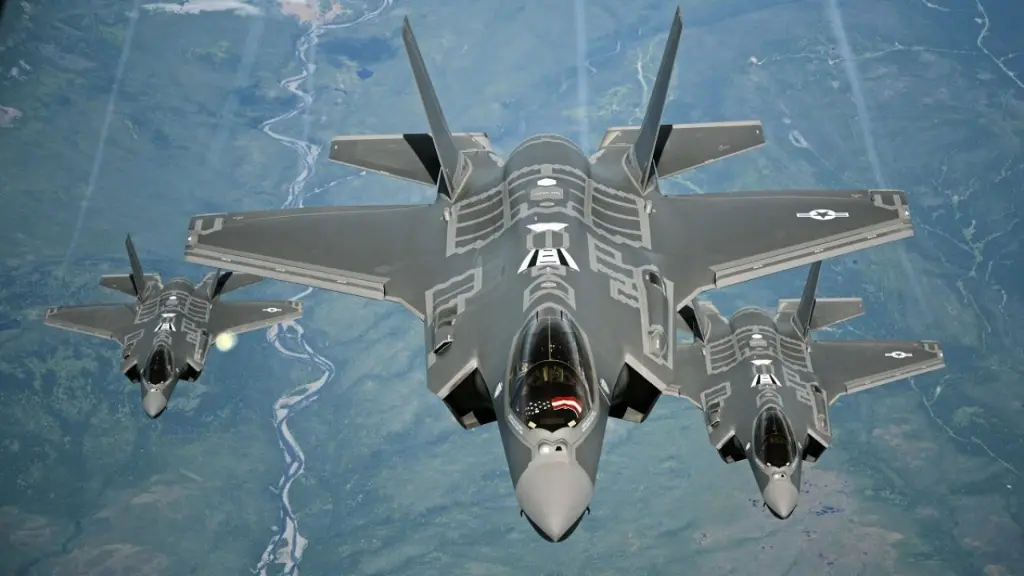
The Lockheed Martin F-35 Lightning II stands as a technological marvel and a lightning rod for controversy. As the world’s most expensive defense program and the cornerstone of modern air forces for the United States and its allies, the F-35 represents a new paradigm in air combat. Yet, its journey has been marked by a constant, public debate over its design philosophy, staggering costs, and technical challenges. This analysis delves into the F-35’s controversial design, its current capabilities, and its evolving role in the future of military aviation.
The Genesis of Controversy: A “One-Size-Fits-All” Design
The core of the F-35’s controversy is its origin in the Joint Strike Fighter (JSF) program, a bold but risky gambit to create a single airframe that could meet the diverse needs of three different U.S. military services:
- F-35A: The conventional takeoff and landing (CTOL) variant for the U.S. Air Force.
- F-35B: The short takeoff/vertical landing (STOVL) variant for the U.S. Marine Corps and allied navies.
- F-35C: The carrier-based catapult-assisted takeoff but arrested recovery (CATOBAR) variant for the U.S. Navy.
This “one-size-fits-all” approach was intended to drastically reduce development, production, and sustainment costs through economies of scale. However, critics argue that the compromises necessary to accommodate the unique requirements of each variant resulted in a “jack of all trades, master of none.”
The inclusion of the F-35B’s massive lift fan, for instance, introduced significant design complexities, weight, and drag, which many believe compromised the performance of the other variants. This approach contributed to a design that, while effective, lacks the pure kinematic performance (e.g., speed, turn rate) of some dedicated fourth-generation fighters, a point frequently raised by detractors.
Design Triumphs: A 5th-Generation Revolution
Despite its troubled genesis, the F-35’s design represents a generational leap in military aviation through its core 5th-generation capabilities:
- Stealth (Very Low Observable): The F-35’s sleek, angular airframe, internal weapons bays, and radar-absorbent materials make it nearly invisible to conventional radar systems. This allows it to penetrate heavily defended airspace with a level of impunity that older fighters could never achieve.
- Sensor Fusion: This is perhaps the F-35’s most significant advantage. The aircraft’s advanced sensors—including an Active Electronically Scanned Array (AESA) radar, Electro-Optical Targeting System (EOTS), and a Distributed Aperture System (DAS) with six infrared cameras—feed a massive amount of data into its central computer. The system then fuses this data into a single, intuitive picture displayed on the pilot’s helmet visor, creating unparalleled situational awareness.
- Network-Centric Operations: The F-35 is not just a fighter; it is a flying sensor and command-and-control node. It can share its real-time battlefield picture with other F-35s, as well as with legacy aircraft, ground units, and naval assets. This “force multiplier” effect transforms every platform it works with, allowing an entire strike package to operate with a shared, unified understanding of the battlespace.
- Advanced Avionics and Cockpit: The F-35’s helmet-mounted display eliminates the need for a traditional head-up display, projecting critical flight and targeting data directly onto the pilot’s visor. Paired with a massive, customizable touchscreen display in the cockpit, this system drastically reduces pilot workload and enhances responsiveness.
Lingering Controversies: Cost, Readiness, and Upgrades
The F-35 program’s controversies have not been limited to its initial design. Decades into its development, a new set of challenges continues to fuel the debate:
- Escalating Costs: The program’s lifetime cost, including acquisition, sustainment, and upgrades over its expected 94-year lifespan, is projected to be in the trillions of dollars. While the average “flyaway cost” per plane has decreased significantly, the long-term sustainment costs and the price of upgrades remain a major concern for the U.S. and its allies.
- Technical Refresh 3 (TR-3) & Block 4 Delays: The F-35’s path to its full combat potential is dependent on a series of major hardware and software upgrades, most notably the “Technology Refresh 3” (TR-3) and the subsequent “Block 4” suite. TR-3, which provides the computing power for Block 4, experienced significant software glitches in recent years, leading to a year-long halt in F-35 deliveries. While new aircraft are now being delivered with a truncated version of TR-3 software, the full combat capability is still being finalized. The ongoing delays and costs of these essential upgrades have led some lawmakers to propose cutting the number of new F-35s being procured annually.
- Engine and Sustainment Issues: The F-35’s Pratt & Whitney F135 engine, while the most powerful turbofan in its class, has experienced persistent issues, including a lack of spare parts, which has contributed to lower-than-desired mission-capable rates for the fleet. The engine’s maintenance and upgrade costs are another source of budgetary friction.
The F-35’s Future in Military Aviation
Despite its controversies, the F-35’s future is not only secure but expanding. It is transitioning from a developmental program to a combat-proven, front-line weapon system. Its future role is defined by several key factors:
- Combat Validation: In 2025, F-35s are being deployed in high-stakes environments, with the Israeli Air Force reportedly using its F-35I “Adir” jets for high-risk strikes against advanced air defenses. These deployments are proving the F-35’s ability to operate and survive in the most challenging of scenarios. The UK also plans a major Carrier Strike Group deployment with F-35Bs in 2025.
- Global Dominance: The F-35 is now the fighter of choice for a growing number of U.S. allies in Europe, the Indo-Pacific, and the Middle East, including new customers like Greece. With over 1,000 aircraft delivered worldwide, the program’s global footprint ensures a level of interoperability and a powerful deterrence capability for NATO and its partners.
- Digital Integration and “Loyal Wingman” Concepts: The F-35’s architecture is being refined to serve as the “quarterback” of the battlefield. The Block 4 upgrades will enable it to control and collaborate with uncrewed aircraft (UCAVs), or “loyal wingmen,” a critical concept for the future of air combat. The F-35 will operate as a command hub, allowing its pilot to direct multiple drones to perform tasks such as reconnaissance, electronic warfare, or even strike missions, dramatically increasing its operational reach and lethality while keeping the pilot out of harm’s way.
- An Enduring Platform: Lockheed Martin has even proposed a “supercharged fifth-generation-plus” version of the F-35 by applying technologies from the secretive Next-Generation Air Dominance (NGAD) program. This would keep the F-35 at the cutting edge for decades to come, complementing the smaller number of dedicated sixth-generation fighters.
In conclusion, the F-35 Lightning II is a paradox—a program defined by intense criticism and unparalleled technological achievement. While its controversial design choices and cost issues will likely remain subjects of debate for years, the aircraft is now firmly established as the backbone of Western airpower. Its future lies not in its raw speed or maneuverability, but in its ability to see first, act first, and command the battlespace, proving that in modern warfare, information superiority is the ultimate weapon.