The Gulf War of 1991, also known as Operation Desert Storm, marked a watershed moment in military aviation, demonstrating the decisive power of precision technology. At the forefront of this revolution were two aircraft from the U.S. Air Force: the F-15E Strike Eagle and the F-16 Fighting Falcon. These fighters, armed with a new generation of sensors and munitions, redefined air warfare by dominating both the skies and the ground with unprecedented accuracy and lethality.
F-15E Strike Eagle: The “Mud-Mover” with Air Superiority DNA
While the F-15C Eagle was an uncontested air-to-air master with an air combat record of 104 kills and zero losses during the war, its newer sibling, the F-15E Strike Eagle, proved to be a dual-role powerhouse. Designed to replace the aging F-111, the F-15E was a dedicated multirole fighter, capable of fighting its way to a target, destroying it, and fighting its way out.
Its primary advantage lay in a suite of advanced precision technologies:
- LANTIRN (Low-Altitude Navigation and Targeting Infrared for Night) Pods: This revolutionary system was the key to the F-15E’s success. It consisted of two pods:
- Navigation Pod: Contained a terrain-following radar that allowed the pilot to fly safely at very low altitudes, at night, and in all weather conditions. This “hands-off” capability provided an enormous tactical advantage, allowing the F-15E to penetrate Iraqi air defenses below their radar coverage.
- Targeting Pod: Equipped with a laser designator and a tracking system, this pod allowed the weapon systems officer (WSO) to precisely mark a ground target for destruction with laser-guided bombs (LGBs) from long range.
- AN/APG-70 Synthetic Aperture Radar: This advanced radar system provided high-resolution ground mapping, allowing the crew to detect and identify ground targets from significant distances. The system could “freeze” a ground map for analysis while the aircraft returned to an air-to-air mode to clear for aerial threats, showcasing its dual-role flexibility.
- Precision-Guided Munitions: The F-15E carried a variety of LGBs, including the GBU-10, GBU-12, and GBU-24, which were used with devastating effect. Its missions were varied but focused on strategic targets: hunting mobile Scud missile launchers in western Iraq at night, destroying command and control bunkers with penetrating bombs, and striking logistical infrastructure.
F-16 Fighting Falcon: The Workhorse of Precision
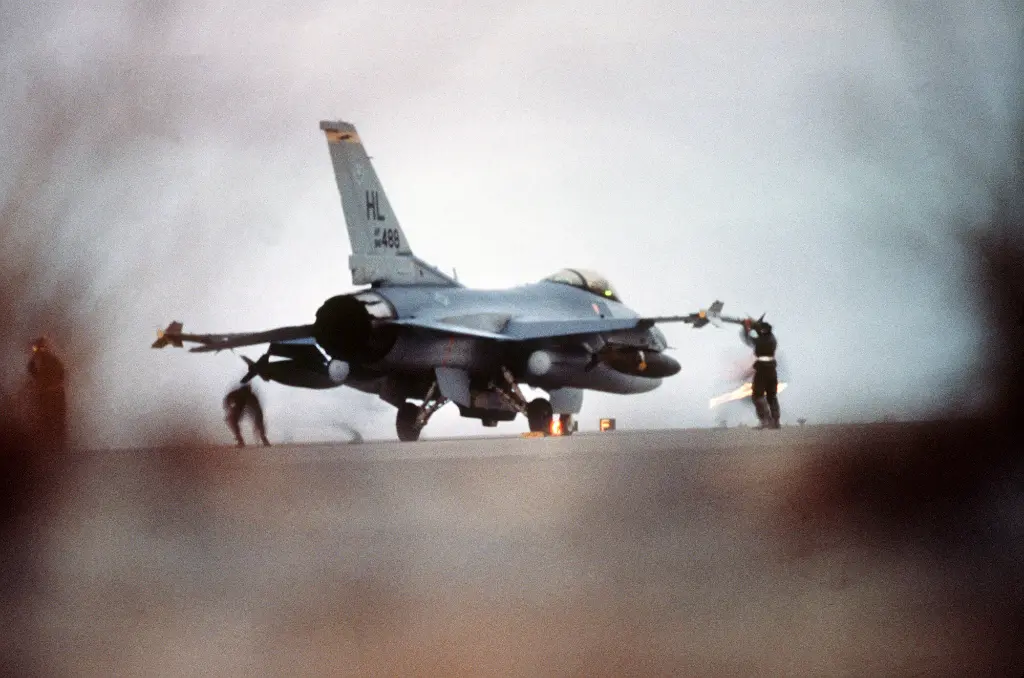
The F-16 Fighting Falcon was the workhorse of the Gulf War air campaign, flying more sorties than any other aircraft—nearly 13,500. Its multirole design, combined with new technology, allowed it to deliver a wide array of weapons with superior accuracy.
- LANTIRN Pods: A portion of the F-16 fleet was also equipped with LANTIRN pods (initially only the navigation pods), which allowed them to perform night attacks with a level of precision that was previously impossible. This was a “real success story” of the war, enabling F-16s to hunt SCUDs and attack a variety of other targets under the cover of darkness.
- Massive Sortie Generation: The F-16’s high mission-capable rate (95.2% during the conflict) meant that it was constantly in the air, flying missions against airfields, military production facilities, and a variety of other ground targets. The sheer volume of sorties flown by the F-16 was instrumental in degrading Iraqi military power.
- Versatility: The F-16 proved to be a highly adaptable platform, able to transition between different missions including Suppression of Enemy Air Defenses (SEAD), Offensive Counter Air (OCA), and Close Air Support (CAS). This versatility was critical in a conflict that required a rapid and flexible response to evolving battlefield conditions.
Dominance of Airspace and Strategic Impact
The combined efforts of the F-15E and F-16, alongside other coalition aircraft, led to the complete domination of Iraqi airspace in the early days of the war.
- Air Superiority: The air-to-air F-15C Eagles, with the support of Airborne Early Warning and Control (AWACS) aircraft, quickly destroyed the Iraqi Air Force. Every fixed-wing aircraft shot down in air-to-air combat by the U.S. Air Force was an F-15C kill. This rapid neutralization of the enemy air threat allowed the F-15E and F-16 to operate freely without fear of significant opposition, paving the way for their air-to-ground dominance.
- Precision and Strategic Paralysis: By leveraging their new precision technologies, F-15Es and F-16s were able to conduct surgical strikes against key strategic targets. This was a radical departure from the carpet bombing of previous conflicts. They targeted command and control centers, communications nodes, and Scud launchers with pinpoint accuracy, disrupting Saddam Hussein’s ability to command his forces and deterring further attacks on Israel.
- Setting the Stage for Ground Operations: The air campaign, led by these precision-strike fighters, essentially won the war before the ground offensive even began. By the time coalition ground forces moved into Kuwait, the Iraqi military was already largely paralyzed. Airpower had destroyed its eyes and ears, its command structure, and much of its logistical support, setting the stage for a swift and decisive victory.
In conclusion, the Gulf War was the proving ground for a new era of airpower, and the F-15E and F-16 were its trailblazers. Their advanced navigation, targeting, and precision-guided weapons systems allowed them to achieve a level of dominance that was unimaginable in previous conflicts, permanently altering the face of modern warfare.