Explore the Vietnam War’s impact on aerial combat, featuring the F-4 Phantom vs. MiG-21 dogfights, missile warfare, and tactical evolution. Learn how this conflict shaped modern fighter jet strategies.
The Vietnam War (1955-1975) was a turning point in the history of aerial combat, marking the transition from traditional dogfights to missile-based warfare and modern tactics. The U.S. F-4 Phantom II faced off against North Vietnam’s MiG-17 and MiG-21, introducing new technologies and exposing the need for refined pilot training. This article dives into the aircraft, battles, technological advancements, and lasting legacy of the Vietnam War, crafted for aviation enthusiasts, historians, and military professionals.
Context of the Vietnam War
The Vietnam War pitted the United States and South Vietnam against North Vietnam, supported by the Soviet Union and China. Dense jungles and sophisticated air defenses, including surface-to-air missiles (SAMs), challenged air operations. The U.S. aimed to disrupt North Vietnamese supply lines through campaigns like Operation Rolling Thunder, while North Vietnam relied on agile fighters and SAMs to counter air superiority.
This addresses search intent for queries like “Vietnam War aerial combat history” by combining historical narratives with technical insights.
Key U.S. Fighter Aircraft
The United States deployed advanced jets, emphasizing versatility but facing initial challenges.
- F-4 Phantom II: Built by McDonnell Douglas, the F-4, operational from 1960, was a Mach 2.2 (1,472 mph or 2,368 km/h) multi-role jet. Armed with AIM-7 Sparrow and AIM-9 Sidewinder missiles, it lacked a gun initially, which hindered dogfights. Over 5,000 were built, serving in air superiority and ground-attack roles.
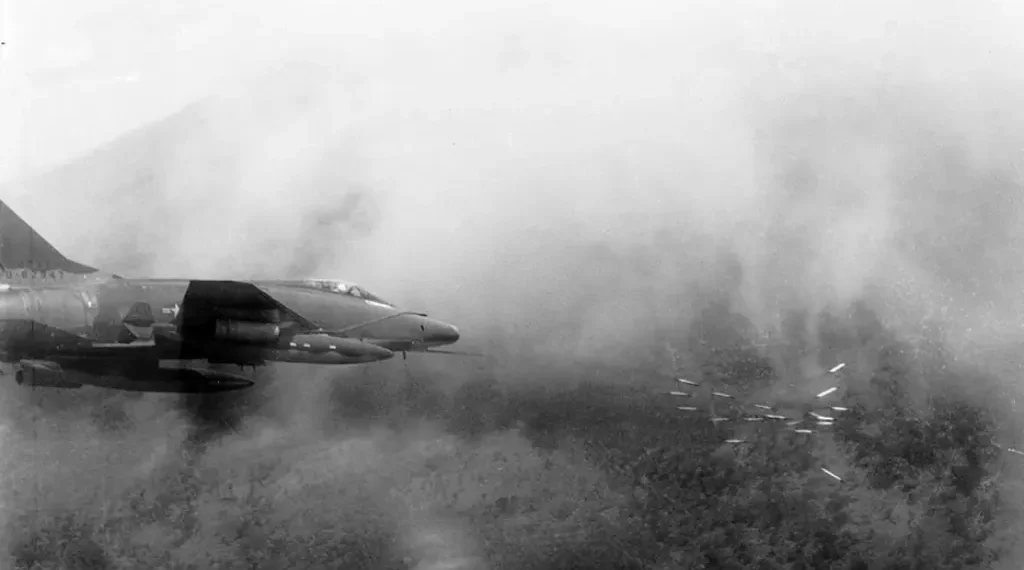
- F-105 Thunderchief: Designed by Republic Aviation, this jet specialized in strike missions but was vulnerable to SAMs and MiGs. It flew over 20,000 sorties, suffering heavy losses.
- Other Models: The F-100 Super Sabre and A-4 Skyhawk supported ground operations, though less prominent in air-to-air combat.
Aviation enthusiasts searching for “F-4 Phantom Vietnam War role” will find detailed specs and historical context here.
North Vietnamese Fighters
North Vietnam’s air force, equipped by the Soviets, relied on lightweight, agile jets.
- MiG-17 Fresco: An evolution of the MiG-15, it reached 711 mph (1,145 km/h) and was armed with 23mm and 37mm cannons. Its maneuverability made it deadly in close-range dogfights.
- MiG-21 Fishbed: Introduced in 1959, this Mach 2 (1,385 mph or 2,228 km/h) jet featured a delta wing and AA-2 Atoll missiles. Over 1,000 were supplied, excelling in hit-and-run ambushes.
- Tactics: North Vietnamese pilots used guerrilla-style tactics, leveraging SAM cover and ground-controlled intercepts.
Queries like “MiG-21 Vietnam War performance” draw readers to this section’s technical and tactical breakdown.
Evolution of Aerial Combat
The Vietnam War shifted air combat paradigms, driven by new technologies and lessons learned:
- Missile Warfare: The introduction of radar-guided (Sparrow) and infrared (Sidewinder) missiles enabled beyond-visual-range (BVR) engagements, though early missiles had low hit rates (10-15%).
- Dogfights Persisted: Despite missiles, close-range combat remained critical due to restrictive rules of engagement and missile unreliability, leading to intense F-4 vs. MiG dogfights.
- Operation Rolling Thunder (1965-1968): The U.S. flew over 300,000 sorties, dropping 864,000 tons of bombs, but faced heavy losses (over 900 aircraft) to SAMs and MiGs.
Statistics: U.S. pilots achieved a 2:1 kill ratio against MiGs, with notable aces like Randy Cunningham (5 kills). North Vietnam lost approximately 200 MiGs.
For historians searching for “Vietnam War dogfight tactics,” this section provides engaging narratives and data.
Technological and Tactical Challenges
The war exposed flaws in U.S. air strategy:
- Rules of Engagement: Restrictions prevented strikes on key targets like MiG bases, limiting effectiveness.
- Training Gaps: Early U.S. pilots lacked dogfighting skills, as training focused on missile combat. This led to losses against agile MiGs.
- SAM Threat: Soviet-supplied SA-2 missiles downed hundreds of U.S. aircraft, prompting electronic countermeasures (ECM).
These challenges resonate with professionals researching “Vietnam War aviation lessons.”
Legacy and Impact on Modern Aviation
The Vietnam War reshaped fighter jet design and training:
- Top Gun Program: The U.S. Navy established the Top Gun school in 1969 to improve air combat maneuvering (ACM), emphasizing dogfighting skills.
- Aircraft Upgrades: The F-4E added a 20mm cannon, addressing dogfight weaknesses. Lessons influenced the F-15 Eagle’s design.
- Tactical Evolution: The war highlighted the need for integrated air defenses, BVR capabilities, and pilot training, shaping modern jets like the F-35.
Explore related topics like F-14 Tomcat in the Cold War or fighter pilot training for deeper insights.
In conclusion, the Vietnam War’s aerial battles marked a critical evolution in fighter jet warfare, blending missiles, dogfights, and new tactics. Its lessons continue to influence modern air combat, captivating those searching for “Vietnam War fighter jet legacy.”