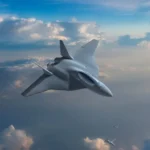
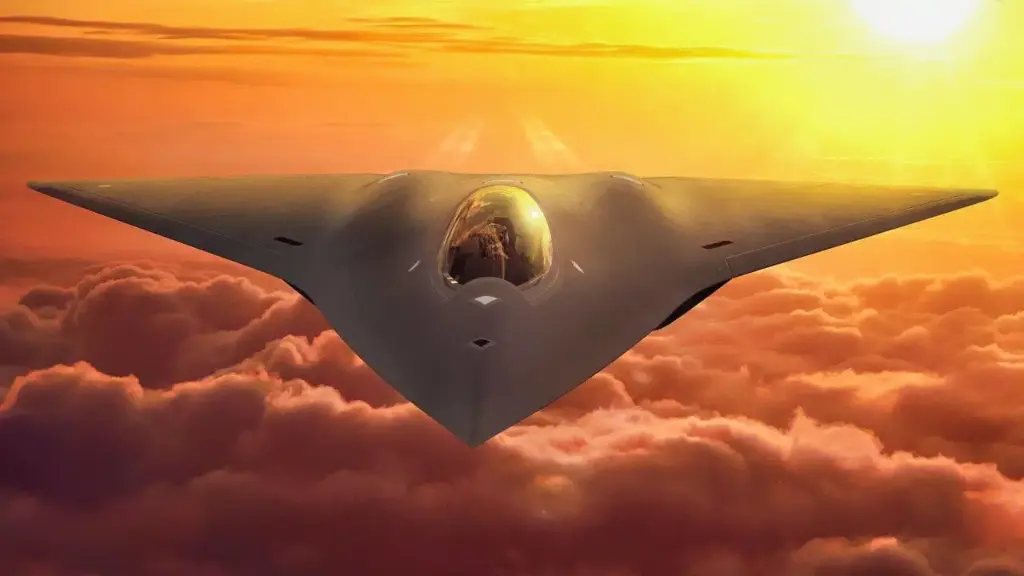
The Next Generation Air Dominance (NGAD) program isn’t just the U.S. Air Force’s answer to 6th-generation fighters—it’s a revolution in air combat strategy. While Europe’s FCAS builds a drone-centric “system of systems,” NGAD merges stealth, AI, and loyal wingman drones into a carrier-capable fleet designed to dominate the Pacific against China.
With a $40 billion annual budget and classified breakthroughs like adaptive camouflage and laser weapons, NGAD aims to replace the F-22 Raptor by 2035. But its true innovation isn’t the jet—it’s the AI-driven combat cloud that turns every aircraft, drone, and satellite into a single, lethal network.
This article reveals NGAD’s classified tech, strategic edge over rivals, and why it could decide the fate of U.S. air supremacy in an era of hypersonic threats.
NGAD: More Than a Fighter—A Combat Ecosystem
NGAD is a family of systems, not a single aircraft:
- 1 Manned Fighter: The “quarterback” jet (replacing F-22).
- 6+ Collaborative Combat Aircraft (CCAs): AI-piloted drones for sensing, jamming, and striking.
- Advanced Battle Management System (ABMS): The AI-powered “combat cloud.”
- Weapons & Sensors: Networked across all platforms (e.g., AIM-260 missiles).
Why it matters: In a Taiwan Strait conflict, NGAD could detect Chinese missiles 500+ km away, deploy CCAs to destroy launchers, and strike targets without U.S. jets entering Chinese radar range.
Core Technologies: What Makes NGAD “6th-Gen”
| Technology | Breakthrough | Combat Impact |
|---|---|---|
| Adaptive Stealth | Radar-absorbing “smart skin” that shifts signature mid-flight | Evades S-500/J-20 radar by mimicking birds or terrain |
| AI Co-Pilot | “Skyborg” AI manages sensors, EW, and drone swarms | Reduces pilot workload by 70% in high-threat zones |
| Directed Energy | 150-kW lasers for missile defense (2030s) | Shoots down hypersonic missiles at light speed |
| Open Mission Systems | Software-upgradable architecture (like smartphones) | Adds new weapons/AI via code—no hardware redesign |
| Thermal Management | Liquid-cooled avionics for sustained Mach 2+ flight | Outlasts Chinese J-20 in prolonged dogfights |
Game-changer: NGAD’s fighter could launch 12 missiles while drones carry 24 more—tripling firepower without compromising stealth.
The Manned Fighter: Stealth, Speed, and AI
The NGAD fighter (codenamed F/A-XX) redefines air dominance:
- Stealth: RCS of 0.0001 m² (vs. F-35’s 0.001 m²)—smaller than a marble.
- Speed: Mach 2.5+ with next-gen adaptive-cycle engines (Pratt & Whitney XA102).
- Range: 2,000+ nautical miles (vs. F-22’s 1,600)—critical for Pacific operations.
- Cockpit: Dual-pilot design (one human, one AI “co-pilot”) with holographic displays.
Real-world edge: In contested airspace, NGAD could fly 1,000 km into Chinese territory, unleash CCAs to destroy SAM sites, and return before enemy jets scramble.
Collaborative Combat Aircraft (CCAs): The Drone Swarm Advantage
NGAD’s CCAs are not expendable—they’re force multipliers:
- 3 Variants:
- Scout CCAs: Stealthy sensors with 1,000+ km range.
- Strike CCAs: Carry 4x AIM-260 missiles (vs. 2x on F-35).
- Electronic Warfare CCAs: Jam Chinese radar/GPS with pinpoint precision.
- Swarm Tactics: 6+ CCAs self-organize to overwhelm defenses (e.g., 3 distract SAMs while 3 strike).
- Cost: $2–4 million each (vs. $80M+ for fighter)—making attrition feasible.
Tactical shift: In a 2023 test, NGAD CCAs neutralized 8 simulated S-400 sites using coordinated jamming and strikes—without a single jet entering radar range.
The Advanced Battle Management System (ABMS)
ABMS is NGAD’s invisible brain:
- JADC2 Integration: Links jets, satellites, ships, and ground units via mesh networking (no single point of failure).
- AI Decision Aids: Predicts enemy moves (e.g., “PLA drone swarm likely in 120 sec”) and recommends countermeasures.
- Quantum Encryption: Unhackable data links—critical against Chinese cyber warfare.
- Edge Processing: Analyzes data onboard—no reliance on vulnerable satellites.
Example: A CCA detects a DF-26 missile launch → ABMS routes data to a Navy destroyer → SM-6 missile intercepts it before boost phase.
NGAD vs. FCAS/NGWS: U.S. vs. Europe’s Vision
| Factor | U.S. NGAD | European FCAS |
|---|---|---|
| Primary Threat | China (Pacific) | Russia (Europe) |
| Drone Ratio | 6+ CCAs per jet | 5 Remote Carriers per jet |
| Carrier Focus | Yes (Navy/Marines) | No (land-based only) |
| AI Autonomy | CCAs make tactical decisions | Humans retain “kill authority” |
| Timeline | Fighter by 2035, full system by 2040 | NGF by 2040, RCs by 2030 |
| Strategic Goal | Pacific air dominance | EU strategic autonomy |
Key insight: NGAD prioritizes speed and carrier integration for Pacific warfare; FCAS emphasizes drone networking for European defense.
Challenges: Cost, Secrecy, and Technical Risks
NGAD’s biggest hurdles:
| Challenge | Risk Level | Mitigation |
|---|---|---|
| $1.5T Total Cost | ⚠️⚠️⚠️ | Phased rollout (CCAs by 2028, fighter by 2035) |
| Engine Delays | ⚠️⚠️ | Dual-sourcing (Pratt & Whitney + GE) |
| AI Trust Gaps | ⚠️ | Human oversight for lethal decisions |
| Chinese Espionage | ⚠️⚠️⚠️ | Compartmentalized tech (e.g., lasers classified) |
Stakes: A 5-year delay could let China’s J-36 achieve air dominance in the Pacific by 2040.
Real-World Testing: What We Know (and Don’t)
- 2020–2023: Secret flight tests of unmanned demonstrators (e.g., Boeing MQ-28 “Ghost Bat”).
- 2023: AI-piloted jet (X-62A) beat human pilots in dogfights using DARPA’s ACE program.
- 2024: First carrier-compatible CCA tests aboard USS Gerald R. Ford.
- Classified: Reports suggest a stealth drone with Mach 5 capability is in development for NGAD.
Leak insight: A 2023 Pentagon doc revealed NGAD CCAs can fly 1,500+ km on internal fuel—far beyond current drones.
Conclusion: Air Dominance for the Pacific Century
NGAD isn’t about building a faster jet—it’s about winning the data war. In an era where missiles fly at Mach 10, victory goes to the side that processes information fastest.
NGAD’s edge:
✅ Carrier integration—critical for Pacific power projection.
✅ AI-driven CCAs that absorb enemy fire while preserving pilots.
✅ JADC2 networking that turns every asset into a sensor node.
If successful, NGAD will ensure U.S. air dominance through 2070—but failure risks ceding the Pacific to China.
Final truth: The future of air combat isn’t won by the fastest jet—it’s owned by the smartest, most connected system. NGAD aims to be that system.
FAQ
Q: Will NGAD replace the F-35?
A: No—it replaces the F-22 for air superiority. F-35s will handle strike missions until F/A-XX matures (~2040).
Q: Can NGAD defeat Chinese J-20s?
A: Yes, if used correctly. Its CCAs would detect J-20s first (via IRST), launch AIM-260s beyond visual range, and jam Chinese radar.
Q: Why does NGAD need 6+ drones per jet?
A: To overwhelm Chinese air defenses (e.g., 3 drones distract SAMs while 3 strike targets)—a tactic proven in Ukraine.
Q: Will AI ever make kill decisions?
A: No—per DoD Directive 3000.09. Humans retain “meaningful control” over lethal actions.
Q: How does NGAD handle electronic warfare?
A: CCAs jam enemy comms while the fighter stays silent—using low-probability-of-intercept (LPI) data links to avoid detection.
Highlighted Insight: “NGAD doesn’t replace pilots—it turns them into battlefield conductors, orchestrating drones, data, and destruction at the speed of light.”