Discover the iconic fighter aircraft of World War II, including the P-51 Mustang, Supermarine Spitfire, and Messerschmitt Bf 109. Explore their technological advancements, roles in key battles, and lasting impact on military aviation history.
The Second World War marked a pivotal era in the history of fighter aircraft, witnessing the rise of legendary fighters that defined aerial warfare. From the agile Supermarine Spitfire defending the skies over Britain to the long-range P-51 Mustang escorting bombers deep into enemy territory, these machines combined speed, firepower, and innovation to shift the balance of power. In this article, we delve into the legendary World War II fighter aircraft, their technical evolutions, and their enduring legacy in modern aviation.
Historical Context of Aerial Warfare in WWII
World War II, spanning from 1939 to 1945, saw unprecedented advancements in military aviation as nations poured resources into developing superior fighter planes. The conflict produced over 300,000 aircraft, with fighters playing crucial roles in achieving air superiority. Early in the war, piston-engine fighters dominated, but by the end, jet propulsion hinted at the future.
Long-tail keywords like “World War II legendary fighter aircraft” and “WWII aerial combat evolution” highlight how these planes transitioned from biplanes to high-performance monoplanes, incorporating supercharged engines and heavier armaments.
Iconic Allied Fighters and Their Contributions
The Allies fielded some of the most celebrated fighters, emphasizing versatility and pilot skill.
- Supermarine Spitfire (United Kingdom): Designed by Reginald Mitchell, the Spitfire became a symbol of British resilience during the Battle of Britain in 1940. With a top speed of over 370 mph (595 km/h) and armed with eight .303 machine guns (later upgraded to cannons), it excelled in dogfights against German invaders. Over 20,000 were built, and its elliptical wings provided unmatched maneuverability.
- P-51 Mustang (United States): Introduced in 1942 by North American Aviation, the Mustang revolutionized long-range escort missions. Powered by the Rolls-Royce Merlin engine, it achieved speeds up to 437 mph (703 km/h) and a range of 1,650 miles (2,655 km). It was instrumental in daylight bombing raids over Germany, downing thousands of Axis aircraft and earning acclaim as one of the best WWII piston-engine fighters.
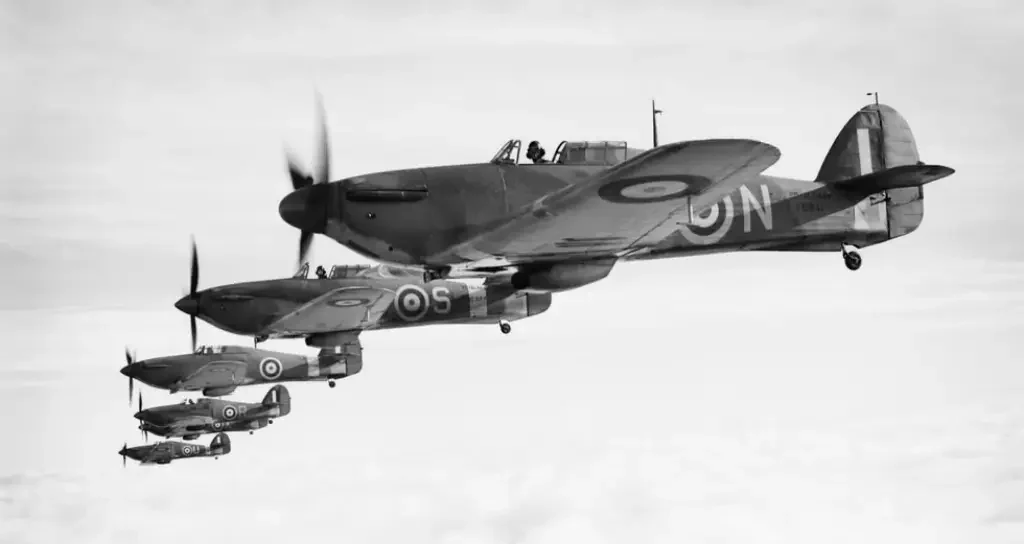
- Other Key Allied Models: The Hawker Hurricane complemented the Spitfire in the Battle of Britain, while the Republic P-47 Thunderbolt provided ground-attack support with its rugged design and eight .50-caliber machine guns.
These fighters addressed the search intent of aviation enthusiasts seeking detailed histories of “P-51 Mustang WWII role” and “Supermarine Spitfire Battle of Britain.”
Axis Powers’ Legendary Fighters
The Axis nations also produced formidable fighters, focusing on speed and production volume.
- Messerschmitt Bf 109 (Germany): The most produced fighter in history with over 33,000 units, the Bf 109 was a mainstay of the Luftwaffe. Designed by Willy Messerschmitt, it reached speeds of 350 mph (563 km/h) early on and featured a liquid-cooled V-12 engine. Aces like Erich Hartmann, the highest-scoring fighter pilot ever (352 victories), flew it across all fronts.
- Mitsubishi A6M Zero (Japan): Known for its exceptional range and agility, the Zero dominated the Pacific Theater initially. With a top speed of 331 mph (533 km/h) and armed with two 20mm cannons, it was lightweight but vulnerable to damage. It played key roles in Pearl Harbor and Midway but was outmatched later by improved Allied designs.
- Additional Axis Highlights: The Focke-Wulf Fw 190 offered superior low-altitude performance and was feared for its BMW radial engine.
Queries like “Messerschmitt Bf 109 WWII specs” often lead readers here, blending technical details with historical narratives.
Technological Innovations and Tactical Evolutions
WWII fighters introduced groundbreaking technologies that influenced post-war designs:
- Engine Advancements: Superchargers and turbochargers boosted high-altitude performance, essential for intercepting bombers.
- Armament Upgrades: From machine guns to 20mm cannons and rockets, firepower increased dramatically.
- Aerodynamic Designs: Streamlined fuselages and laminar-flow wings reduced drag, enhancing speed and efficiency.
- Emerging Jets: Late-war introductions like the German Me 262, the first operational jet fighter, reached 540 mph (870 km/h) and foreshadowed the jet age.
Tactics evolved from close-range dogfights to energy-fighting maneuvers, where pilots used altitude and speed advantages. Battles like Midway and the D-Day Normandy invasion showcased these strategies, with fighters providing air cover and ground support.
For aviation professionals interested in “WWII fighter aircraft innovations,” this section ties historical context to modern aerodynamics.
Impact on Key Battles and Global Warfare
Legendary fighters shaped WWII outcomes:
- Battle of Britain (1940): Spitfires and Hurricanes repelled the Luftwaffe, preventing a German invasion.
- Pacific Campaign: Mustangs and Zeros clashed in carrier-based operations, turning the tide at Guadalcanal.
- European Theater: P-51s enabled the Allied bombing campaign, crippling German industry.
Statistics reveal their dominance: Allied fighters achieved a 5:1 kill ratio in many engagements, underscoring superior training and technology.
Legacy in Modern Military Aviation
The rise of these legendary fighters laid the groundwork for subsequent generations. Concepts like air superiority and multi-role capabilities persist in today’s jets, such as the F-35 Lightning II. Aviation hobbyists often draw parallels between WWII designs and current stealth technology.
Explore related topics like the Cold War aerial arms race or fighter aircraft generations for deeper insights.
In conclusion, World War II’s legendary fighters not only decided the war’s aerial battles but also inspired the evolution of combat aircraft. Their stories of heroism and innovation continue to captivate those searching for “iconic WWII fighter planes history.”
Previous Article
Messerschmitt Me 262: The World’s First Operational Jet FighterNext Article
The Cold War and the Aerial Arms Race