The modern fighter pilot’s cockpit is a symphony of technology, but few aircraft represent such a dramatic leap forward as the F-35 Lightning II. Unlike the cluttered, button-filled cockpits of previous generations, the F-35’s design is dominated by sleek, integrated displays.
This isn’t just a matter of aesthetics; it’s a fundamental change in how a pilot interacts with their aircraft, the mission, and the world around them. This article will take you on a deep dive into the two core display systems of the F-35, explaining how they work together to give pilots unparalleled situational awareness and tactical advantage.
The Panoramic Cockpit Display: A Window into the Battlespace
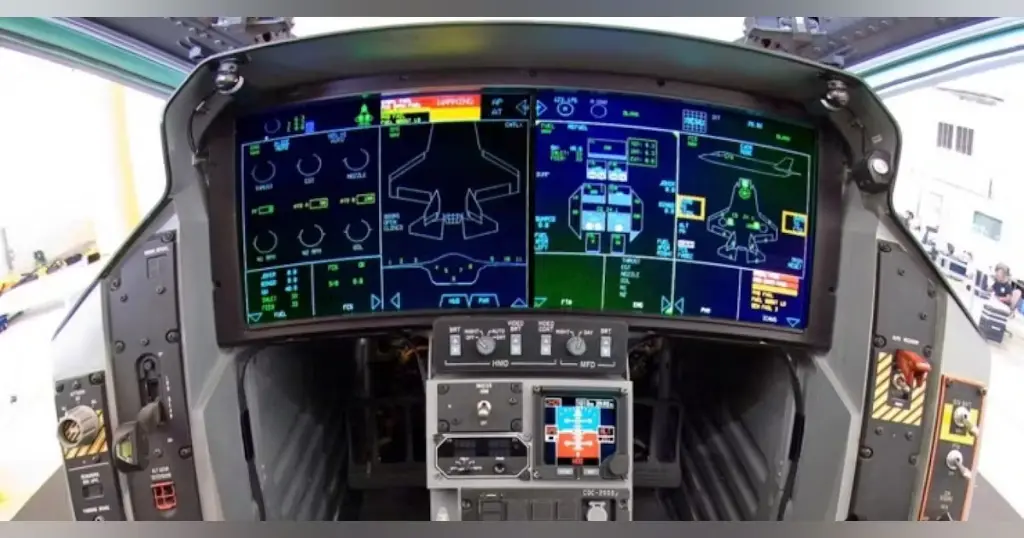
Step into the cockpit of an F-35, and your eyes are immediately drawn to a single, expansive screen. This is the Panoramic Cockpit Display (PCD), a massive 20-by-8-inch high-resolution touchscreen that serves as the aircraft’s primary control and information hub.
In older jets, pilots had to scan dozens of individual gauges, buttons, and small screens, a process that demanded constant mental effort and could lead to information overload. The F-35’s PCD changes all that by consolidating all vital flight, sensor, and tactical information into one unified interface. This is made possible by the aircraft’s sophisticated sensor fusion capabilities. The F-35 doesn’t just collect data from its radar, infrared sensors, and external data links—it automatically processes and merges this information into a single, cohesive, and easy-to-understand picture.
Customizable and Intuitive
The PCD isn’t a static display. It functions much like a modern tablet or computer desktop, allowing the pilot to customize the layout to their needs. They can drag and drop different “windows” of information, from a tactical situation map to a detailed view of their weapons status. This customization means that during different phases of a mission, the pilot can prioritize the most relevant information without having to manually switch between separate systems. The display is controlled through an intuitive combination of touchscreen gestures, a cursor, and even voice commands, which is critical for reducing workload and keeping the pilot’s hands on the flight stick and throttle.
Built for Survivability
The PCD is also designed with a deep understanding of the realities of combat. The display is electronically split into two separate units. This redundancy is a crucial safety feature, ensuring that even if one half of the screen is damaged in combat, the other half remains fully functional. This design choice highlights a core principle of the F-35: robustness and adaptability in the face of a hostile environment.
The Helmet-Mounted Display: Seeing Through the Plane
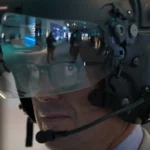
While the PCD is impressive, the true game-changer for the F-35 pilot is the Gen III Helmet-Mounted Display System (HMDS). This is not just a helmet; it’s the pilot’s primary visual interface with the aircraft and the outside world. It completely replaces the traditional Head-Up Display (HUD) with a system that projects all flight, sensor, and tactical information directly onto the pilot’s visor.
Unprecedented Situational Awareness
The HMDS gives the pilot what’s often referred to as a “virtual HUD.” Instead of having to look forward at a fixed piece of glass to see crucial flight data, the pilot sees that same information overlaid on their view, no matter where they are looking. This provides a constant, uninterrupted stream of data, from altitude and airspeed to targeting cues. This constant feedback is essential for maintaining situational and spatial awareness during high-G maneuvers or in a chaotic battlespace.
The “Look-Through” Capability
The most extraordinary feature of the HMDS is its “look-through” or “transparent cockpit” capability. This is made possible by the Distributed Aperture System (DAS), a series of six infrared cameras embedded in the skin of the aircraft. These cameras provide a continuous, 360-degree spherical view of the aircraft’s surroundings.
The HMDS takes the video feed from these cameras and projects it onto the visor, allowing the pilot to “see through” the aircraft’s floor or fuselage. A pilot can simply turn their head to look “down” at the ground or “behind” them, with the helmet projecting a live video feed of what’s happening outside the aircraft. This capability is revolutionary for target identification, threat detection, and landing.
Integrated Night Vision
The HMDS also seamlessly integrates a high-resolution night vision system. Unlike older systems that required a separate set of bulky night vision goggles to be attached to the helmet, the F-35’s system projects the night vision imagery directly onto the visor. This eliminates the need for pilots to ever switch systems, allowing for a smooth and effortless transition between day and night operations.
Synergy: The Power of Integration
The true power of the F-35’s displays lies in the synergy between the PCD and the HMDS. The two systems work in perfect harmony, creating a complete and intuitive user experience. The PCD provides the broad strategic picture, while the HMDS gives the pilot the immediate tactical details and a live view of their surroundings.
This integration means that the pilot is no longer just flying the aircraft; they are an extension of the aircraft’s entire sensor and data-gathering network. The pilot is freed from the cognitive load of managing information, allowing them to focus on the mission: being a tactician and a decision-maker.
This dual-display system is a testament to the F-35’s design philosophy, prioritizing the pilot’s ability to process and act on information faster than any adversary. It’s a key reason why the F-35 is considered a 5th-generation fighter and why it sets a new standard for what a military cockpit can and should be.